USAID DEC
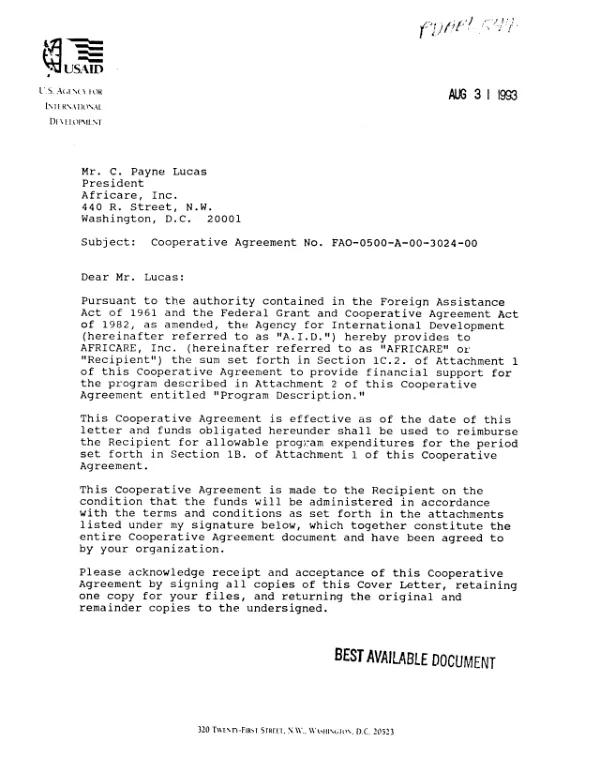
AID cooperative agreement no. FAO-0500-A-00-3024-00 to AFRICARE, Inc. in support of its proposal, entitled `Ganzourgou child survival project II - Burkina Faso", and `Adamawa State child survival/maternal health project -- Nigeria", dated November 30, 1992
Sign inUSAID. BUR. FOR FOOD AND HUMANITARIAN ASSISTANCE. OFC. OF PRIVATE AND VOLUNTARY COOPERATION (PVC)
AID cooperative agreement no. FAO-0500-A-00-3024-00 to AFRICARE, Inc. in support of its proposal, entitled `Ganzourgou child survival project II - Burkina Faso", and `Adamawa State child survival/maternal health project -- Nigeria", dated November 30, 1992
Grant to Africare for child survival projects in Ganzourgou, Burkina Faso, and in Adamawa State, Nigeria.
1993
Sign in to readA free account is required to download.
Abstract
In Burkina Faso, Africare will expand its existing child survival project to cover all 33 villages in Meguet Department (vs. 14 currently), with a total population of 50,000. The project approach is to extend child survival strategies to the household level by training neighborhood volunteers who will work closely with the project"s 8 health promoters, the 66 village health workers, and nurses in the 5 rural health clinics in the area. Interventions will be in: (1) diarrheal disease control, by educating mothers to use oral rehydration therapy, including of home-available fluids and cereal-based solutions, and to continue breastfeeding and improve their child feeding practices during and after episodes; (2) growth monitoring and nutrition, by promoting caloric and vitamin-rich foods for children and lactating pregnant women; (3) maternal health and family planning, including improved village midwife skills, detection/referral of high-risk pregnancies and counseling, and promotion of child spacing and of integrated maternal child health/FP services in the rural health centers; (4) immunization of children aged 0-24 months and women of child-bearing age; and (5) AIDS education. In Nigeria, Africare"s child survival project in two Local Government Areas (LGAs) of Adamawa State will benefit 38,500 infants, 67,500 children aged 1-4, and 56,000 women of reproductive age. By the project"s end, each LGA will have sustainable mechanisms to maintain full immunization coverage of 70% or better of children aged 0-11 months; at least a third of eligible women will have received tetanus toxoid immunization. Mothers will be taught by project-trained agents (village health workers, LGA health staff, NGO members, and traditional birth attendants) to administer home-mixed sugar-salt solution for diarrhea. In addition, at least one-third of the estimated 10,400 home deliveries (none currently assisted by trained attendants) in each LGA each year will be assisted by a trained birth attendant. Health education efforts will include training of women in modern child spacing methods (the percentage of contraceptive acceptors is expected to increase from 1-2% to 5%) and in the importance of exclusive breastfeeding and appropriate weaning foods. Five persons from each of 48 villages in each LGA (480 persons overall) will be trained to explain prophylaxis and treatment of malaria for all age groups. Finally, 24 self-help projects will be supported by private matching funds by Africare in 24 villages, providing improved food, water, and/or sanitation.
Related documents
Documents in this collection
 1993
1993USAID DEC
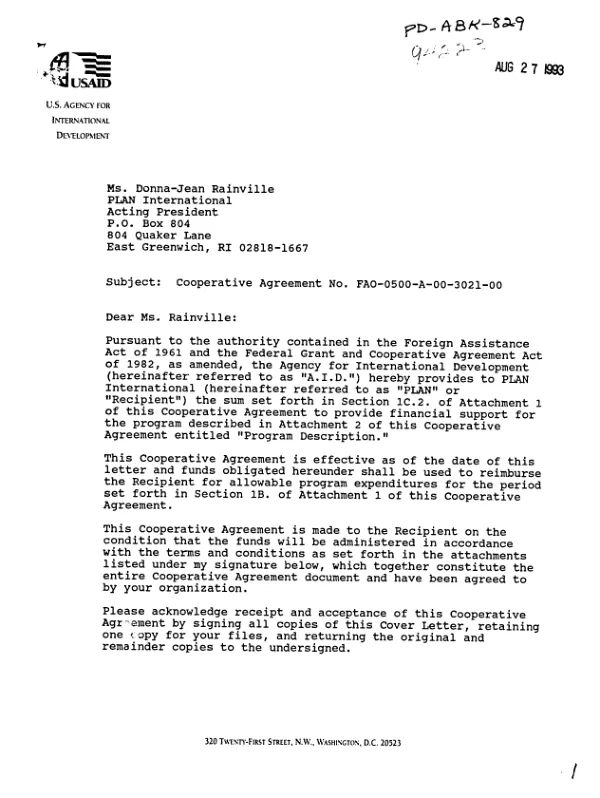
AID cooperative agreement no. FAO-0500-A-00-3021-00 to PLAN International for the recipient"s proposal, `For our mothers and children : working together for effective and sustainable child survival programs`
Open record 1990
1990USAID DEC
![AID cooperative agreement no. FAO-0500-A-00-3027-00 with the Foundation for the People [Peoples] of the South Pacific (FSP) in support of its proposal, entitled `Improving the quality of child survival services in the South Pacific (Vanuatu and Kiribati)," dated December 8, 1992](https://covers.devme.ai/gen/46669.webp)