USAID DEC
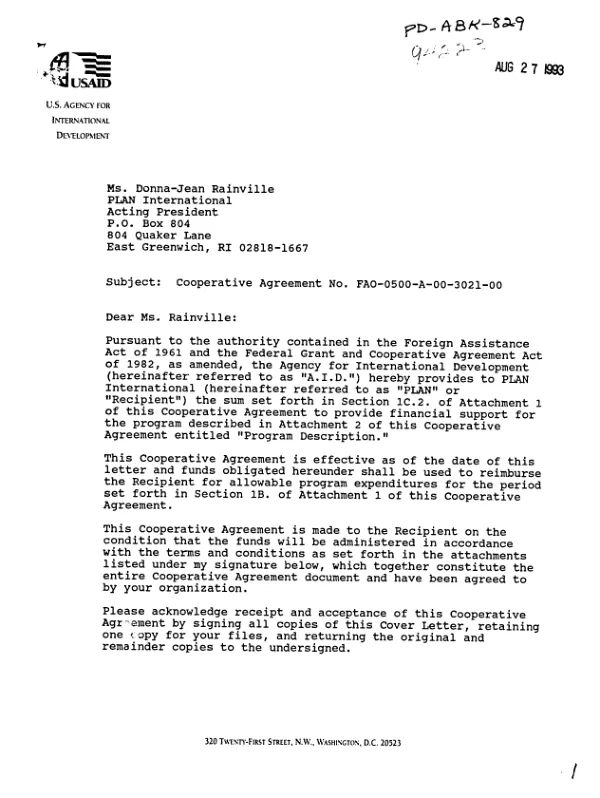
AID cooperative agreement no. FAO-0500-A-00-3027-00 with the Foundation for the People [Peoples] of the South Pacific (FSP) in support of its proposal, entitled `Improving the quality of child survival services in the South Pacific (Vanuatu and Kiribati)," dated December 8, 1992
Sign inUSAID. BUR. FOR FOOD AND HUMANITARIAN ASSISTANCE. OFC. OF PRIVATE AND VOLUNTARY COOPERATION (PVC)
AID cooperative agreement no. FAO-0500-A-00-3027-00 with the Foundation for the People [Peoples] of the South Pacific (FSP) in support of its proposal, entitled `Improving the quality of child survival services in the South Pacific (Vanuatu and Kiribati)," dated December 8, 1992
Grant is provided to the Foundation for the Peoples of the South Pacific (FSP) to improve the quality of child survival services in two regions in the South Pacific.
1993
Sign in to readA free account is required to download.
![AID cooperative agreement no. FAO-0500-A-00-3027-00 with the Foundation for the People [Peoples] of the South Pacific (FSP) in support of its proposal, entitled `Improving the quality of child survival services in the South Pacific (Vanuatu and Kiribati)," dated December 8, 1992](https://covers.devme.ai/gen/46669.webp)
Abstract
FSP will seek to improve services for 25,818 children under six and 21,457 women of childbearing age on the island of Espiritu Santo in Vanuatu and on six islands of the Gilbert group in Kiribati. FSP will (1) increase immunization coverage (including tetanus toxoid) by improving the cold chain with solar-powered refrigerators, training supervisors and nurses in Expanded Program of Immunization (EPI) management, and using community groups and leaders to promote immunization; (2) train nurses to educate mothers in home management of diarrhea, and train community leaders to increase community involvement in sanitation; (3) train health workers in the diagnosis and treatment of Vitamin A deficiency in children under 6, and distribute Vitamin A capsules to semi-annually to children under 6 and pregnant women; and (4) improve maternal nutrition and weaning practices through education of mothers and community members, improve health worker skills in growth monitoring and promotion; (5) improve prenatal care by training traditional birth attendants (TBAs) in hygienic delivery techniques and in recognizing and referring high-risk pregnancies; (6) improve case management of acute respiratory infection (ARI) by nurses and educate mothers to recognize danger sign of ARI; and (7) promote malarial prophylaxis for pregnant women, improve malaria diagnosis, and involve health center staff and the community in vector control programs.
Related documents
Documents in this collection
 1993
1993USAID DEC
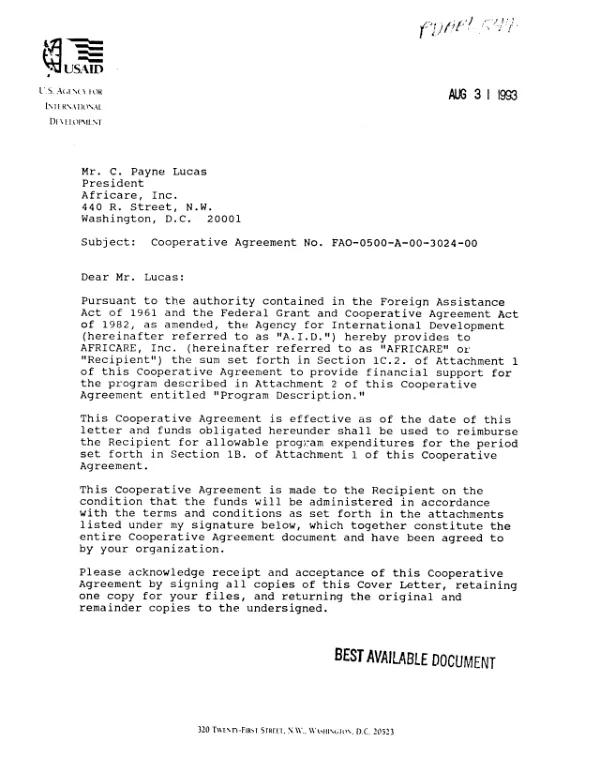
AID cooperative agreement no. FAO-0500-A-00-3024-00 to AFRICARE, Inc. in support of its proposal, entitled `Ganzourgou child survival project II - Burkina Faso", and `Adamawa State child survival/maternal health project -- Nigeria", dated November 30, 1992
Open record 1989
1989USAID DEC