USAID DEC
An Evaluation of Gender Mainstreaming by the Ministry of Public Health in Afghanistan to Make Health Policies and Services People-Centered
Sign inFUTURES GROUP INTERNATIONAL, LLC
An Evaluation of Gender Mainstreaming by the Ministry of Public Health in Afghanistan to Make Health Policies and Services People-Centered
The Ministry of Public Health in Afghanistan has made significant progress in mainstreaming gender into its health policies and programs.
2014 · 1 pages
Sign in to readA free account is required to download.
Abstract
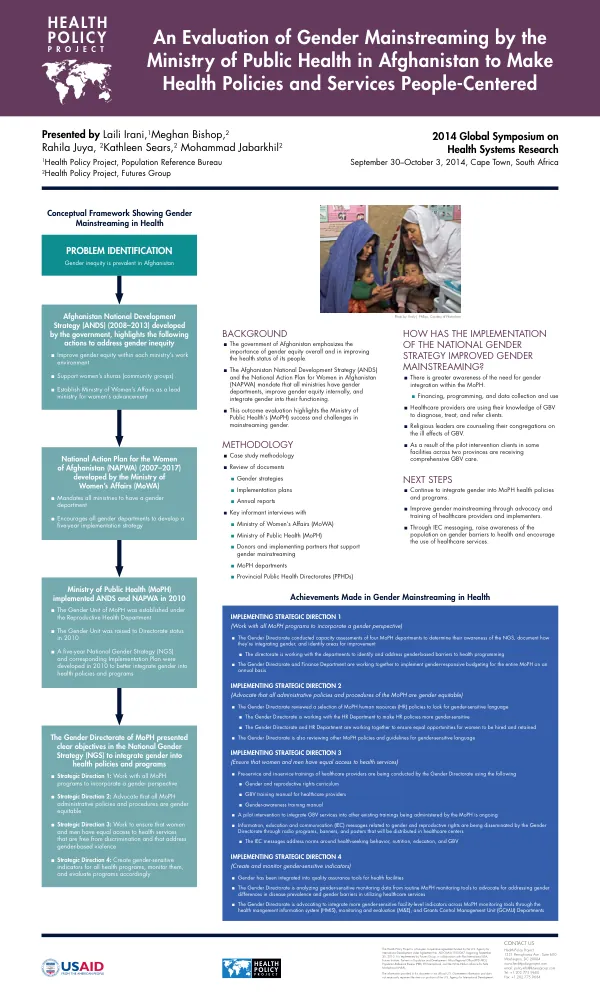
The Ministry's Gender Directorate was established in 2010 under the Reproductive Health Department, and it was later raised to Directorate status in the same year. The Directorate developed a five-year National Gender Strategy (NGS) and corresponding Implementation Plan to integrate gender into health policies and programs. The NGS outlined four strategic directions to achieve gender mainstreaming in health. Strategic Direction 1 aimed to work with all Ministry of Public Health (MoPH) programs to incorporate a gender perspective. To achieve this, the Gender Directorate conducted capacity assessments of four MoPH departments to determine their awareness of the NGS and identify areas for improvement. The directorate is also working with the departments to identify and address gender-based barriers to health programming. Strategic Direction 2 focused on advocating that all MoPH administrative policies and procedures are gender equitable. The Gender Directorate reviewed a selection of MoPH human resources (HR) policies to look for gender-sensitive language and is working with the HR Department to make HR policies more gender-sensitive. The directorate is also reviewing other MoPH policies and guidelines for gender-sensitive language. Strategic Direction 3 aimed to ensure that women and men have equal access to health services. Pre-service and in-service trainings of healthcare providers are being conducted by the Gender Directorate using gender and reproductive rights curriculum, GBV training manual for healthcare providers, and gender-awareness training manual. A pilot intervention to integrate GBV services into other existing trainings being administered by the MoPH is ongoing. Strategic Direction 4 focused on creating and monitoring gender-sensitive indicators. Gender has been integrated into quality assurance tools for health facilities, and the Gender Directorate is analyzing gender-sensitive monitoring data from routine MoPH monitoring tools to advocate for addressing gender differences in disease prevalence and gender barriers in utilizing healthcare services. The implementation of the National Gender Strategy has improved gender mainstreaming in the MoPH. There is greater awareness of the need for gender integration within the MoPH, and financing, programming, and data collection and use are being implemented in a more gender-sensitive manner. Healthcare providers are using their knowledge of GBV to diagnose, treat, and refer clients, and religious leaders are counseling their congregations on the ill effects of GBV. As a result of the pilot intervention, clients in some facilities across two provinces are receiving comprehensive GBV care. The next steps for the MoPH include continuing to integrate gender into health policies and programs, improving gender mainstreaming through advocacy and training of healthcare providers and implementers, and raising awareness of the population on gender barriers to health and encouraging the use of healthcare services through IEC messaging.