USAID DEC
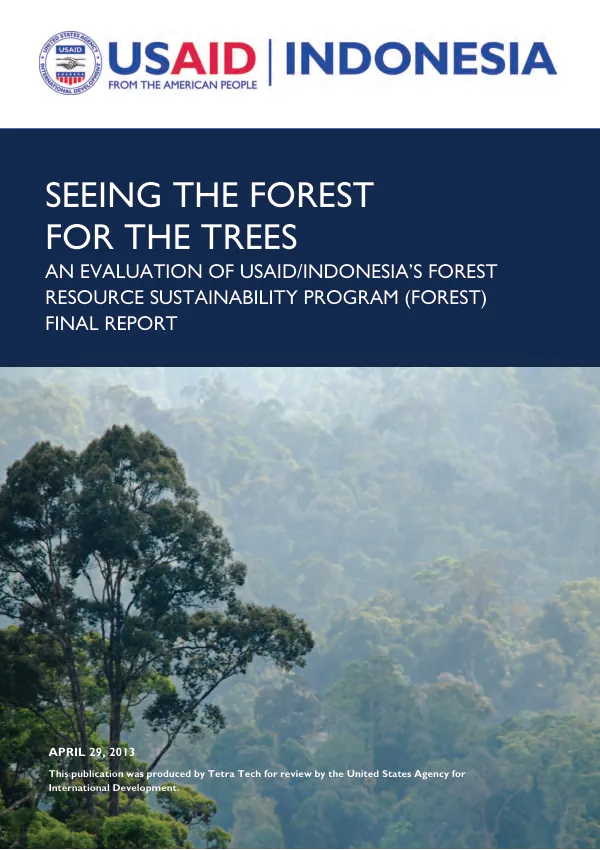
An Evaluation of USAID/Indonesia's Forest Resource Sustainability Program (FOREST) Final Report
Sign inTETRA TECH
An Evaluation of USAID/Indonesia's Forest Resource Sustainability Program (FOREST) Final Report
The Forest Resource Sustainability Program (FOREST) in Indonesia was a USAID-funded initiative aimed at promoting sustainable forest management and reducing greenhouse gas emissions.
2013 · 117 pages
Sign in to readA free account is required to download.
Abstract
The program was implemented from 2009 to 2013 and focused on several key areas, including forest conservation, sustainable forest management, and community development. The program's objectives were to reduce deforestation and forest degradation, promote sustainable forest management practices, and support the development of forest-based communities. To achieve these objectives, FOREST implemented a range of activities, including forest conservation and restoration, sustainable forest management planning, and community-based forest management. One of the key components of the program was the Indonesia Forest and Climate Support (IFACS) project, which aimed to support the development of sustainable forest management practices and reduce greenhouse gas emissions. The project worked with local communities, government agencies, and other stakeholders to promote sustainable forest management practices and develop forest management plans. The program also supported the development of forest-based communities through the provision of training and capacity-building activities. These activities aimed to enhance the skills and knowledge of community members in areas such as forest management, sustainable agriculture, and entrepreneurship. The evaluation of the FOREST program found that it had made significant contributions to the conservation and sustainable management of Indonesia's forests. The program had helped to reduce deforestation and forest degradation, promote sustainable forest management practices, and support the development of forest-based communities. The evaluation also identified several challenges and limitations of the program, including the need for more effective coordination and collaboration among stakeholders, the need for more robust monitoring and evaluation systems, and the need for more effective communication and outreach to local communities. Overall, the FOREST program was an important initiative that contributed to the conservation and sustainable management of Indonesia's forests. The program's achievements and lessons learned can inform future initiatives and programs aimed at promoting sustainable forest management and reducing greenhouse gas emissions. The program's geographic focus was on several provinces in Indonesia, including Kalimantan and Sumatra. The program's timeframes were from 2009 to 2013, with a midterm evaluation conducted in 2011. The program's recommendations included the need for more effective coordination and collaboration among stakeholders, the need for more robust monitoring and evaluation systems, and the need for more effective communication and outreach to local communities. The program's implementation details included the establishment of forest management units, the development of forest management plans, and the provision of training and capacity-building activities to local communities. The program's methodology included a range of activities, including forest conservation and restoration, sustainable forest management planning, and community-based forest management. The program's key findings included the reduction of deforestation and forest degradation, the promotion of sustainable forest management practices, and the support of forest-based communities. The program's conclusions included the need for more effective coordination and collaboration among stakeholders, the need for more robust monitoring and evaluation systems, and the need for more effective communication and outreach to local communities. The program's recommendations included the need for more effective coordination and collaboration among stakeholders, the need for more robust monitoring and evaluation systems, and the need for more effective communication and outreach to local communities. The program's annexes included a range of supporting documents, including the evaluation statement of work, the evaluation work plan, and the sources of information bibliography.