USAID DEC
Analysis of PAR-Related Legal Issues
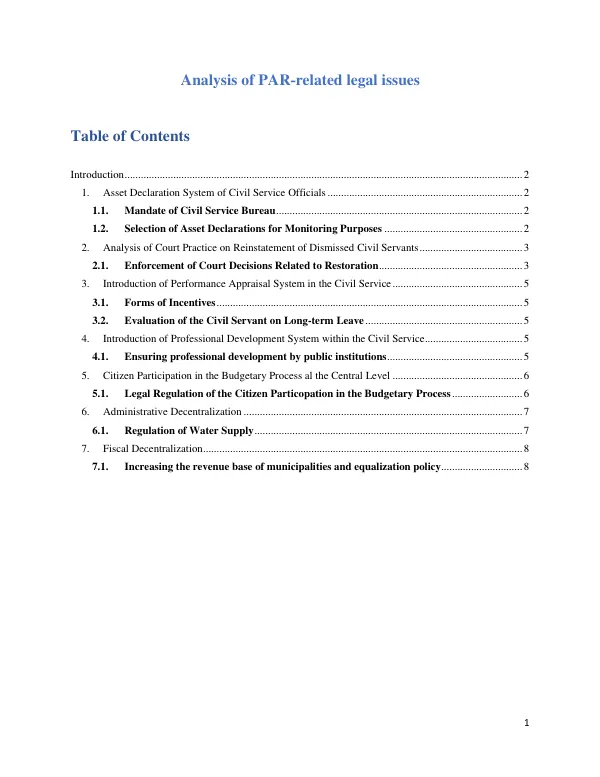
Asset Declaration System of Civil Service Officials The Civil Service Bureau's mandate in monitoring asset declarations is limited, restricting its ability to effectively monitor and identify potential conflicts of interest and corruption.
2021 · 9 pages
Sign in to readA free account is required to download.
Abstract
The Bureau relies on declarants to provide evidence, which may not be comprehensive or accurate. For instance, declarants may not disclose all bank accounts, leaving some information beyond monitoring. To address this limitation, it is recommended that the Civil Service Bureau's mandate be broadened to enable effective monitoring. This can be achieved by granting the Bureau the authority to freely request and receive information from public and private institutions, such as commercial banks, regarding declarants' accounts. However, this does not imply unrestricted access to personal data and account details. The current mechanism for selecting asset declarations for monitoring purposes is not effective. The Special Independent Commission is rarely established, and the system lacks additional criteria for random selection. To increase the effectiveness of the declaration monitoring mechanism, it is recommended that amendments be introduced to the Georgian Government's Decree #81, allowing the Civil Service Bureau to select declarations for monitoring based on a risk-based approach. This approach increases the likelihood of selecting declarations with significant inaccuracies. In addition, it is suggested that the total number of officials selected by random selection and the Commission be determined as a mandatory amount. If an independent commission is not established or the 5% of officials are not selected, the missing number should be added to the number of officials selected by the system. Analysis of Court Practice on Reinstatement of Dismissed Civil Servants The Law of Georgia on Civil Service prescribes the mechanism for reinstatement of illegally dismissed employees. However, employers often resort to manipulations, such as reorganizations or appointment of a different person to the position, to avoid reinstatement. The employing agency is required to immediately reinstate the person to the same position, and if such a position does not exist, to a different, equal position in the system of the same public institution. If reinstatement in the same public institution is impossible due to the inexistence of vacant equal positions, the public institution shall address the LEPL Public Service Bureau with a request to find an equal position in the public sector. However, reinstatement in a different public institution is possible with the consent of the officer and the public institution. If an unlawfully dismissed officer cannot be reinstated due to unavailability of an equal vacant position, they shall be transferred to the reserve of officers and receive missed pay, as well as compensation in the full amount of the last salary for six months. The research revealed that the enforcement of court decisions related to restoration is often hindered by employers' manipulations. To address this issue, it is recommended that the Public Service Bureau be empowered to monitor and enforce court decisions related to reinstatement, ensuring that employers comply with the law and reinstated officers receive their rightful compensation. Introduction of Performance Appraisal System in the Civil Service The Performance Appraisal System is a crucial component of the civil service reform. The system aims to evaluate the performance of civil servants and provide incentives for good performance. The forms of incentives include bonuses, promotions, and other rewards. However, the evaluation of civil servants on long-term leave is a challenge, as it is difficult to assess their performance during their absence. To address this challenge, it is recommended that the Performance Appraisal System be modified to include a provision for evaluating civil servants on long-term leave. This can be achieved by developing a system for assessing their performance based on their previous work, as well as their contributions to the organization during their absence. Introduction of Professional Development System within the Civil Service The Professional Development System is essential for enhancing the skills and competencies of civil servants. The system aims to provide opportunities for civil servants to develop their skills and knowledge, enabling them to perform their duties effectively. However, the system faces challenges, such as ensuring that public institutions provide professional development opportunities for their employees. To address this challenge, it is recommended that public institutions be required to provide professional development opportunities for their employees. This can be achieved by developing a system for monitoring and evaluating the provision of professional development opportunities, as well as providing incentives for institutions that provide such opportunities. Citizen Participation in the Budgetary Process at the Central Level Citizen participation in the budgetary process is essential for ensuring that the budget reflects the needs and priorities of the citizens. The Law of Georgia on Budgetary Process prescribes the mechanism for citizen participation in the budgetary process. However, the implementation of this mechanism is challenging, as it requires the involvement of citizens in the budgetary process. To address this challenge, it is recommended that the Law of Georgia on Budgetary Process be amended to provide for more effective citizen participation in the budgetary process. This can be achieved by developing a system for involving citizens in the budgetary process, as well as providing incentives for institutions that involve citizens in the budgetary process. Administrative Decentralization Administrative decentralization is a crucial component of the civil service reform. The system aims to transfer powers and responsibilities from the central government to local governments,
Related documents