USAID DEC
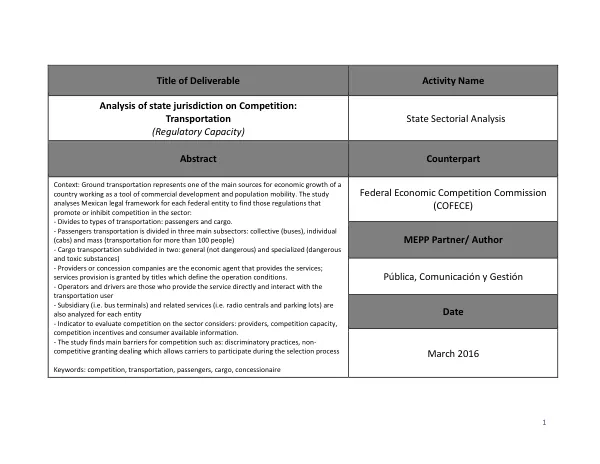
Analysis of state jurisdiction on Competition: Transportation (Regulatory Capacity) State Sectorial Analysis
Sign inUSAID DEC
Analysis of state jurisdiction on Competition: Transportation (Regulatory Capacity) State Sectorial Analysis
The analysis of state jurisdiction on competition in the transportation sector in Mexico is a comprehensive study that examines the regulatory framework of each federal entity to identify regulations that promote or inhibit competition.
2016 · 409 pages
Sign in to readA free account is required to download.
Abstract
The study focuses on the transportation sector, which is a crucial component of a country's economic growth, serving as a tool for commercial development and population mobility. The transportation sector is divided into two main subsectors: passengers and cargo. Passengers transportation is further divided into three subsectors: collective (buses), individual (cabs), and mass (transportation for more than 100 people). Cargo transportation is subdivided into two subsectors: general (non-dangerous) and specialized (dangerous and toxic substances). The study also examines the providers or concession companies, operators and drivers, subsidiary services (such as bus terminals), and related services (such as radio centrals and parking lots). The analysis considers indicators to evaluate competition in the sector, including providers, competition capacity, competition incentives, and consumer available information. The study finds that main barriers for competition include discriminatory practices, non-competitive granting dealing, which allows carriers to participate in the selection process. The study's methodology involves a sectorial analysis, which examines the general aspects of sectorial regulation and competition. The analysis is conducted for each federal entity, including Aguascalientes, Baja California, Baja California Sur, Campeche, Chiapas, Chihuahua, Coahuila, Colima, Distrito Federal, Durango, Estado de México, Guanajuato, Guerrero, Hidalgo, Jalisco, Michoacán, Morelos, Nayarit, Nuevo León, Oaxaca, Puebla, Querétaro, Quintana Roo, San Luis Potosí, Sinaloa, Sonora, Tabasco, Tamaulipas, Tlaxcala, Veracruz, Yucatán, and Zacatecas. The analysis reveals that the transportation sector is subject to various regulations, which can either promote or inhibit competition. The study identifies the need for a regulatory framework that ensures the sector is as efficient as possible, guaranteeing competition among actors, safety, and quality services for all users. The study's findings are presented in a detailed manner, with each federal entity analyzed separately. The analysis provides a comprehensive understanding of the regulatory framework of the transportation sector in Mexico, highlighting the need for a more competitive and efficient sector. The study's conclusions emphasize the importance of a regulatory framework that promotes competition and efficiency in the transportation sector. The analysis provides recommendations for improving the sector, including the need for a more competitive granting process, the elimination of discriminatory practices, and the provision of consumer information. The study's bibliography and annex provide additional information and resources for further analysis and research. The study's methodology and findings provide a comprehensive understanding of the regulatory framework of the transportation sector in Mexico, highlighting the need for a more competitive and efficient sector.
Related documents