USAID
ANC Counseling Guide: Immediate Postpartum Family Planning
Immediate postpartum family planning is a critical aspect of maternal and child health.
2013 · 2 pages
Sign in to readA free account is required to download.
Abstract
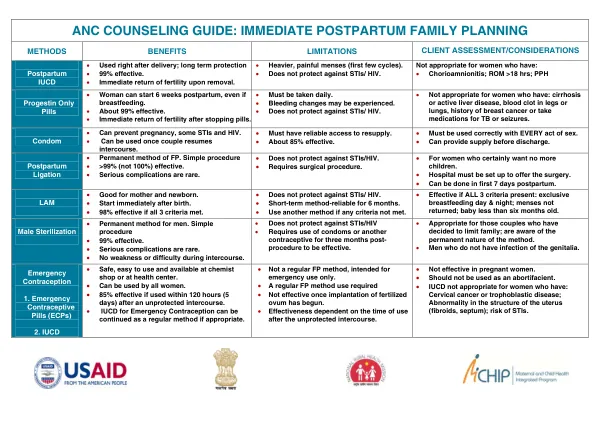
The ANC Counseling Guide provides information on various family planning methods, their benefits, limitations, and client assessment considerations. Postpartum IUCD is a long-term protection method that can be used immediately after delivery. It is 99% effective and offers immediate return of fertility upon removal. However, it may cause heavier and more painful menses during the first few cycles, and it does not protect against STIs or HIV. Postpartum IUCD is not recommended for women with chorioamnionitis, ROM greater than 18 hours, or postpartum hemorrhage. Progestin-only pills can be started six weeks postpartum, even if breastfeeding. They are approximately 99% effective and offer immediate return of fertility after stopping the pills. However, they must be taken daily and may cause bleeding changes. Progestin-only pills do not protect against STIs or HIV and are not recommended for women with cirrhosis or active liver disease, blood clots in the legs or lungs, history of breast cancer, or those taking medications for TB or seizures. Condoms can be used to prevent pregnancy, some STIs, and HIV. They can be used once the couple resumes intercourse and must be used correctly with every act of sex. Condoms are approximately 85% effective and must have reliable access to resupply. They can provide protection before discharge. Postpartum ligation is a permanent method of family planning that is simple to perform. It is greater than 99% effective, but serious complications are rare. Postpartum ligation does not protect against STIs or HIV and requires a surgical procedure. It is recommended for women who are certain they do not want any more children and can be performed in the first seven days postpartum. The Lactational Amenorrhea Method (LAM) is a good option for mother and newborn. It can be started immediately after birth and is 98% effective if all three criteria are met: exclusive breastfeeding day and night, no return of menses, and the baby is less than six months old. LAM does not protect against STIs or HIV and is a short-term method that is reliable for six months. Male sterilization is a permanent method for men that is simple to perform. It is 99% effective, and serious complications are rare. Male sterilization does not protect against STIs or HIV and requires the use of condoms or another contraceptive for three months post-procedure to be effective. It is recommended for couples who have decided to limit their family and are aware of the permanent nature of the method. Emergency contraception is available in the form of emergency contraceptive pills (ECPs) and IUCD. ECPs are safe, easy to use, and available at chemist shops or health centers. They can be used by all women and are 85% effective if used within 120 hours (five days) after an unprotected intercourse. IUCD for emergency contraception can be continued as a regular method if appropriate. However, it is not a regular family planning method and is intended for emergency use only. It is not effective once implantation of the fertilized ovum has begun and is not recommended for women with cervical cancer, trophoblastic disease, abnormality in the structure of the uterus, or risk of STIs. The safe times for postpartum initiation of various family planning methods are outlined in the table. Condoms can be used immediately after delivery, while IUCD can be inserted 48 hours postpartum. Female sterilization can be performed in the first seven days postpartum, and emergency contraceptive pills can be used within 120 hours (five days) after an unprotected intercourse. Progestin-only pills can be started six weeks postpartum, and oral contraceptive pills can be started four weeks postpartum. Lactational Amenorrhea Method (LAM) can be started immediately after birth, and male sterilization can be performed at any time.