USAID
Colombian Carbon Market Current State, and Expectations for 2020
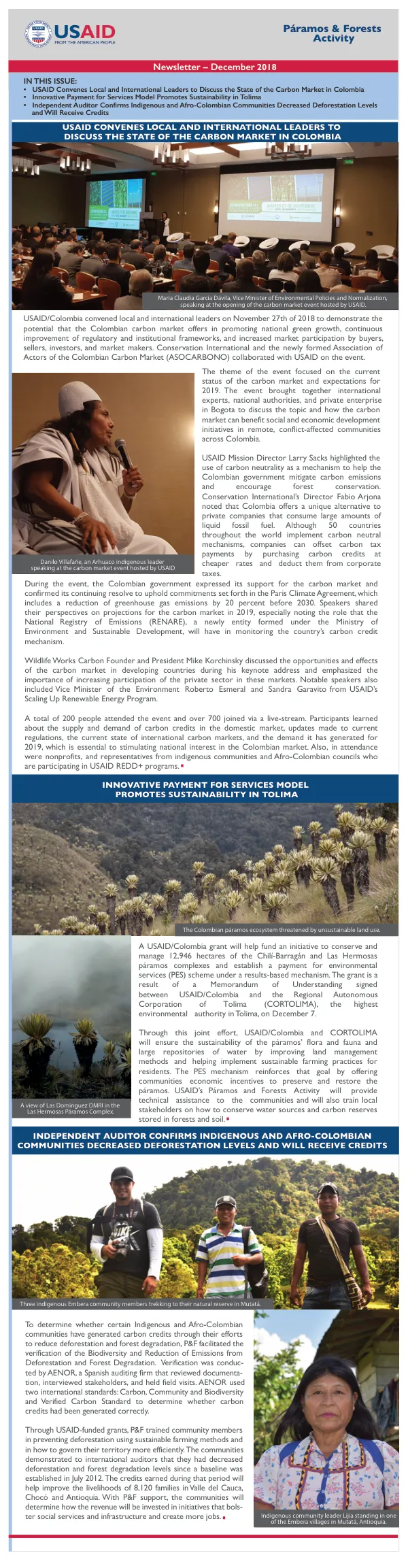
The Colombian Carbon Market Current State, and Expectations for 2020 event brought together stakeholders from across the country with potential buyers, investors, and USAID initiatives.
2020 · 1 pages
Sign in to readA free account is required to download.
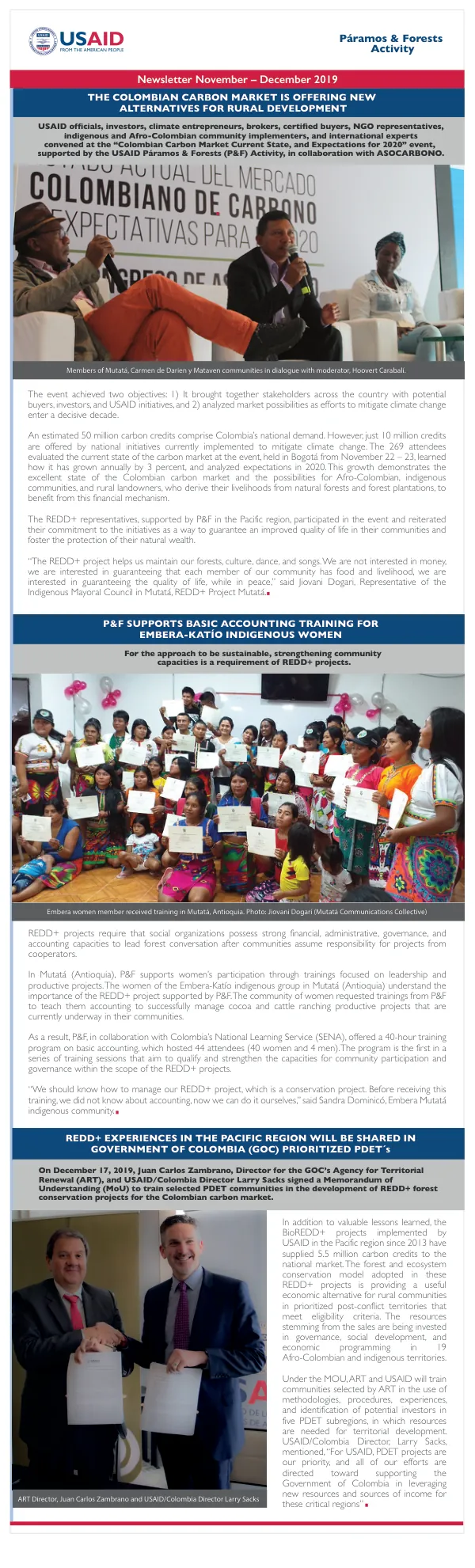
Abstract
The event analyzed market possibilities as efforts to mitigate climate change enter a decisive decade. An estimated 50 million carbon credits comprise Colombia's national demand, with only 10 million credits offered by national initiatives currently implemented to mitigate climate change. The 269 attendees evaluated the current state of the carbon market, which has grown annually by 3 percent. This growth demonstrates the excellent state of the Colombian carbon market and the possibilities for Afro-Colombian, indigenous communities, and rural landowners to benefit from this financial mechanism. REDD+ representatives, supported by P&F in the Pacific region, participated in the event and reiterated their commitment to the initiatives as a way to guarantee an improved quality of life in their communities and foster the protection of their natural wealth. REDD+ projects require that social organizations possess strong financial, administrative, governance, and accounting capacities to lead forest conservation after communities assume responsibility for projects from cooperators. In Mutatá (Antioquia), P&F supports women's participation through trainings focused on leadership and productive projects. The women of the Embera-Katío indigenous group in Mutatá (Antioquia) understand the importance of the REDD+ project supported by P&F. The community of women requested trainings from P&F to teach them accounting to successfully manage cocoa and cattle ranching productive projects that are currently underway in their communities. As a result, P&F, in collaboration with Colombia's National Learning Service (SENA), offered a 40-hour training program on basic accounting, which hosted 44 attendees (40 women and 4 men). The program is the first in a series of training sessions that aim to qualify and strengthen the capacities for community participation and governance within the scope of the REDD+ projects. Strengthening community capacities is a requirement of REDD+ projects for the approach to be sustainable. The BioREDD+ projects implemented by USAID in the Pacific region since 2013 have supplied 5.5 million carbon credits to the national market. The forest and ecosystem conservation model adopted in these REDD+ projects is providing a useful economic alternative for rural communities in prioritized post-conflict territories that meet eligibility criteria. The resources stemming from the sales are being invested in governance, social development, and economic programming in 19 Afro-Colombian and indigenous territories.