USAID DEC
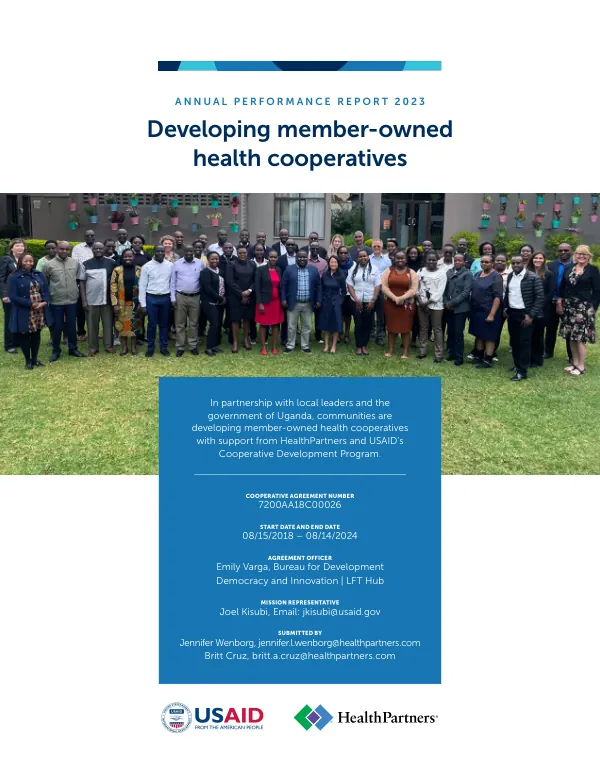
Annual Performance Report 2023: Developing Member-Owned Health Cooperatives in Uganda
Sign inHEALTH PARTNERS INTERNATIONAL
Annual Performance Report 2023: Developing Member-Owned Health Cooperatives in Uganda
Health cooperatives are business-owned and democratically controlled by their members.
2023 · 16 pages
Sign in to readA free account is required to download.
Abstract
They make shared risk possible, spreading the cost of care across all members. This allows cooperatives to negotiate with care providers for high-quality, affordable, and affordable care and benefit packages that meet their needs. Health cooperatives are generally not interested in profits; members join to benefit from reduced wait times to seek care. They keep administrative costs low since they do not require a third-party administrator. In a health cooperative, premiums are set for care providers to make a small surplus. Providers make more when members are healthier, incentivizing them to provide quality care and health education. The health cooperative model developed by HealthPartners is locally sustainable and has been adapted for use in rural low- and middle-income countries. The model includes training guides and toolkits for local stakeholders to start and sustainably manage partnerships, increasing provider cost recovery and the quality of care offered by health facilities. HealthPartners has worked with the Ministry of Trade, Industry, and Cooperatives (MOTIC) to introduce health cooperatives in Uganda. MOTIC is now using HealthPartners' trainers' guides and recommending that Savings and Credit Societies (SACCOs) add health to the products they offer to members. HealthPartners has trained 35,000 members in Uganda, providing them with access to quality care and improved health outcomes. The Ministry of Health (MOH) has a strategy to reach the informal sector as part of their National Health Insurance Scheme (NHIS). HealthPartners has also been recognized by the United Nations for its model's potential to advance Sustainable Development Goal 3: Good Health and Wellbeing for all. The model has been adopted by the Kenyan government as part of their Social Health Insurance (SHI) plan. In Kenya, 63% of employment is informal, and the lack of health insurance is particularly consequential. HealthPartners, USAID/Kenya, and the MOH have adopted a partnership strategy to address this challenge by connecting the informal sector to their new SHI program through cooperatives. Cooperatives share the goal of improving health, improving productive capacity, and fulfilling their cooperative value of concern for their members and community. The cooperative sector in Kenya is vast, with many members part of the informal sector, indicating significant potential for expanding health care access through cooperatives. The partnership between the cooperative sector and the SHI program is mutually beneficial. The government saves marketing, enrollment, and administrative costs by working with groups where risk is pooled and financing mechanisms are available. Cooperative members have financial protection and better health, increasing their productivity and cooperative returns. HealthPartners has developed partnerships with various partners, including the Uganda Catholic Medical Bureau, Uganda Muslim Medical Bureau, and private health facilities. These partnerships have improved regulation and built a foundation to incorporate health cooperatives in Uganda's National Health Insurance Scheme (NHIS). A Steering Committee chaired by the Commissioner of Planning, MOH, and composed of women leaders in health and economics, reviewed plans and reports, conducted site visits, and advocated to increase the health cooperative network. The partnership with the International Cooperative Alliance Africa created demand for tools and technical resources to support the health cooperative model.
Related documents