QED GROUP, LLC
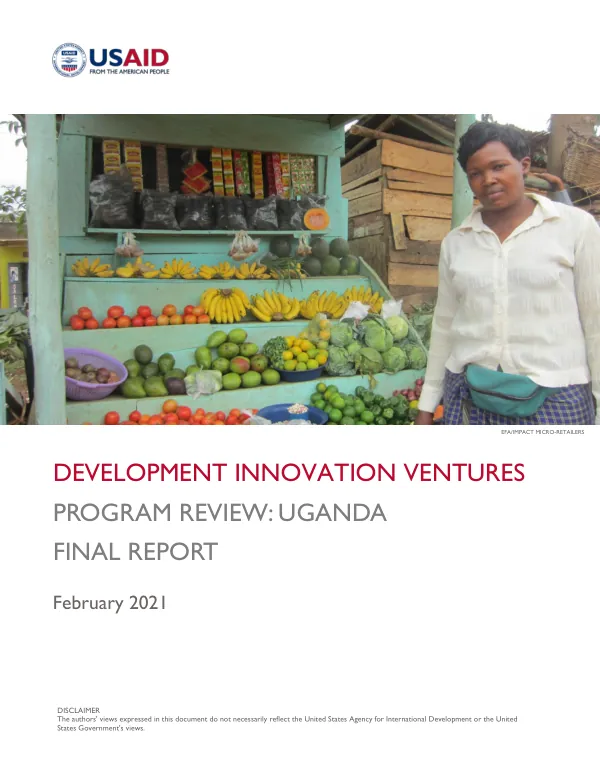
Development Innovation Ventures Program Review: Uganda Final Report
Development Innovation Ventures (DIV) Program Review: Uganda Since 2010, DIV has funded more than 225 innovations in 48 countries, reaching 55 million beneficiaries.
2021 · 36 pages
Sign in to readA free account is required to download.
Abstract
In Uganda, DIV has supported 22 innovations, with a goal of assessing the degree to which DIV grantees were able to scale following receipt of USAID funding. The review aimed to identify factors contributing to the success or failure of each grantee in scaling their innovation. The review objectives included determining the current operating status of grantees, establishing the factors leading to success or failure, obtaining cumulative and current data for six core Key Performance Indicators (KPIs) specified by DIV, deriving lessons on innovation processes for USAID/Uganda and USAID DIV, and assessing the structures, systems, and processes used for data management within the KPIs. A mixed-methods approach was used, including a review of existing DIV and grantee documents, data, and reports; an online survey; assessments of grantees' Monitoring, Evaluation, and Learning (MEL) systems; and remote qualitative key informant interviews with key personnel involved with the grant. Data analysis involved the creation of an Excel-based data management plan, data cleaning, and data analysis using statistical software. The review found that 11 DIV grantees operated in Uganda between 2010-2020. The grantees were assessed based on their ability to scale following receipt of USAID funding. The review identified factors contributing to the success or failure of each grantee, including the grantee's ability to adapt to changing circumstances, the quality of the innovation, and the level of support provided by DIV. The review also found that the grantees were able to achieve significant outcomes, including reaching 55 million beneficiaries and generating $1.3 million in revenue. However, some grantees faced challenges in scaling their innovation, including limited market access and inadequate funding. The review identified several lessons learned, including the importance of adapting to changing circumstances, the need for high-quality innovations, and the importance of providing adequate support to grantees. The review also identified several recommendations for future programming, including the need to provide more support to grantees and to focus on innovations that have the potential to scale. The primary audience for this final evaluation is USAID/DIV and the USAID Mission in Uganda, which can use the program review findings and recommendations to inform future programming. Additional stakeholders may include DIV grantees, other innovators, other development actors, government actors, and the general public. The review was conducted by the Uganda Learning Activity (ULA) and QED Group, with funding from USAID/Uganda. The review was led by Deborah Bryant, with support from Chris Degnan, Jennifer Pierre, and Solome Nantumbwe. Additional contributors included Erica Holzaepfel and Andrew Carmona. The review was submitted to USAID/DIV and the USAID Mission in Uganda on March 16, 2021, and resubmitted on May 14, 2021. The review was conducted under contract number 72061719C00003 with USAID/Uganda. The review was conducted in accordance with the USAID Evaluation Policy and the USAID Evaluation Handbook. The review was also conducted in accordance with the DIV Program Review Guidelines. The review was conducted using a mixed-methods approach, including a review of existing DIV and grantee documents, data, and reports; an online survey; assessments of grantees' MEL systems; and remote qualitative key informant interviews with key personnel involved with the grant. The review was conducted from October 2020 to February 2021. The review involved a total of 14 unique virtual data collection activities with 11 grantees. Data analysis involved the creation of an Excel-based data management plan, data cleaning, and data analysis using statistical software. The review identified several challenges, including the need for more support to grantees, the need to focus on innovations that have the potential to scale, and the need to improve the quality of innovations. The review also identified several recommendations for future programming, including the need to provide more support to grantees and to focus on innovations that have the potential to scale. The review was conducted from October 2020 to February 2021. The review involved a