USAID
Annual Performance Report: FY 2023
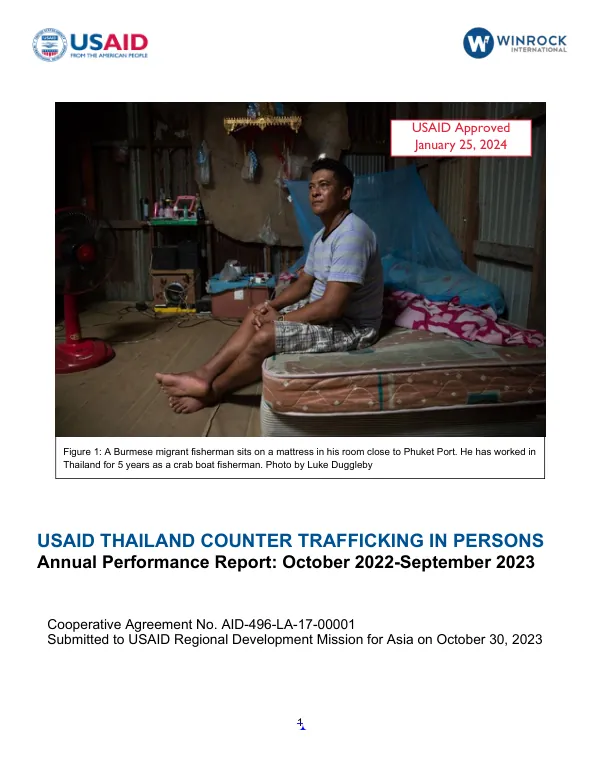
The USAID Thailand CTIP program aimed to reduce human trafficking in Thailand by addressing the root causes of trafficking and strengthening protection systems.
2023 · 237 pages
Sign in to readA free account is required to download.
Abstract
The program focused on three intermediate results: reducing demands and incentives for trafficked labor, empowering at-risk populations to safeguard their rights, and strengthening protection systems. Demands and incentives for trafficked labor were reduced through various interventions. Ethical standards and practices among employers and businesses were improved through co-creation workshops, stakeholder mapping, and industry analysis. For example, the program worked with the Global Platform for Sustainable Natural Rubber (GPSNR) to address human rights and forced labor risks in the rubber supply chain. Additionally, the program engaged private sector stakeholders to promote ethical employment practices for domestic work and construction. Consumer attitudes and awareness of trafficked labor in goods and services were measurably improved through social behavior change communication (SBCC) comprehensive formative research and a study of migrant representation in Thai media. The program also supported the Royal Thai Government (RTG) to scale up technological solutions to reduce worker vulnerability to trafficking in the fishing industry. At-risk populations were empowered to safeguard their rights through various interventions. Awareness and understanding of rights among most at-risk populations were increased through coordination with CTIP efforts in source countries, engaging migrant response centers, and developing a migrant protection toolkit. Access to support services by at-risk populations was improved through service provider mapping, network platforms, and supporting migrant legal cases. The program also strengthened protection systems through various interventions. Identification of trafficked persons was improved through supporting the implementation of Thailand's National Referral Mechanism (NRM) and the Greater Mekong Subregion Trafficking in Persons (TRM). Support services were strengthened to better address the needs of trafficked persons through government- and NGO-supported shelters collaboration, service provision for LGBTQI+ people, and learning events on local system strengthening. Monitoring, evaluation, and learning were critical components of the program. A MEL plan was developed for the extension phase, and learning and adaptive management were implemented through a learning agenda and learning questions. The program also conducted a baseline study, data quality assessment, and monitoring of grantees and implementing partners. Progress in key performance indicators was significant. Private sector partners took high-level actions to reduce risk factors for trafficking, and USG engagements were jointly undertaken with private sector enterprises. The program also supported the implementation of the NRM and TRM, and strengthened support services for trafficked persons.