INTERNATIONAL RESOURCES GROUP
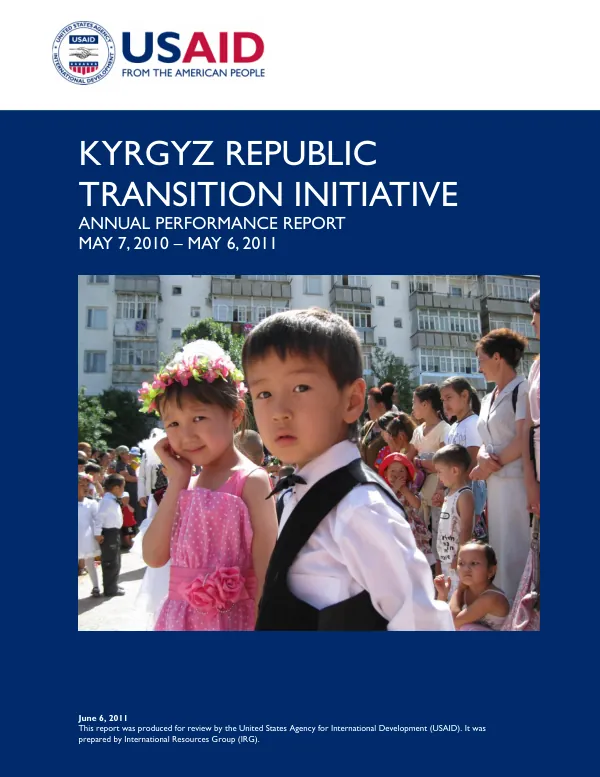
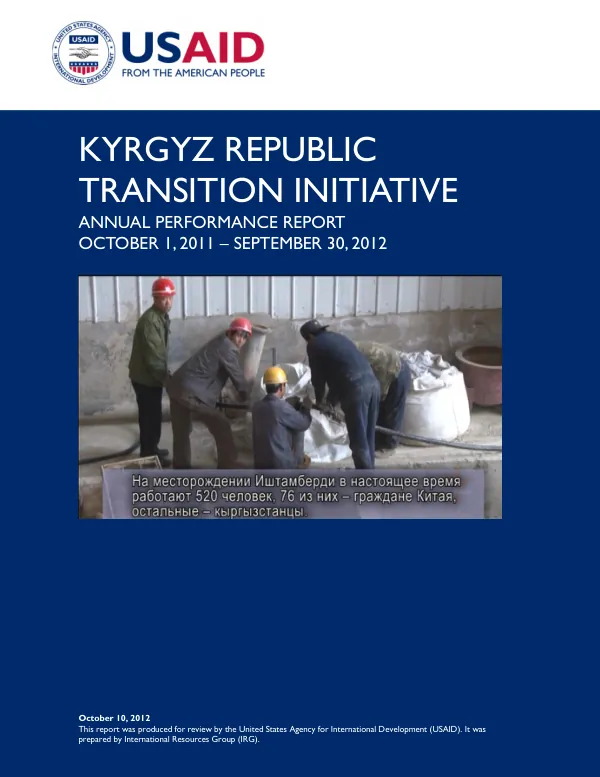
Annual Performance Report: Kyrgyz Republic Transition Initiative
The Kyrgyz Republic Transition Initiative (KRTI) began in May 2010 in response to the country's political crises.
2012 · 17 pages
Sign in to readA free account is required to download.
Abstract
The initiative was launched by USAID's Office of Transition Initiatives (OTI) to support the country's efforts in establishing transparent, accountable, and effective governance at both national and local levels. The program aimed to address emerging sources of instability and conflict within communities that had the potential to derail the ongoing democratic transition. The USAID/OTI program provided small grants to civil society, government, and private sector partners to implement high-impact, short-term projects in volatile communities. The program's model was designed to be fast, flexible, and responsive to a dynamic environment, allowing partners to implement pilot initiatives and catalytic projects that built momentum for continued long-term development. The program's objectives were to support the ongoing democratic political transition at the national and local level, and to address emerging sources of instability and drivers of conflict at the community level. To achieve these objectives, the program focused on six activity clusters: increasing access to reliable and objective information, expanding opportunities for youth and vulnerable populations, improving government responsiveness and accountability, promoting diversity and pluralism, strengthening civil society capacity, and stimulating economic recovery. In Year 2 of the program, the October 30, 2011 presidential election marked a critical milestone in Kyrgyzstan's ongoing political transition. The election established Central Asia's first parliamentary system of governance, with Almazbek Atambaev being sworn into office as the next President of the Kyrgyz Republic in early December 2011. The newly elected President and government developed an action plan called "Stability and Life of Dignity," which aimed to implement a series of reforms within 100 days. The action plan targeted areas such as the fight against corruption, with President Atambaev approving a "State Anti-Corruption Strategy and Counteraction Measures" on February 2, 2012. A poll conducted by the International Republican Institute (IRI) in late April showed that 96% of respondents believed the traffic safety department of the Ministry of Internal Affairs (MIA) to be the most corrupt government body. The Ministry of Internal Affairs' (MIA) Anti-Corruption Department reported on 311 cases of corruption revealed jointly with the General Prosecutor's Office (GPO) in the first six months of 2012. Some of the cases concerned high-ranking officials, including the former Minister of Social Development Ravshan Sabirov, MP Nurlan Sulaimanov, and Deputy Minister of Social Development G. The program continued to work with local and international stakeholders to consolidate democratic governance and ensure social and political stability in the Kyrgyz Republic. The USAID/OTI program remained committed to supporting the country's efforts in establishing a more stable, secure democracy, while laying the groundwork for continued long-term development.
Related documents