INTERNATIONAL RESOURCES GROUP
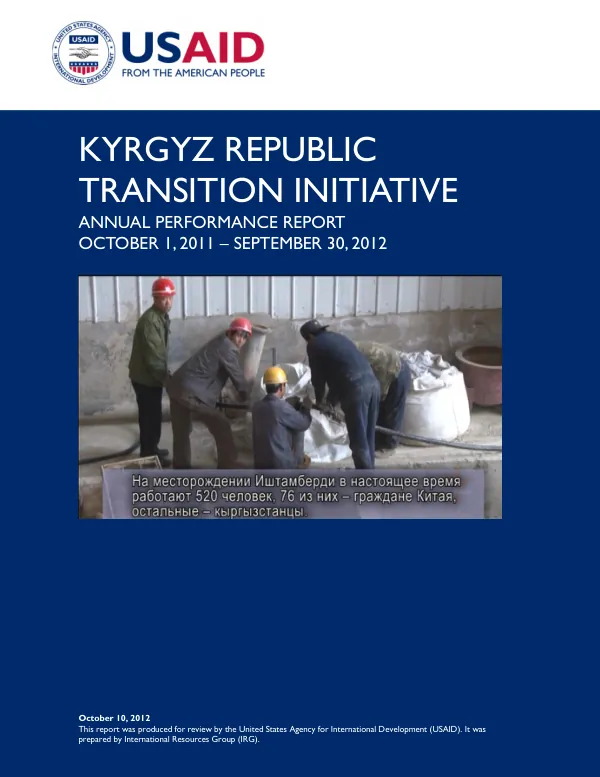
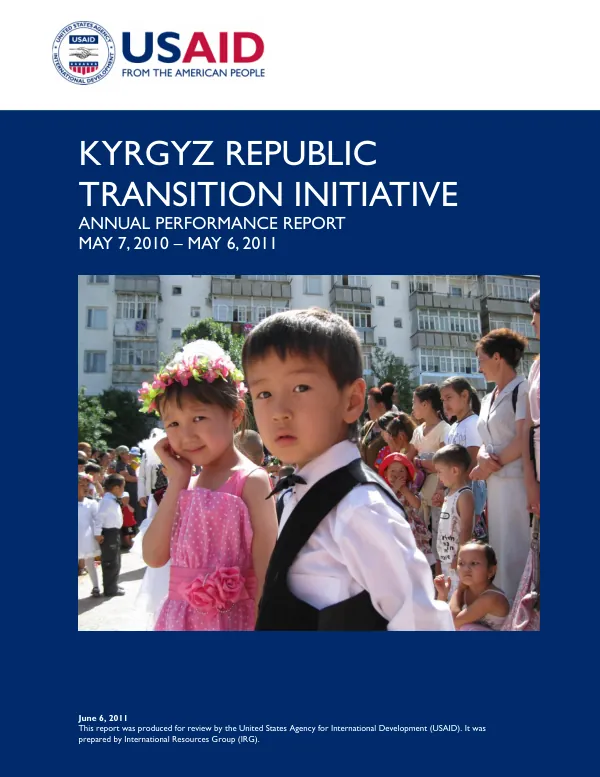
Annual Performance Report: Kyrgyz Republic Transition Initiative
The USAID/OTI program in the Kyrgyz Republic was launched in May 2010 in response to the country's political crisis.
2011 · 24 pages
Sign in to readA free account is required to download.
Abstract
The program aimed to support the country's efforts to establish a more stable and secure democracy by providing small grants to civil society, government, and private sector partners to implement high-impact, short-term projects in volatile communities. The program's objectives included mitigating conflict and improving governance. To mitigate conflict, OTI supported community-driven infrastructure rehabilitation, increased short-term income and employment opportunities, and media initiatives that increased access to reliable information and expanded community dialogue. OTI also engaged marginalized and volatile communities prone to conflict, supporting activities that promoted respect for pluralism and tolerance. In terms of improving governance, OTI supported inclusive, responsive, and transparent governance at national and local levels, increasing the ability of citizens and communities to engage constructively in democratic processes. OTI provided technical assistance and equipment to help restore critical government functions and services vital to community peace and stability, supporting public services that helped restore trust between government and constituents. The program operated in an environment of political turbulence, generalized fears, and threats of violence during the first year of operations. An inter-ethnic conflict erupted in the south in June 2010, leaving thousands displaced, dead, or missing and causing massive damage to administrative and community infrastructure. In response, OTI geared its activities towards government and civil society efforts to increase citizen participation in decision-making processes, mitigate conflict at the national and local levels, and restore critical government functions. The parliamentary elections held on October 10, 2010, went calmly, legitimizing the constitution and Roza Otunbaeva as the Provisional President until the end of 2011. However, the Ata Jurt party, associated with the Bakiev regime, was selected on the greatest number of ballots, and several weeks were required to form a new government. The program's activities were designed to be fast, flexible, and responsive to a dynamic and changing environment, allowing partners to implement pilot initiatives and catalytic projects to help build momentum for continued long-term development. The program's model was intended to leverage other donor efforts, both existing and planned, to support an ongoing democratic political transition and address emerging sources of instability and drivers of conflict at national and community levels. The USAID/OTI program in the Kyrgyz Republic demonstrated its effectiveness in mitigating the potential for conflict in volatile communities and bringing about positive change in governance during the first year of operations. The program's activities were designed to promote democratic processes, build trust between citizens and government, and support inclusive, responsive, and transparent governance at national and local levels.