ACDI/VOCA
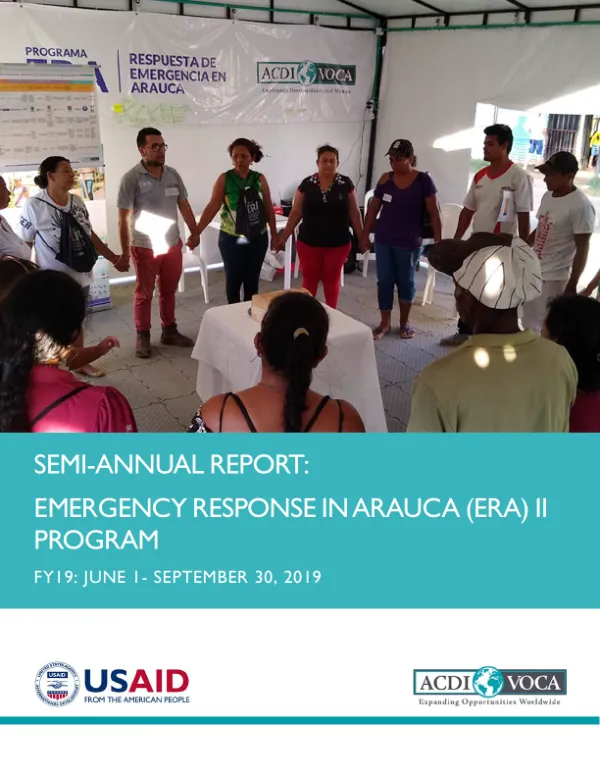
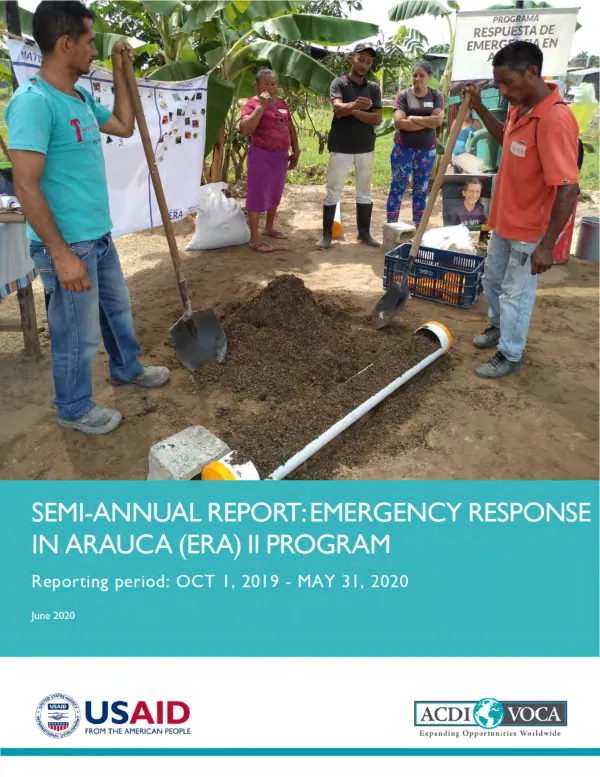
Semi-Annual Report: Emergency Response in Arauca Program FY20: June 2020
The Emergency Response in Arauca (ERA II) program is a semi-annual report covering the period from June 2020.
2020 · 17 pages
Sign in to readA free account is required to download.
Abstract
The program is funded by the United States Agency for International Development (USAID) through the Office of U.S. Foreign Disaster Assistance (OFDA). The report highlights the program's activities and accomplishments in improving the lives of vulnerable populations in Arauca, Colombia. The population surveyed under the ERA program consists of 4,381 Colombian nationals and 3,745 Venezuelans, representing 53.9 percent and 46.1 percent of the total population, respectively. The majority of the population has been affected by the migratory crisis, with 66.75 percent of the population surveyed having been affected by the crisis. The report also notes that only 16.7 percent of Venezuelans have an identification document to stay legally in Colombia, while 83.3 percent have no document of any kind. The report highlights the challenges faced by the population, including limited access to the general social security health system, with only 51.59 percent of the population having access to the system. The majority of those without access to the public health system are Venezuelans, who make up 89.73 percent of those without access. The report also notes that the occupational profile of the population is divided into two groups: those aged 0-17 and those over 18 years old. The majority of the population over 18 years old is economically inactive or studying. The ERA II program has several objectives, including improving the sustainable production and availability of food, providing self-sufficient food alternatives to 278 households. The program will provide the necessary materials to establish 278 household gardens and broiler chicken livestock units. The program will also support participants with technical assistance and training needed for the proper use and maintenance of the gardens and livestock modules. The agriculture and food security component of the program has carried out several activities, including training workshops and technical assistance visits. The training workshops have been attended by 316 heads of household, 50 percent of whom are Venezuelan migrant families, 23.1 percent are Colombian returnees, and 26.9 percent are from the Colombian host population. The technical assistance visits have been carried out to help with the establishment and maintenance of household gardens and livestock units. The program has also provided support to the participants with the technical assistance and training needed for the proper use and maintenance of the gardens and livestock modules, food diversification, improvement of nutritional practices, and renewal of production cycles. The program has verified that the materials, tools, and inputs delivered for the household gardens were well-managed and used properly. The report highlights the challenges faced by the program, including the need to improve the sustainable production and availability of food, providing self-sufficient food alternatives to 278 households. The program will continue to provide support to the participants with technical assistance and training needed for the proper use and maintenance of the gardens and livestock modules. The report concludes by highlighting the accomplishments of the program, including the establishment of 278 household gardens and broiler chicken livestock units, and the provision of technical assistance and training to 316 heads of household. The program will continue to work towards improving the lives of vulnerable populations in Arauca, Colombia.