ACDI/VOCA
Quarterly Progress Report: Disaster Risk Reduction in San Pedro
The Disaster Risk Reduction in San Pedro (DRRSP) program is a 12-month initiative funded by the United States Agency for International Development (USAID) through the Office of U.S.
2016 · 7 pages
Sign in to readA free account is required to download.
Abstract
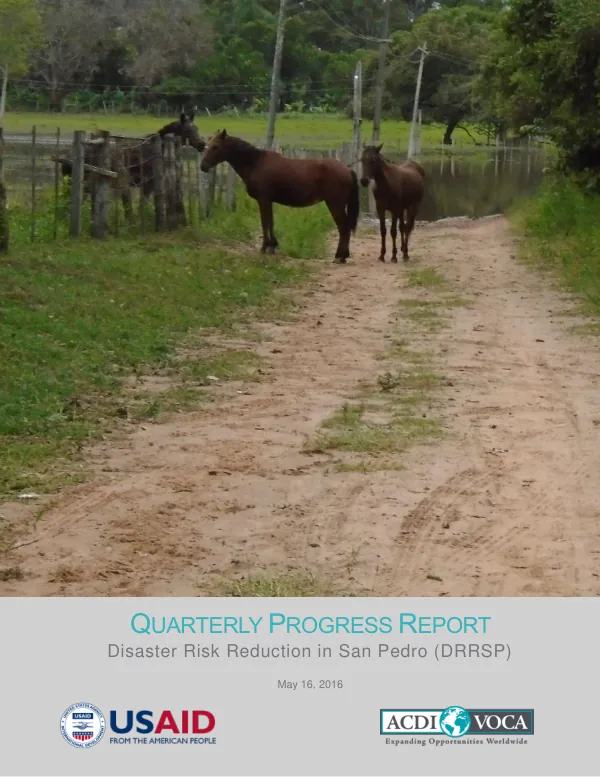
Foreign Disaster Assistance (OFDA). The program aims to increase the resilience of communities and households in the districts of San Pedro de Ycuamandiyú and Puerto Antequera in Paraguay, which are prone to flooding due to the El Niño climate phenomenon. The program focuses on three sectors: Risk Management Policy and Practice, Agriculture and Food Security, and Shelter and Settlements. Under Risk Management Policy and Practice, the program will provide communities, local government, and institutions with tools and capacities to proactively manage risk, including decentralization of services and early warning systems. Agriculture and Food Security activities will help families secure sustainable food production by improving food preservation and planning techniques, as well as providing training and resources for traditional and floating gardens. The program will also provide model structural and nonstructural solutions to people affected by floods, including facilitating action planning for shelter in the case of emergencies, piloting innovative emergency shelter solutions, and introducing a water pump to drain water during flooding. The program will measure progress through ten indicators, including the number of people trained in disaster preparedness, the number of trainings conducted, and the percentage of people trained who retain skills and knowledge after two months. During the first month of operation, the DRRSP program accomplished multiple key start-up activities contributing to its overall objectives. Highlights include the rapid mobilization of the program team, the establishment of ACDI/VOCA operational systems, policies, and procedures, and the completion of administrative and financial requirements. The program director oriented staff on the work plan, setting a schedule of activities for each of the sectors of the program. The program director also participated in briefings with the Secretary of Risk Management and Reduction from San Pedro and SEN's Prevention General Director, introducing the program and identifying ideas and areas for potential immediate collaboration. The program will be fully operational during the next quarter, finalizing its structured start-up process, testing its administrative and financial systems and tools, and securing collaborative agreements with local implementing partners, resource organizations, and beneficiary groups.