USAID DEC
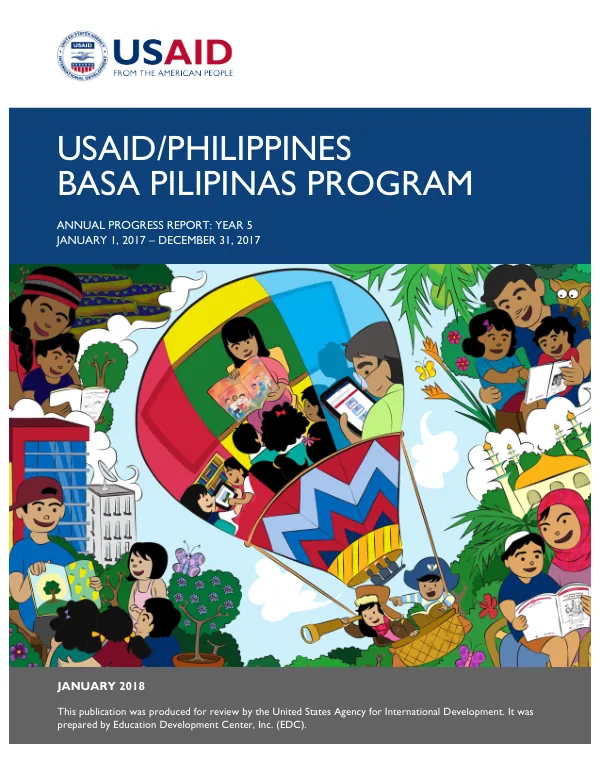
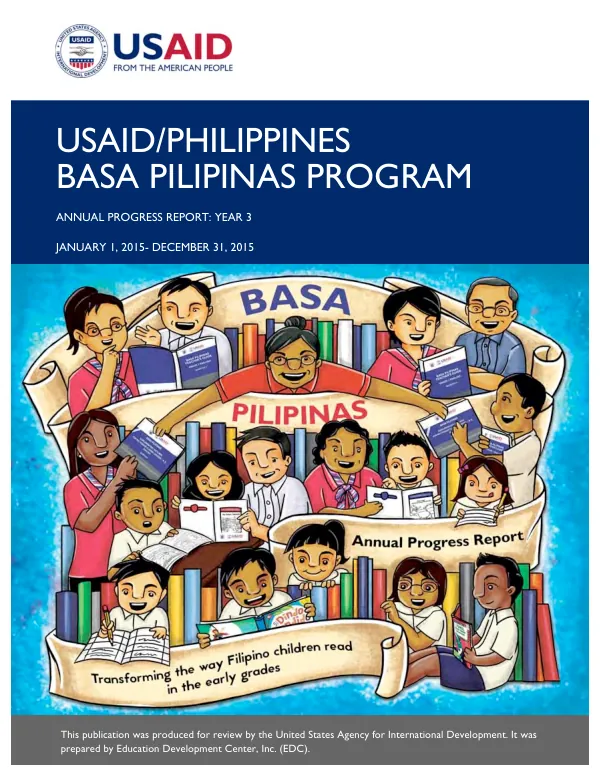
Annual Progress Report: Year 3 (January–December 2015) for the USAID/Philippines Basa Pilipinas Program
Sign inCENTER FOR EDUCATIONAL DEVELOPMENT
Annual Progress Report: Year 3 (January–December 2015) for the USAID/Philippines Basa Pilipinas Program
The Basa Pilipinas Program is a flagship basic education project launched in January 2013 by USAID in the Philippines.
2016 · 179 pages
Sign in to readA free account is required to download.
Abstract
The program aims to improve reading instruction, delivery systems, and access to quality reading materials for early grade pupils. The program has reached 1.1 million early grade pupils and strengthened reading instruction for 12,995 teachers and 3,414 school heads and administrators in select school divisions in Regions 1 and 7. The program's implementation focused on three key interventions: improved reading instruction, improved reading delivery systems, and improved access to quality reading materials. The program distributed close to 5 million teaching and learning materials to schools in Ilocos Norte, Ilocos Sur, La Union, Cebu, Bohol, and the cities of Mandaue, San Fernando, and Tagbilaran. The program also established demonstration plots in 15 communities, which showed yield improvements of 60% when applying the recommended practices. The program's monitoring and evaluation (M&E) component played a crucial role in tracking progress and identifying areas for improvement. The M&E system used a combination of quantitative and qualitative data collection methods, including surveys, focus group discussions, and observations. The program also conducted regular data quality assessments to ensure the accuracy and reliability of the data. The program's outreach and communications (O&C) component was responsible for disseminating information about the program's activities and achievements to stakeholders, including the Department of Education, local government units, and the media. The program also established partnerships with various organizations, including the Philippine Business for Social Progress and the National Book Store Foundation, to support its activities. The program's post-typhoon Haiyan (Yolanda) disaster education recovery assistance component provided support to schools affected by the disaster. The program distributed teaching and learning materials, provided training to teachers, and established temporary learning spaces to support the recovery efforts. The program's financial summary for Year 3 shows that the total project spending was $4.2 million, with $2.1 million allocated for program activities and $1.1 million for program support and administration. The program's projected expenditures for Quarter 1, Year 4 are $1.2 million. The program's key accomplishments in Year 3 include: * Improved reading instruction for 12,995 teachers and 3,414 school heads and administrators * Distribution of close to 5 million teaching and learning materials to schools * Establishment of demonstration plots in 15 communities, which showed yield improvements of 60% when applying the recommended practices * Conduct of regular data quality assessments to ensure the accuracy and reliability of the data * Establishment of partnerships with various organizations to support the program's activities * Provision of support to schools affected by the post-typhoon Haiyan disaster The program's results are correlated to the Contract Monitoring Plan (CMP), which outlines the program's key performance indicators and targets. The program's progress is reported quarterly to the USAID/Philippines Office of Education, which provides oversight and guidance to the program.