USAID DEC
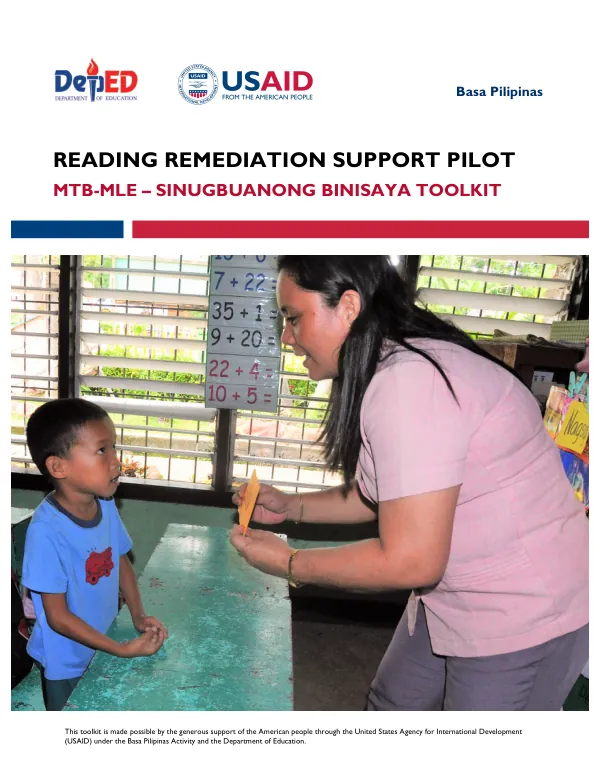
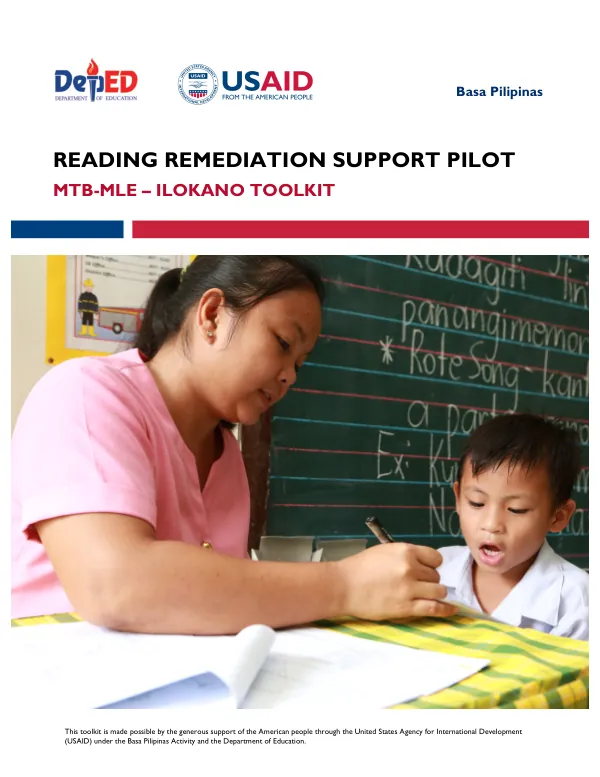
USAID Basa Pilipinas Reading Remediation Support Pilot Toolkit (Ilokano) - FINAL MAY 2018
Sign inCENTER FOR EDUCATIONAL DEVELOPMENT
USAID Basa Pilipinas Reading Remediation Support Pilot Toolkit (Ilokano) - FINAL MAY 2018
The Reading Remediation Support Pilot (RRSP) is a study implemented by the Department of Education in the Philippines, in collaboration with the Basa Pilipinas Project, a technical support initiative of the United States Agency for International Development (USAID).
2018 · 55 pages
Sign in to readA free account is required to download.
Abstract
The RRSP aims to test a three-stage process for providing reading remediation to Grade 1 and 2 learners. The RRSP framework adapts the Response-to-Intervention (RTI) approach, where students progress through levels of instructional support based on their learning needs. In Stage 1, teachers conduct whole-class instruction and formative assessments to identify learners' needs. In Stage 2, teachers provide small-group reading remediation instruction to identified "less abled" learners. In Stage 3, teachers provide small-group reading remediation to learners who need continuous support, while also providing individualized instruction to learners who require more intensive support. The RRSP learning profiles categorize learners into three groups based on their literacy assessment results. The first profile (P1) includes learners who struggle with phonological processing abilities, affecting their word reading, spelling, and oral reading fluency. The second profile (P2) includes learners who struggle with comprehension, while the third profile (P3) includes learners who struggle with most literacy domains. The RRSP Toolkit is a collection of informal assessment, instructional planning, and progress monitoring and reporting tools. Participating teachers received the toolkit, which includes screening tools, literacy assessment forms, remediation plans, and progress reporting tools. The toolkit is designed to support teachers in identifying learners' needs, planning remediation instruction, and monitoring learners' progress. The RRSP schedule outlines the implementation plan for participating schools and teachers. The study is divided into three stages, each lasting 9 weeks, with the last 4 weeks dedicated to reviewing learners' skill levels. Stage 1 focuses on whole-class instruction with differentiation, while Stage 2 involves small-group reading remediation instruction. Stage 3 combines small-group and individual reading remediation instruction. The RRSP process involves four steps: screening, assessment and placement, instructional planning, and reading remediation. Screening is conducted at the end of each stage to identify learners who require remediation. Assessment and placement are conducted at the end of Stage 1 and 2 to determine learners' specific areas of need and group them according to learning profiles. Instructional planning is done in every stage to prepare remediation plans and weekly plans. Reading remediation is conducted in Stage 2 and 3, with small-group instruction for each learning profile and individualized instruction for learners who require more intensive support. The RRSP study aims to provide a structured approach to reading remediation in the Philippines, addressing the needs of learners who struggle with reading. The study's findings and recommendations are expected to inform the development of reading remediation programs and policies in the country.
Related documents