FAMILY HEALTH INTERNATIONAL
Annual Report 2012: FIELD-Support LWA
FIELD-Support is a Leader with Associates (LWA) cooperative agreement between the Office of Microenterprise and Private Enterprise Promotion (MPEP) at USAID/E3 and FHI 360.
2012 · 40 pages
Sign in to readA free account is required to download.
Abstract
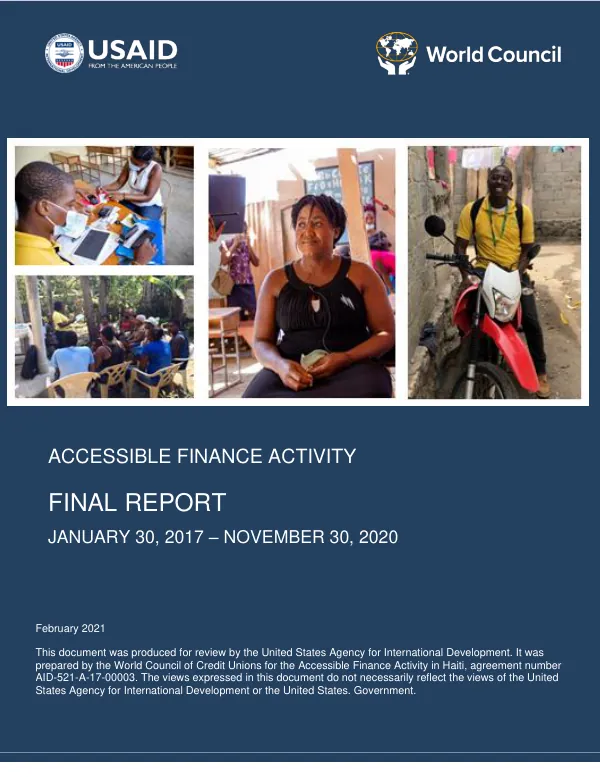
The FIELD-Support consortium, led by FHI 360, works collaboratively to reduce poverty and promote sustained, equitable growth through microenterprise development, microfinance, value chain development, institutional and human capacity-building, and market-based approaches. The FIELD-Support LWA is a pre-competed flexible mechanism that has included multi-year cooperative agreements, short-term field-based pilots, quantitative and qualitative research studies and evaluations, and targeted country assessments and program design assignments for Missions. FIELD-Support works at every level of the economy, from regulatory agencies and financial institutions to business service providers, micro, small, and medium-sized enterprises (MSMEs), and vulnerable households. FIELD-Support's priorities for fostering more inclusive financial services have addressed problems at multiple levels: at the industry level to lower critical barriers that inhibit the provision of more inclusive financial services; at the institutional level to increase the capacity of service providers and other stakeholders to supply services on a sustainable basis; and at the client level to increase the ability, awareness, and willingness of consumers to access the services on offer. One of FIELD-Support's key program activities under this area is the Haiti Integrated Finance for Value Chains and Enterprises (HIFIVE) Associate Award. HIFIVE is USAID/Haiti's next phase in a sequenced strategy to further develop the country's financial services sector to promote employment generation, improve livelihoods, and boost the economy. HIFIVE's activities focus on improving the availability of financial products to support the expansion of agricultural and other production and the expansion of availability of access to financial products and services in rural and agricultural areas. The core of the program is the HIFIVE Catalyst Fund (HCF), a $22.5 million grant pool to increase financial services in rural and agricultural zones. These targeted grants support innovation and experimentation in development of technology solutions, capacity building, financial services and products, and risk mitigation. To date, HCF has issued nearly 60 grants, totaling $14 million. Of the 60 grants, seven are structured as public private partnerships. The grants have been used to support a large variety of activities, including value chain finance and rural expansion of financial services, ICT improvements that are expanding financial inclusion/client outreach, and market information development. HIFIVE also includes a business development services (BDS) component under which 372 MSMEs have received BDS services from HIFIVE. The success of HIFIVE's BDS approach depends on the careful identification of key value chain actors who both need BDS to be able to access finance and, once gaining access to finance, could significantly improve either the governance, management, and/or market efficiencies within the chain. Accompanying the delivery of BDS, the HIFIVE team brokers finance by linking institutions to appropriate value chain actors seeking finance. The development of sustainable financial products and services to meet the needs of Haiti's rural and agricultural populations and MSMEs requires the existence of a robust microfinance sector whose institutions have the capacity to design and offer a broad array of financial products and services. HIFIVE provides support to individual institutions and industry networks contributing to the vitality of the sector. It also supports market information activities, including the annual census of the microfinance sector and GIS mapping of financial points of service to assure that reliable market information is available to help inform the planning and evolution of the sector. In the last year, HIFIVE also completed a census of the Haitian microfinance sector, which provides valuable insights into the sector's current state and future directions. The census highlights the importance of a robust microfinance sector in supporting the development of sustainable financial products and services that meet the needs of Haiti's rural and agricultural populations and MSMEs.