USAID DEC
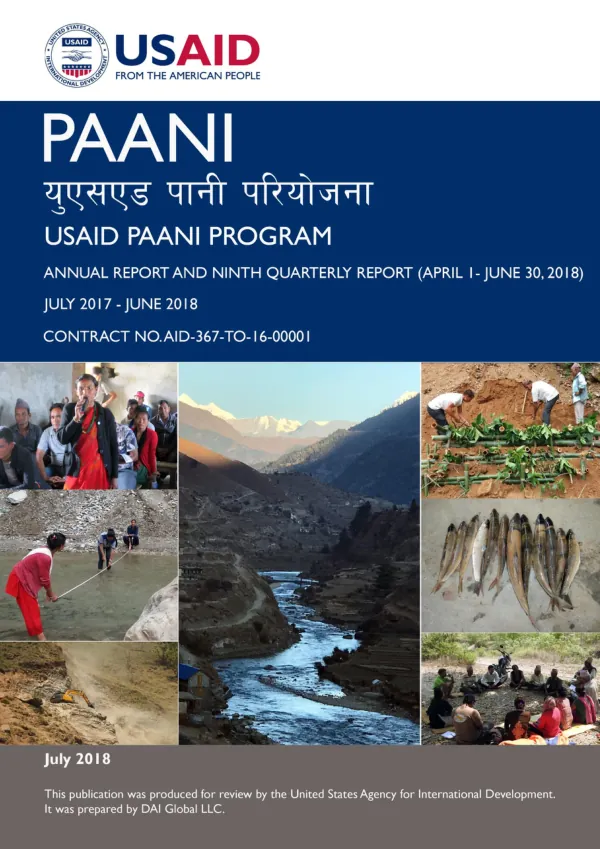
Annual Report and Ninth Quarterly Report (April 1 – June 30, 2018) USAID Paani Program
Sign inDAI GLOBAL, LLC
Annual Report and Ninth Quarterly Report (April 1 – June 30, 2018) USAID Paani Program
The USAID Paani Program is a development initiative focused on improving water management and aquatic biodiversity in Nepal.
2018 · 138 pages
Sign in to readA free account is required to download.
Abstract
The program is implemented by DAI Global LLC under the contract AID-367-TO-16-00001. The program's development hypothesis is based on the idea that improved water management and aquatic biodiversity can lead to increased economic benefits and improved livelihoods for local communities. The program's strategic approach is divided into four main components: Strategic Approach 1A, 1B, 1C, and 1D, which focus on improving water management and aquatic biodiversity through various interventions. Strategic Approach 1A focuses on improving water quality through the implementation of best management practices (BMPs) and the establishment of water quality monitoring systems. Strategic Approach 1B focuses on improving aquatic biodiversity through the implementation of conservation measures and the establishment of protected areas. Strategic Approach 1C focuses on improving the livelihoods of local communities through the provision of training and capacity-building programs. Strategic Approach 1D focuses on improving the governance and management of water resources through the establishment of community-based water management systems. The program also focuses on partnerships and collaboration with various stakeholders, including local governments, civil society organizations, and private sector entities. The program has established partnerships with several organizations, including the Asian Development Bank, the Department of Agriculture, and the Department of National Parks and Wildlife Conservation. The program has also conducted stakeholder consultations and meetings with various stakeholders to identify social and environmental issues and to develop a comprehensive understanding of the program's impact. The program has made significant progress in improving water management and aquatic biodiversity in Nepal. The program has established a network of water quality monitoring stations and has implemented BMPs to improve water quality. The program has also established protected areas to conserve aquatic biodiversity and has provided training and capacity-building programs to improve the livelihoods of local communities. The program has also made significant progress in improving the governance and management of water resources through the establishment of community-based water management systems. The program's midterm evaluation has shown significant improvements in water quality and aquatic biodiversity. The program has also shown significant improvements in the livelihoods of local communities, with increased income and improved food security. The program has also shown significant improvements in the governance and management of water resources, with increased community participation and improved decision-making processes. The program has also made significant progress in knowledge sharing and learning. The program has established a knowledge management system to share best practices and lessons learned with various stakeholders. The program has also conducted research and assessments to identify areas for improvement and to develop new interventions. The program has also established partnerships with several research institutions to conduct research and assessments on water management and aquatic biodiversity. The program's next quarter plan includes several major activities, including the establishment of a new water quality monitoring station, the implementation of new BMPs, and the provision of training and capacity-building programs to local communities. The program also plans to conduct a comprehensive evaluation of its impact and to develop a new work plan to address areas for improvement.