USAID DEC
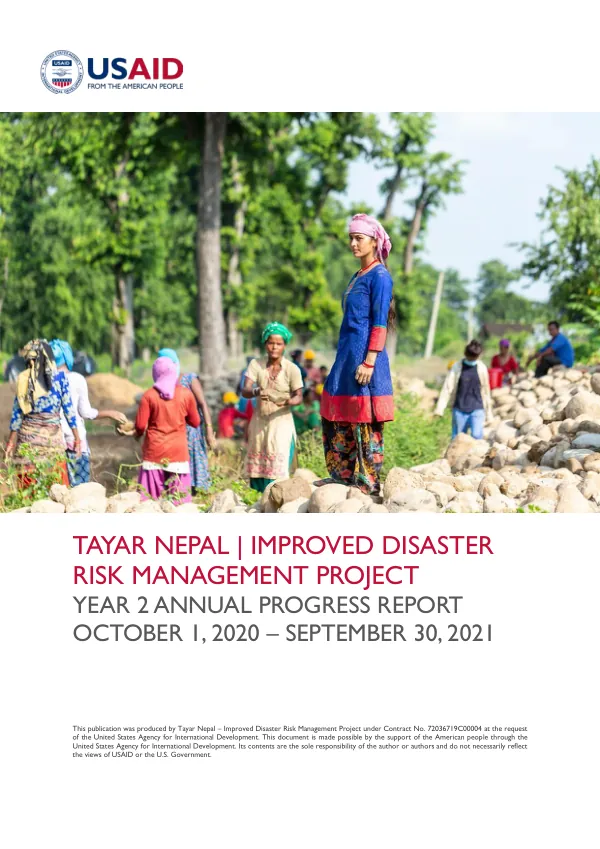
Tayar Nepal | Improved Disaster Risk Management Project Year 2 Annual Progress Report
Sign inDAI GLOBAL, LLC
Tayar Nepal | Improved Disaster Risk Management Project Year 2 Annual Progress Report
The Tayar Nepal – Improved Disaster Risk Management Project is a USAID-funded initiative aimed at enhancing disaster risk management in Nepal.
2021 · 94 pages
Sign in to readA free account is required to download.
Abstract
The project's second year, spanning from October 1, 2020, to September 30, 2021, was marked by numerous disasters, including the COVID-19 pandemic, severe cold waves, and uncontrolled wildfires. The project's Component 1 focused on improving national-level systems and institutions. Activity 1.1 involved support to the National Disaster Risk Reduction and Management Authority (NDRRMA), while Activity 1.2 aimed to complete a stocktaking of disaster risk reduction and management laws and policies and initiate work on a model disaster risk management policy toolkit. The project also supported national-level disaster coordination, relocation and resettlement efforts, and implemented a grants program. Component 2 focused on building capacity at the municipal level. Activity 2.1 enhanced municipal-level institutional setup and legislative arrangements, while Activity 2.2 built municipal-level disaster risk management capacity. The project also carried out risk-sensitive land use planning, implemented replicable disaster mitigation activities in municipalities, and engaged in disaster risk finance innovation and private sector engagement. Component 3 focused on strengthening disaster preparedness, response, and recovery. Activity 3.1 involved a rapid assessment of municipal readiness, while Activity 3.2 inventoried humanitarian disaster response capability. The project also implemented a grants program to support disaster risk reduction and management activities. Throughout the year, the project faced numerous challenges, including the COVID-19 pandemic, severe cold waves, and uncontrolled wildfires. Despite these challenges, the project made significant progress in enhancing disaster risk management in Nepal. The project's efforts were focused on building capacity at the national and municipal levels, improving disaster risk reduction and management laws and policies, and supporting disaster risk finance innovation and private sector engagement. The project's achievements in the second year included the completion of a stocktaking of disaster risk reduction and management laws and policies, the initiation of work on a model disaster risk management policy toolkit, and the implementation of a grants program to support disaster risk reduction and management activities. The project also made significant progress in building municipal-level disaster risk management capacity and implementing risk-sensitive land use planning. The project's efforts were supported by a range of stakeholders, including the Government of Nepal, international organizations, and local communities. The project's achievements were also recognized through various media coverage and awards. In terms of monitoring and evaluation, the project used a range of indicators to track progress and assess the impact of its activities. The project's monitoring and evaluation framework was designed to ensure that the project's activities were aligned with its objectives and that progress was being made towards achieving its goals. The project's organizational development and capacity building efforts were also significant, with a focus on building the capacity of local organizations and communities to manage disaster risk. The project's curriculum design and training efforts were also aimed at building the capacity of local organizations and communities to manage disaster risk. Overall, the Tayar Nepal – Improved Disaster Risk Management Project made significant progress in enhancing disaster risk management in Nepal during its second year. The project's efforts were focused on building capacity at the national and municipal levels, improving disaster risk reduction and management laws and policies, and supporting disaster risk finance innovation and private sector engagement.