USAID DEC
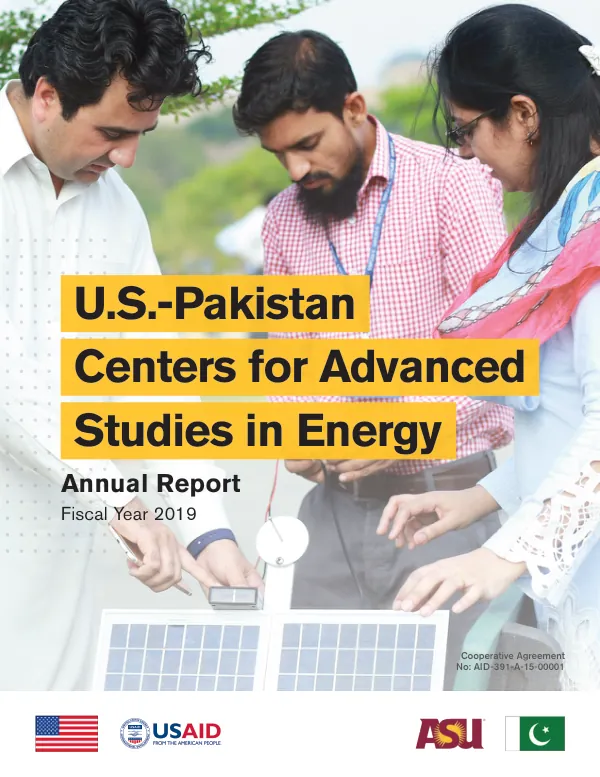
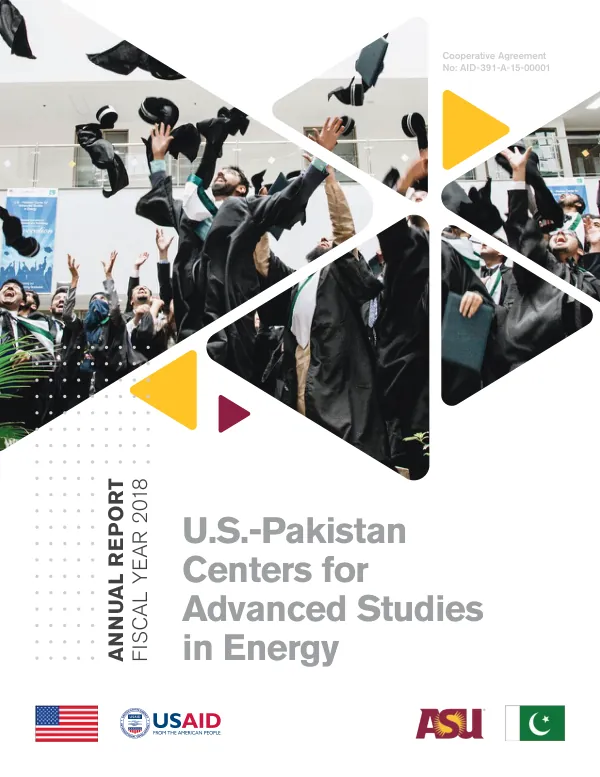
Annual Report Fiscal Year 2018: U.S.-Pakistan Centers for Advanced Studies in Energy
Sign inARIZONA STATE UNIVERSITY
Annual Report Fiscal Year 2018: U.S.-Pakistan Centers for Advanced Studies in Energy
The U.S.-Pakistan Centers for Advanced Studies in Energy (USPCASE) is a partnership between Arizona State University (ASU) and two leading Pakistani universities: National University of Sciences and Technology (NUST) and University of Engineering and Technology Peshawar (UET-P), along with partner Oregon State University (OSU).
2018 · 60 pages
Sign in to readA free account is required to download.
Abstract
The program aims to strengthen academic programs, support energy research, educate a new generation of skilled engineers, and build enduring connections among government, industry, and academia. The USPCASE program has made significant progress in its first year, with a focus on creating state-of-the-art post-graduate education programs in renewable, electrical, and thermal energy, as well as energy management. The program has initiated and supported the development of a technology center to support the energy sector with training, certifications, and testing facilities. Additionally, USPCASE has strengthened student understanding of applied research through internships and undertaken nearly 50 joint and applied research projects. The program has also organized educational conferences, technical workshops, industry stakeholder meetings, and more. USPCASE supports the academic and research advancement of Pakistani students and faculty by hosting more than 200 exchange students and faculty at ASU and OSU. The program has also worked to ensure the sustainability of initiatives at NUST and UET-P through fundraising strategies and the cultivation of six public-private partnerships with the goal of raising $2M in funding, creating 20 new labs and two libraries, and securing 100 internships. USPCASE is focused on the collaboration needed to develop world-class centers of energy engineering that will serve as Pakistan's go-to think tanks with the technical expertise to close the energy gap. The program is working to actively engage 120 stakeholders over the life of the project. USPCASE has held its fourth National Stakeholders Meeting and Research Expo on April 25, 2018, at the Islamabad Serena Hotel in Pakistan. Stakeholder engagement is key to the sustainability of the Centers for Advanced Studies in Energy. The centers are developing a critical mass of expertise, creating an educated workforce through the preparation of graduate students, developing technical and policy solutions, and providing technical bandwidth to public and private energy organizations in Pakistan. USPCASE is engaging with a wide range of energy sector stakeholders in Pakistan to promote modernization and relevance of the curriculum, strengthen policy decisions, and drive innovation. The USPCASE centers are focused on creating long-lasting collaborative partnerships with stakeholders that have the potential to transform the energy sector and realize long-term benefits for Pakistan. Stakeholder input and feedback are critical to the success of the Centers for Advanced Studies in Energy at NUST and UET. The stakeholder meetings provide the latest information on degree programs and research projects, and provide a forum for input and feedback. The program has made significant progress in its first year, with a focus on creating state-of-the-art post-graduate education programs in renewable, electrical, and thermal energy, as well as energy management. The program has also strengthened student understanding of applied research through internships and undertaken nearly 50 joint and applied research projects. USPCASE has supported the academic and research advancement of Pakistani students and faculty by hosting more than 200 exchange students and faculty at ASU and OSU. The program has also worked to ensure the sustainability of initiatives at NUST and UET-P through fundraising strategies and the cultivation of six public-private partnerships with the goal of raising $2M in funding, creating 20 new labs and two libraries, and securing 100 internships. USPCASE has engaged with a wide range of energy sector stakeholders in Pakistan to promote modernization and relevance of the curriculum, strengthen policy decisions, and drive innovation. The USPCASE centers are focused on creating long-lasting collaborative partnerships with stakeholders that have the potential to transform the energy sector and realize long-term benefits for Pakistan. The program has made significant progress in its first year, with a focus on creating state-of-the-art post-graduate education programs in renewable, electrical, and thermal energy, as well as energy management. The program has also strengthened student understanding of applied research through internships and undertaken nearly 50 joint and applied research projects.
Related documents