ARIZONA STATE UNIVERSITY
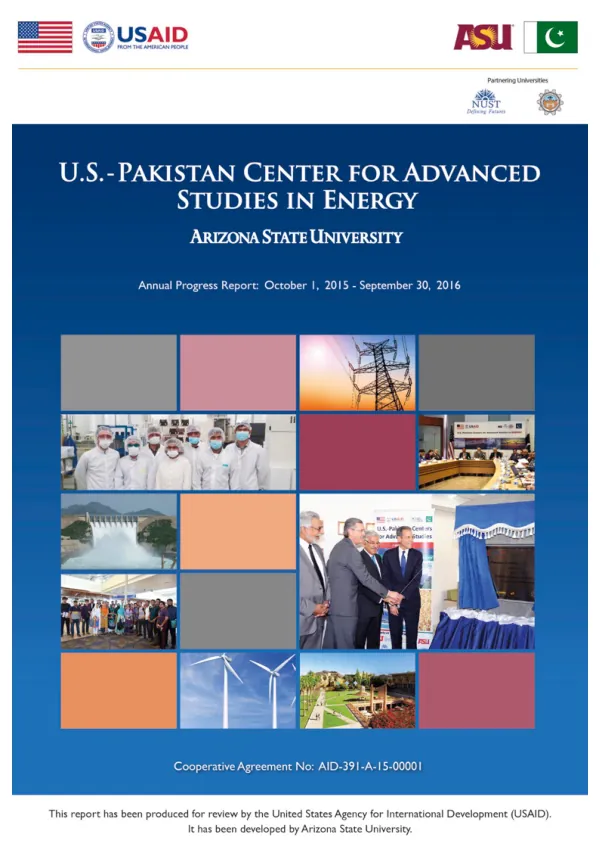
USPCAS-E (ASU) Annual Progress Report (Oct 2015 – Sept 2016)
The U.S.-Pakistan Centers for Advanced Studies in Energy (USPCAS-E) is a collaborative effort between Arizona State University (ASU) and two Pakistani universities, the National University of Sciences and Technology (NUST) and the University of Engineering and Technology (UET) Peshawar.
2016 · 43 pages
Sign in to readA free account is required to download.
Abstract
The program aims to support the implementation of USPCAS-E's activities in the field of energy. During the period from October 2015 to September 2016, ASU continued to work closely with NUST and UET Peshawar to support the implementation of USPCAS-E's activities. The program focused on five key components: governance, curriculum reform, applied research, exchanges and scholarships, and sustainability. One of the key achievements of the program was the development of an annual FY 17 work plan format and content, which were shared with NUST and UET to ensure alignment. ASU also provided assistance to NUST and UET to help them complete their strategic plans and integrate them within the overall structure of their respective institutions. ASU, along with NUST, developed the USPCAS-E catalogues for energy systems engineering, electrical energy engineering, and thermal energy engineering. This included the development of over 28 new courses at NUST. Similarly, ASU, along with UET, developed the curriculum catalogue for electrical energy systems engineering and material for energy storage and conversion, which included 20 new courses at UET in the center's thematic areas. The program also organized the first of a series of national stakeholders' meetings in Islamabad in March 2016. The meeting served as a platform for candid discussions on ways to create a collaborative and sustainable environment under which key stakeholders and universities would work to enhance cooperation and foster partnerships. In response to the nationwide call for applied research proposals in energy, NUST received a total of 130 proposals, and UET Peshawar received 57 proposals. ASU undertook an extensive review of the proposals and graded them for their viability. Based on this, NUST selected 10 projects, and UET Peshawar selected nine projects for funding. During this year, ASU provided assistance to both universities to technically and financially evaluate bids for laboratory equipment for Electrical Energy System Engineering and Materials for Energy Storage and Conversion. ASU also organized three technical workshops in Islamabad, which were facilitated by senior ASU faculty. The workshops included a Solar Photovoltaic (PV) Systems workshop, an Energy Policy workshop, and a Fuel cells and Batteries workshop. Based on the results from participants' evaluation, the respondents were extremely satisfied with the workshops, and the program received positive feedback from the participants.