USAID
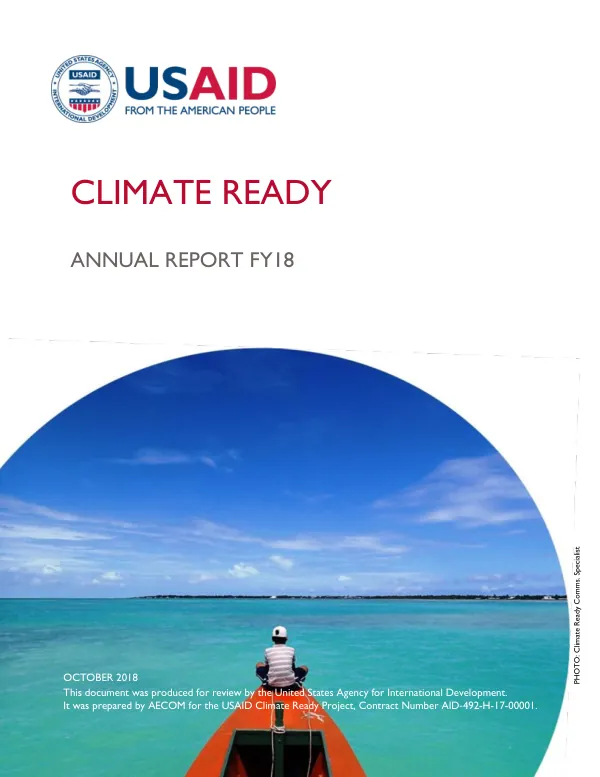
Annual Report FY18: USAID Climate Ready
The USAID Climate Ready project began in 2017 with the goal of supporting Pacific Island countries in their efforts to adapt to the impacts of climate change.
2018 · 130 pages
Sign in to readA free account is required to download.
Abstract
The project was implemented in 14 countries, including Kiribati, the Federated States of Micronesia, the Republic of the Marshall Islands, and Tonga. The project's overall objective was to increase the resilience of these countries to climate-related disasters and to support their efforts to reduce greenhouse gas emissions. The project's technical progress was evaluated against three intermediate results (IRs). IR 1 focused on the development of national, sub-national, and sectoral policies, regulations, and legal frameworks necessary for achieving adaptation goals. By the end of FY18, all 14 countries had developed and implemented policies and regulations to support climate change adaptation. IR 2 aimed to increase the Pacific Island Countries' (PICs) ability to access international, multilateral climate change funds. By the end of FY18, PICs had increased their access to these funds, with a total of $15 million secured. IR 3 focused on building professional capacity and management systems to coordinate, manage, monitor, and report on adaptation projects. By the end of FY18, the project had trained over 200 professionals in climate change adaptation and had established a management system to track and report on project progress. The project also provided supplemental technical assistance (STA) to support the development of climate change policies and regulations in the Pacific Island countries. The project made significant progress against its monitoring and evaluation (M&E) plan targets. The project's M&E indicators showed a 27% increase in the number of climate change policies and regulations in place, a 25% increase in the number of adaptation projects implemented, and a 30% increase in the amount of funding secured for climate change adaptation. The project also made progress on cross-cutting issues, including gender equity and social inclusion. The project supported the development of gender-sensitive climate change policies and regulations and provided training to women on climate change adaptation. The project also supported the development of public-private alliances to support climate change adaptation and provided training to small businesses on climate change adaptation. The project's administration progress was also significant, with the project team achieving a 95% rate of compliance with USAID's financial management regulations. The project also made significant progress on implementation issues, including the development of a project management plan and the establishment of a project monitoring and evaluation system. The project's planned activities for FY19 included the continuation of the project's technical assistance to the Pacific Island countries, the development of a project management plan, and the establishment of a project monitoring and evaluation system. The project's financial analysis for FY18 showed a total expenditure of $15 million, with a total of $10 million remaining in the project budget. The project's communications media hits for FY18 included a total of 150 media hits, with a total of 50 media hits in the Pacific Island countries. The project's M&E indicators and performance deliverables are outlined in Annex F of the report. The project's sub-activities by activity and objective are outlined in Annex G of the report, and the project's sub-activities by country are outlined in Annex H of the report.
Related documents