USAID
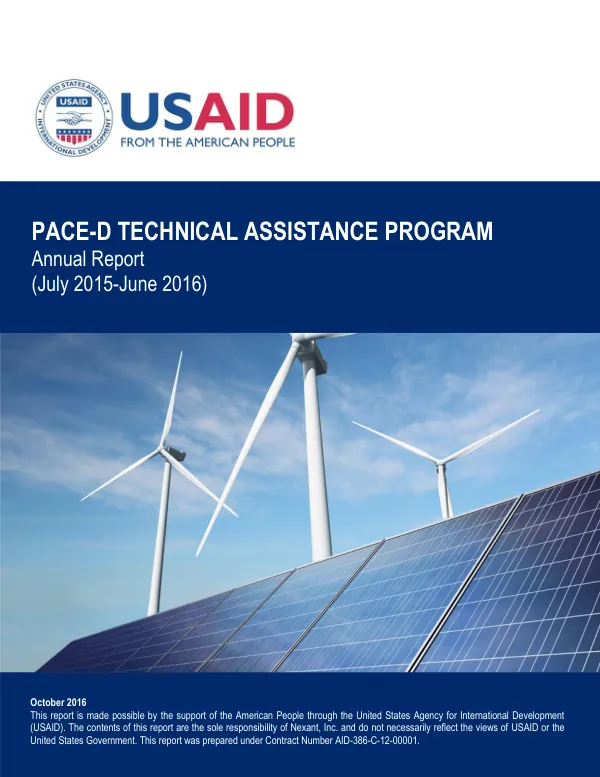
Annual Report July 2014-June 2015: PACE-D Technical Assistance Program
The PACE-D Technical Assistance Program is a partnership aimed at advancing clean energy deployment in India.
2015 · 95 pages
Sign in to readA free account is required to download.
Abstract
The program was established in 2012 and is funded by the United States Agency for International Development (USAID) under Contract No. AID-386-C-12-00001. The program's primary objective is to support the development of a robust clean energy market in India by providing technical assistance and capacity building to various stakeholders. Regulatory Partnership is one of the key achievements of the program. The partnership has facilitated the development of a regulatory framework that supports the deployment of energy-efficient technologies and renewable energy sources. The program has also worked closely with the Government of India to strengthen the policy and regulatory framework for energy efficiency and renewable energy deployment. Development Result 1: Energy Efficiency is a key focus area of the program. The program has supported the deployment of energy-efficient technologies through various interventions, including the development of energy-efficient appliances and the implementation of energy-efficient practices in industries. The program has also worked with financial institutions to develop innovative financing mechanisms for energy-efficient technologies. Development Result 2: Renewable Energy is another key focus area of the program. The program has supported the deployment of renewable energy technologies, including solar photovoltaic (PV) rooftop systems, rural pilots, and energy storage systems. The program has also worked with the Government of India to develop a policy and regulatory framework that supports the deployment of renewable energy sources. The program has made significant progress in achieving its objectives. The program has supported the deployment of energy-efficient technologies in various industries, including the cement and steel sectors. The program has also supported the development of renewable energy projects, including solar PV rooftop systems and rural pilots. The program has also worked with financial institutions to develop innovative financing mechanisms for energy-efficient technologies and renewable energy projects. The program has also made significant progress in capacity building and training. The program has provided training and capacity building to various stakeholders, including government officials, industry representatives, and financial institutions. The program has also developed a range of training materials and best practices manuals that have been widely disseminated. The program has also made significant progress in measurement and verification (M&V) of energy efficiency and renewable energy projects. The program has developed a range of M&V tools and methodologies that have been used to evaluate the performance of energy-efficient technologies and renewable energy projects. The program has also worked closely with various stakeholders, including government agencies, industry associations, and financial institutions. The program has also collaborated with other U.S. agencies and programs to leverage resources and expertise. The program has also made significant progress in administrative actions, including the management of sub-contracts and international deployment. The program has also made significant progress in changes in staff, including the recruitment of new staff members and the training of existing staff members. The program has also proposed a range of events and trainings for the next year, including knowledge sharing and outreach events, and training programs. The program has also developed a range of training materials and best practices manuals that will be widely disseminated. Overall, the PACE-D Technical Assistance Program has made significant progress in achieving its objectives and has contributed to the development of a robust clean energy market in India. The program's achievements and progress are a testament to the program's commitment to supporting the development of a clean energy market in India.
Related documents