USAID
Net Zero Energy Vision for Indian Railways
Indian Railways has embarked on an ambitious mission to reduce its energy consumption and produce greener energy.
2018 · 4 pages
Sign in to readA free account is required to download.
Abstract
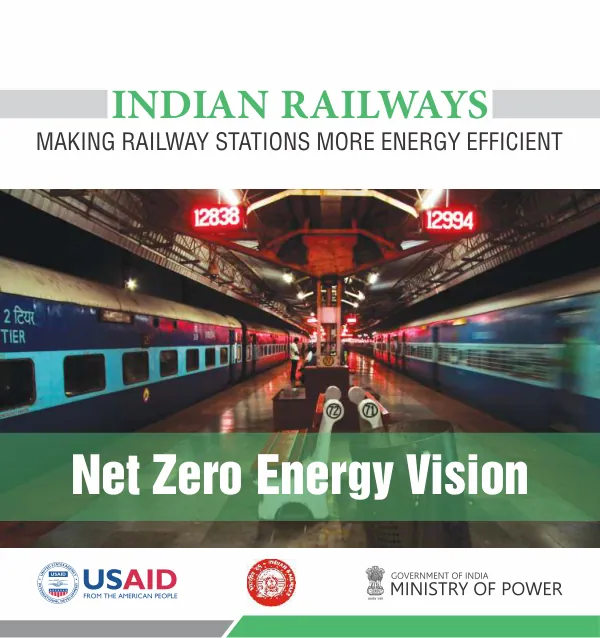
As part of its low-carbon growth strategy, the organization aims to decrease emission intensity by 33 percent over the next 15 years by improving rail traction energy and fuel efficiency. Additionally, Indian Railways plans to develop 1 GW of solar energy and 500 MW of wind power by 2020. To achieve these goals, Indian Railways has formulated energy efficiency plans to reduce its energy consumption, thereby reducing its energy bill by INR 5,000 crores over the next five years. The organization has notified energy consumption targets for all 16 zones across both traction and non-traction categories as part of the Perform, Achieve and Trade (PAT) scheme of the Bureau of Energy Efficiency. Energy audits have been conducted at various stations, workshops, and factories to identify potential interventions for energy conservation and efficiency improvement. The Electrical Energy Management Directorate of the Ministry of Railways has rolled out several guidelines for Zonal Railways to reduce energy intensity and electricity consumption. These guidelines include the installation of 100 percent LED lights at all railway buildings and installations, the use of 3-phase energy-efficient locomotives, and the implementation of net zero energy building concepts for new railway stations. The guidelines also emphasize the use of BEE Star-rated equipment in railway applications and the conduct of energy audits of large load centers to assess demand profiles and actual end-use to map energy consumption patterns. Indian Railways has also collaborated with the U.S.-India Partnership to Advance Clean Energy - Deployment Technical Assistance (PACE-D TA) Program to develop a net zero energy building (NZEB) vision for nearly 400 railway stations. The program has supported the development of guidelines for green and NZEB railway stations redevelopment, as well as the preparation of NZEB tender specifications and evaluation processes. The program has also organized roundtables and workshops for NZEB knowledge dissemination. The PACE-D TA Program is a six-year initiative led by the U.S. Agency for International Development and the U.S. Department of State, in partnership with the Ministry of Power and the Ministry of New and Renewable Energy. The program has focused on energy efficiency, renewable energy, and cleaner fossil technologies, with the aim of accelerating the deployment of clean energy, expanding U.S.-India trade and investment linkages, and facilitating knowledge exchange. In its sixth year, the program is accelerating rooftop solar deployment across eight states in India.