USAID
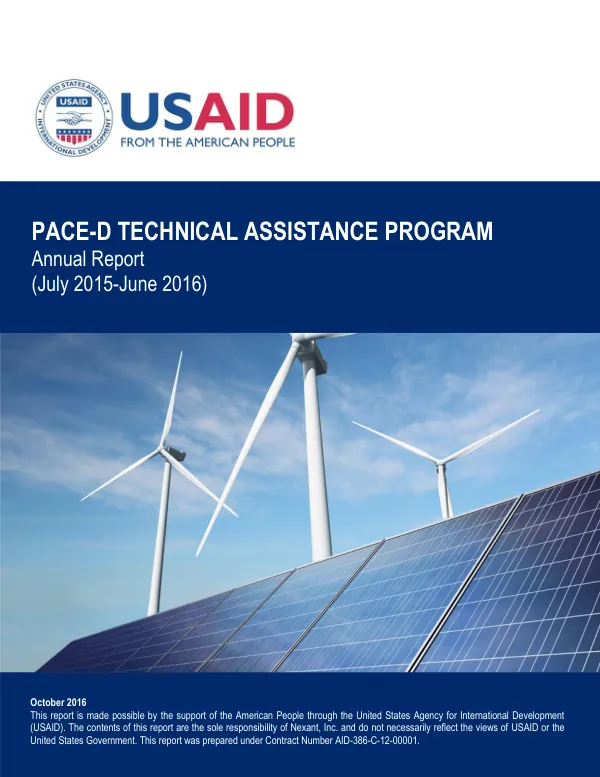
PACE-D Technical Assistance Program Annual Report July 2015-June 2016
The PACE-D Technical Assistance Program is a USAID-funded initiative aimed at promoting clean energy deployment in India.
2016 · 132 pages
Sign in to readA free account is required to download.
Abstract
The program's primary objective is to improve end-use energy efficiency, increase the supply of renewable energy, and accelerate the adoption of cleaner fossil technologies. The program's achievements during the period of July 2015 to June 2016 are documented in the annual report. Development Result 1 focuses on improved end-use energy efficiency through the deployment of energy efficiency technologies. Task 1, Market Driven Energy Efficiency Technology Deployment, involved the identification and promotion of energy-efficient technologies in the market. Task 2, Institutional Development and Strengthening of Policy Framework for EE Deployment, aimed to strengthen the policy framework for energy efficiency deployment at the state level. Task 3, Technical assistance and Capacity Building to Develop and Implement Innovative Financing Mechanisms, provided technical assistance to develop and implement innovative financing mechanisms for energy efficiency projects. Task 4, Capacity Building, Education, Training, Public Outreach Programs, focused on capacity building, education, and training for stakeholders involved in energy efficiency projects. Development Result 2 focused on increasing the supply of renewable energy through the scaling-up of renewable energy technologies. Task 1, Institutional Development and Strengthening of Policy and Regulatory Framework at the State Level for RE Deployment, aimed to strengthen the policy and regulatory framework for renewable energy deployment at the state level. Task 2, Market-driven RE technology Deployment, involved the promotion of renewable energy technologies in the market. Task 3, Technical Assistance and Capacity Building to Develop and Implement Innovative Finance Mechanisms, provided technical assistance to develop and implement innovative financing mechanisms for renewable energy projects. Task 4, Capacity Building, Training, Outreach, Dissemination and Sharing of Best Practices, focused on capacity building, training, and outreach for stakeholders involved in renewable energy projects. The program also implemented Development Result 3, which focused on the adoption and accelerated deployment of cleaner fossil technologies and management practices to achieve supply-side efficiency from existing fossil power generation. Task 1, Deployment of Cleaner Fossil Technology and Management Practice in Existing Plants, involved the deployment of cleaner fossil technologies and management practices in existing power plants. Task 2, Capacity Building, Training, Outreach, Dissemination and Sharing of Best Practices, focused on capacity building, training, and outreach for stakeholders involved in cleaner fossil technologies. The program's progress on the 5-year project implementation plan is also documented in the report. The report highlights the achievements of the program in terms of the development results, tasks, and indicators. The program's indicators, such as the number of energy-efficient technologies deployed, the amount of renewable energy generated, and the number of stakeholders trained, are also presented in the report. The program's management structure and administrative actions are also documented in the report. The report highlights the contractual issues, status of contract deliverables, administrative actions, and status of sub-contracts. The program's international deployment, changes in staff, and proposed events and trainings for the next year are also presented in the report. The report also includes a list of acronyms used in the document, which provides a reference for readers unfamiliar with the terminology used in the report. The acronyms include definitions for organizations, programs, and technologies related to energy efficiency and renewable energy.
Related documents