USAID DEC
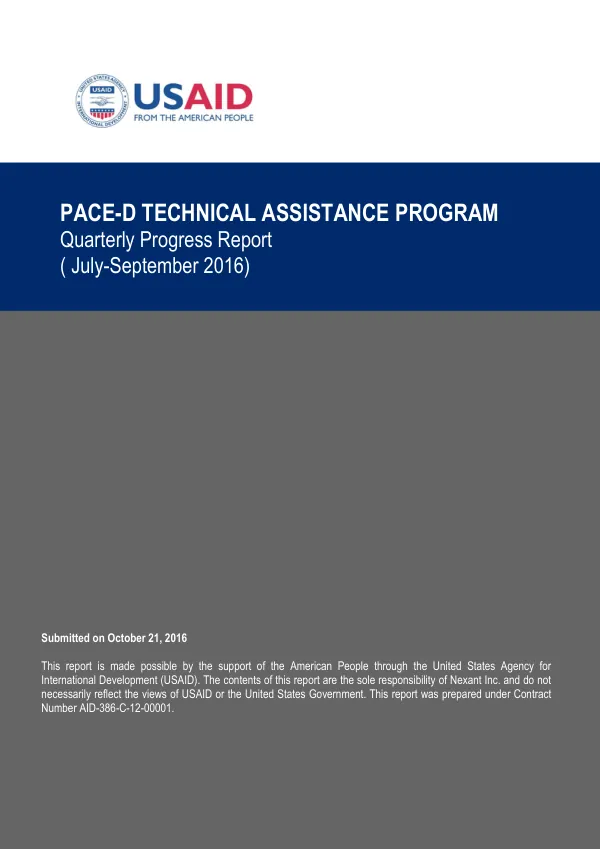
Quarterly Progress Report (July–September 2016): PACE-D Technical Assistance Program
Sign inUSAID
Quarterly Progress Report (July–September 2016): PACE-D Technical Assistance Program
The PACE-D Technical Assistance Program is a collaborative effort between the United States Agency for International Development (USAID) and Nexant Inc.
2016 · 103 pages
Sign in to readA free account is required to download.
Abstract
to promote the adoption of clean energy technologies in India. The program aims to improve end-use energy efficiency, increase the supply of renewable energy, and accelerate the deployment of cleaner fossil technologies. The program is focused on five key development results, including improved end-use energy efficiency, increased supply of renewable energy, and adoption of cleaner fossil technologies. To achieve these results, the program is implementing a range of tasks, including market-driven energy efficiency technology deployment, institutional development and strengthening of policy frameworks, and capacity building and training programs. In the July-September 2016 quarter, the program made significant progress in achieving its development results. The market-driven energy efficiency technology deployment task saw the deployment of energy-efficient technologies in several states, including Andhra Pradesh and Karnataka. The institutional development and strengthening of policy frameworks task resulted in the development of a best practices guide for energy efficiency in buildings. The program also made progress in increasing the supply of renewable energy. The institutional development and strengthening of policy and regulatory frameworks at the state level for renewable energy deployment task resulted in the development of a detailed project report for a renewable energy project in the state of Rajasthan. The market-driven renewable energy technology deployment task saw the deployment of renewable energy technologies in several states, including Gujarat and Madhya Pradesh. In addition to these achievements, the program also made progress in adopting and accelerating the deployment of cleaner fossil technologies and management practices. The deployment of cleaner fossil technology and management practice in existing plants task saw the deployment of cleaner fossil technologies in several power plants in India. The program also conducted several knowledge-sharing and outreach events, including a training program on energy efficiency in buildings. The program also established baselines for monitoring and evaluation, and maximized the use of local partners and enhanced their capacity. The program's progress was also reflected in the achievements of its partners, including the Indian Renewable Energy Development Agency Limited (IREDA) and the Energy Efficiency Services Limited (EESL). These partners played a key role in the program's achievements, including the deployment of energy-efficient technologies and the development of renewable energy projects. Overall, the PACE-D Technical Assistance Program made significant progress in achieving its development results in the July-September 2016 quarter. The program's achievements demonstrate its commitment to promoting the adoption of clean energy technologies in India and improving energy efficiency and security in the country. The program's progress was also reflected in the development of several key documents, including the best practices guide for energy efficiency in buildings and the detailed project report for a renewable energy project in the state of Rajasthan. These documents provide valuable insights into the program's achievements and the challenges it faced in implementing its development results. The program's achievements also demonstrate its commitment to transparency and accountability. The program's quarterly progress report provides a detailed account of its achievements and the challenges it faced in implementing its development results. The report also provides information on the program's budget and expenditure, and its plans for the next quarter. Overall, the PACE-D Technical Assistance Program is a significant initiative that aims to promote the adoption of clean energy technologies in India. The program's achievements demonstrate its commitment to improving energy efficiency and security in the country, and its progress provides valuable insights into the challenges and opportunities of promoting clean energy technologies in India.
Related documents