FUNDACIÓN IDEAS PARA LA PAZ
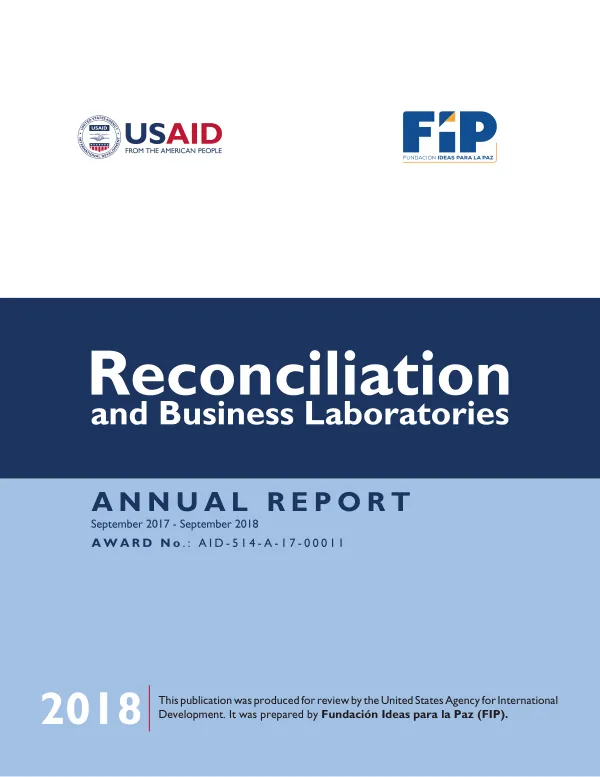
Annual Report: Reconciliation and Business Laboratories
The Laboratories project, implemented by Fundación Ideas para la Paz, aims to contribute to the transformation of relationships between the business sector and its stakeholders in specific Colombian regions.
2018 · 73 pages
Sign in to readA free account is required to download.
Abstract
The project's main objective is to strengthen peacebuilding processes at the regional level by fostering dialogue and conflict resolution between local actors and the business sector. The project is structured upon three components: Training, Dialogue, and Cooperation, and is premised upon Theory of Change and People to People approaches. The project started in September 2017 in three Colombian regions: Buenaventura-Valle del Cauca, Buriticá-Antioquia, and Cañón del Porce-Antioquia. These regions have witnessed conflicts and tensions between business and local actors. During the first year of implementation, the project worked directly with 265 participants, formally called Laboratories' associates. The budget for the project includes USD$1,440,898, with USD$1,380,061 provided by USAID and USD$60,837 cost-shared by FIP. The project's context analysis highlights the internal armed conflict in Colombia, which has left more than 8 million victims. The conflict emerged due to various factors, including land use and ownership, restrictions on political participation, and the relationship between violence and politics. The State's fragility has contributed to the proliferation of illegal armed actors and the consolidation of institutions, identities, and norms revolving around the dynamics of war. To address the problem of political violence, the State launched several peace initiatives, including negotiations with guerrilla groups and paramilitary groups. The project's Theory of Change and People to People approaches aim to facilitate the development of a dialogue strategy between actors involved and foster conflict resolution. The project also seeks to promote meeting and dialogue spaces between parties to create more robust peacebuilding conditions. The project's implementation has focused on training, dialogue, and cooperation, with a budget of USD$516,043 spent during the first year of implementation. The project's geographic coverage includes the regions of Buenaventura-Valle del Cauca, Buriticá-Antioquia, and Cañón del Porce-Antioquia. The project's reporting period is from September 2017 to September 2018. The project's main findings and achievements during the first year of implementation include the direct work with 265 participants, the development of a dialogue strategy, and the facilitation of meeting and dialogue spaces between parties. The project's cross-cutting activities include a Gender and Social Inclusion Strategy, which aims to promote the participation of women and other marginalized groups in the project's activities. The project also has an Environmental Compliance component, which aims to ensure that the project's activities do not harm the environment. The project's Monitoring and Evaluation component aims to track the project's progress and outcomes, while the Communications and Dissemination component aims to share the project's findings and achievements with stakeholders. The project's sustainability is ensured through the development of a Theory of Change and People to People approaches, which aim to facilitate the development of a dialogue strategy between actors involved and foster conflict resolution. The project's implementation has focused on training, dialogue, and cooperation, with a budget of USD$516,043 spent during the first year of implementation. The project's geographic coverage includes the regions of Buenaventura-Valle del Cauca, Buriticá-Antioquia, and Cañón del Porce-Antioquia. The project's challenges and opportunities include the need to address the underlying conflicts associated with land distribution, different developmental models, and the use of land and subsoil. The project's lessons learned include the importance of citizen participation as a key force for change and the need to promote a new relationship between Colombia's regions, the State, and other actors. The project's next year planned activities include the continuation of the project's implementation in the three regions, with a focus on training, dialogue, and cooperation.
Related documents