FUNDACIÓN IDEAS PARA LA PAZ
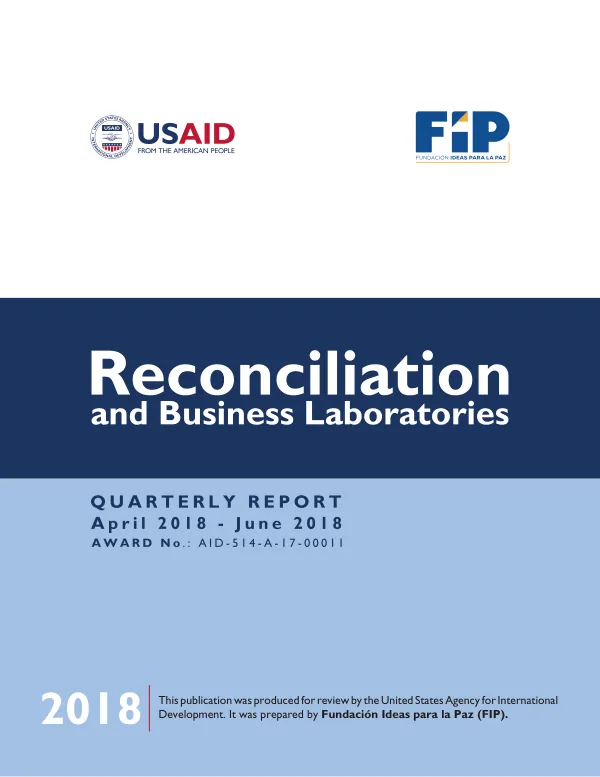
Quarterly Report Summary: Reconciliation and Business Laboratories
The Reconciliation and Business Laboratories project, also known as R&B Labs, is a project funded by the United States Agency for International Development (USAID) and implemented by Fundación Ideas para la Paz (FIP) to transform relationships between the private sector, local authorities, and communities in Colombia.
2018 · 54 pages
Sign in to readA free account is required to download.
Abstract
The project aims to contribute to the transformation of relationships between local actors around an economic event or activity, and to strengthen peacebuilding processes at the regional level. The project focuses on three regions in Colombia: Buenaventura-Valle del Cauca, Buriticá-Antioquia, and Porce Canyon-Antioquia. The project's main objective is to promote favorable conditions for peacebuilding in Colombia by addressing tensions over economic and social development models, and by strengthening peacebuilding processes at the regional level. The project is structured upon three components: dialogue strategy, trust measuring instrument, and training component. The dialogue strategy involves developing a dialogue strategy between actors involved, which contributes to conflict resolution. The trust measuring instrument is used to measure trust levels among actors, and the training component involves training local actors on conflict resolution and peacebuilding. In the Buriticá region, the project team completed the recruitment of associates from local authorities, business sector, and communities between March and June 2018. The team also opened an office in the town to facilitate the implementation of the project and carried out the first workshops called Rela-torios as part of the Laboratories' regional diagnosis component. The workshops aimed to initiate the Laboratories and enrich information about the ways in which actors from different sectors perceive relations between each other. The project team also implemented the trust measuring instrument to more than 200 beneficiaries from the three regions and all actors. The instrument measures trust levels among actors and provides insights into the drivers of trust. The project team completed the second team training and started the implementation of the Gender and Social Inclusion strategy. The project's context analysis highlights the internal armed conflict in Colombia, which has left more than 8 million victims. The conflict has emerged out of a panoply of different factors, including issues of land use and its ownership, restrictions on political participation, the relationship between violence and politics, drug trafficking, ideological strife, and the fragility of the Colombian State. The project aims to address these factors and promote favorable conditions for peacebuilding in Colombia. The project's geographic coverage includes Buenaventura-Valle del Cauca, Buriticá-Antioquia, and Porce Canyon-Antioquia. The project's reporting period is April-June 2018, and the project started on September 26, 2017. The project's prime implementing partner is Fundación Ideas para la Paz, and the contract/agreement number is AID-514-A-17-00011. The project's progress report highlights the completion of the recruitment of associates, the opening of an office in the town, and the implementation of the trust measuring instrument. The report also highlights the challenges faced by the project, including the involvement of EPM's employees as associates of the project. The report provides insights into the project's activities, outcomes, and lessons learned. The project's monitoring and evaluation plan involves the use of the trust measuring instrument to measure trust levels among actors. The plan also involves the use of other instruments, including the Rela-torios workshops and the Gender and Social Inclusion strategy. The plan aims to provide insights into the project's outcomes and impact. The project's environmental compliance involves the implementation of measures to minimize the project's environmental impact. The project's communication and dissemination plan involves the use of various channels to disseminate information about the project's activities and outcomes. The project's program management and administrative issues involve the management of the project's budget, personnel, and logistics. The project's next quarter planned activities involve the continuation of the project's activities, including the implementation of the trust measuring instrument and the training component. The project's financial reporting involves the submission of financial reports to USAID. The project's annexes include information about the project's activities, outcomes, and lessons learned. The annexes also include information about the project's budget, personnel, and logistics.