USAID DEC
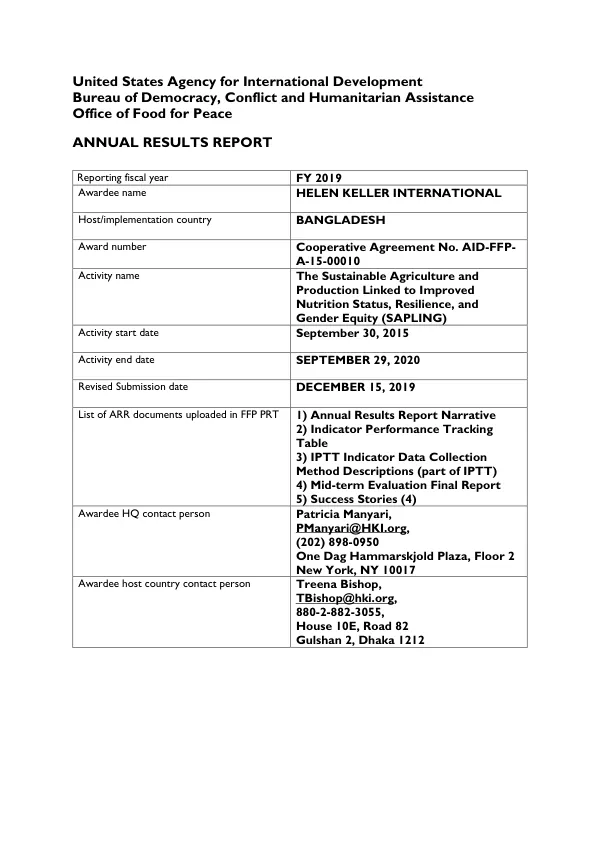
Annual Results Report FY 2019: The Sustainable Agriculture and Production Linked to Improved Nutrition Status, Resilience, and Gender Equity (SAPLING) Project in Bangladesh
Sign inCATHOLIC RELIEF SERVICES ORGANIZATION
Annual Results Report FY 2019: The Sustainable Agriculture and Production Linked to Improved Nutrition Status, Resilience, and Gender Equity (SAPLING) Project in Bangladesh
The Sustainable Agriculture and Production Linked to Improved Nutrition Status, Resilience, and Gender Equity (SAPLING) project is implemented in the Chittagong Hill Tracts (CHT) region of Bangladesh, focusing on five upazilas of Bandarban District.
2019 · 33 pages
Sign in to readA free account is required to download.
Abstract
The project is a consortium effort with Helen Keller International (HKI) as the lead, responsible for maternal and child health and nutrition, gender equality and social inclusion, and environment. Catholic Relief Services (CRS) leads on disaster management, water, sanitation and hygiene, local capacity building, and Savings and Internal Lending Communities (SILC). iDE is the lead on Income Generating Activities (IGA), and Caritas Bangladesh provides administrative support in three upazilas and technical oversight on WASH, DM, and SILC in all five. SAPLING operationalizes its theory of change through three purposes: 1) Increased income and access to nutritious foods attained more equitably by both women and men; 2) Improved nutrition and health status of children under five years of age, pregnant and lactating women, and adolescent girls; and 3) Improved ability of households, communities, and systems to mitigate, adapt to, and recover from human-induced and natural shocks and stressors. The project's interventions involve Integrated Enhanced Homestead Food Production (IEHFP), Income Generating Activities (IGAs), SILC, maternal and child health and nutrition (MCHN), and disaster risk management (DRM). Local capacity building, water, sanitation and hygiene (WASH), gender equality and social inclusion (GESI), and natural resource management (NRM) are integrated throughout SAPLING's activities. In the Chittagong Hill Tracts, women have limited decision-making power, assets, and confidence compared to men. SAPLING's interventions primarily target women to provide them with knowledge and skills to improve their ability to earn and save income, produce nutritious food, and protect themselves from shocks and stressors. The project also focuses on youth, recognizing their potential as a force for country development. SAPLING has initiated activities such as adolescent girls' groups, first responder youth, and high school volunteers in collaboration with the Bangladesh Red Crescent Society (BDRCS) and Forest Management Brigades (FMB). In fiscal year 2019, SAPLING implemented activities in 1,579 paras (villages), both pourashovas (municipalities), and all 104,331 unique participants exceeded the life of award (LOA) target of 87,304. The project exceeded its target through efforts to increase participation in programmatic interventions, including vitamin A supplementation campaigns, re-enrollment of IEHFP, training of disaster management volunteers, and IGA opportunities for men based on mid-term evaluation recommendations. SAPLING's multi-year implementation strategies produced marked success in FY19, with annual results meeting or exceeding targets in several areas, including increased income and access to nutritious foods, improved nutrition and health status, and improved disaster risk management. The project's interventions have improved the lives of thousands of people in the Chittagong Hill Tracts, particularly women and youth.
Related documents
Documents in this collection
 2020
2020USAID DEC
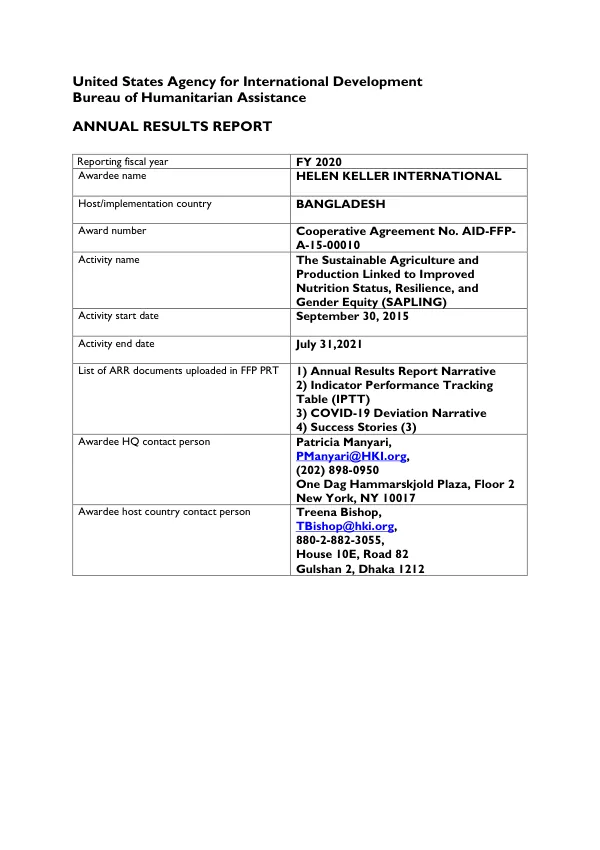
Annual Results Report FY 2020: The Sustainable Agriculture and Production Linked to Improved Nutrition Status, Resilience, and Gender Equity (SAPLING) Development Food Security Activity
Open record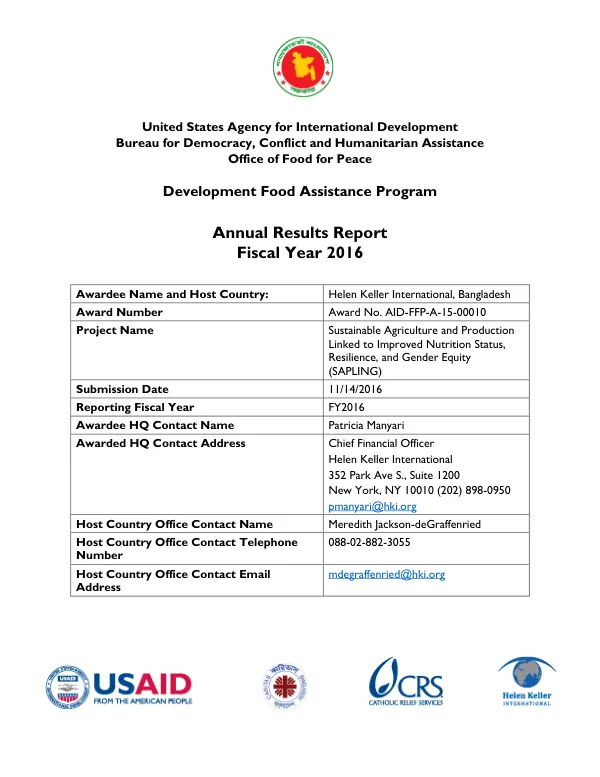 2016
2016USAID DEC