USAID DEC
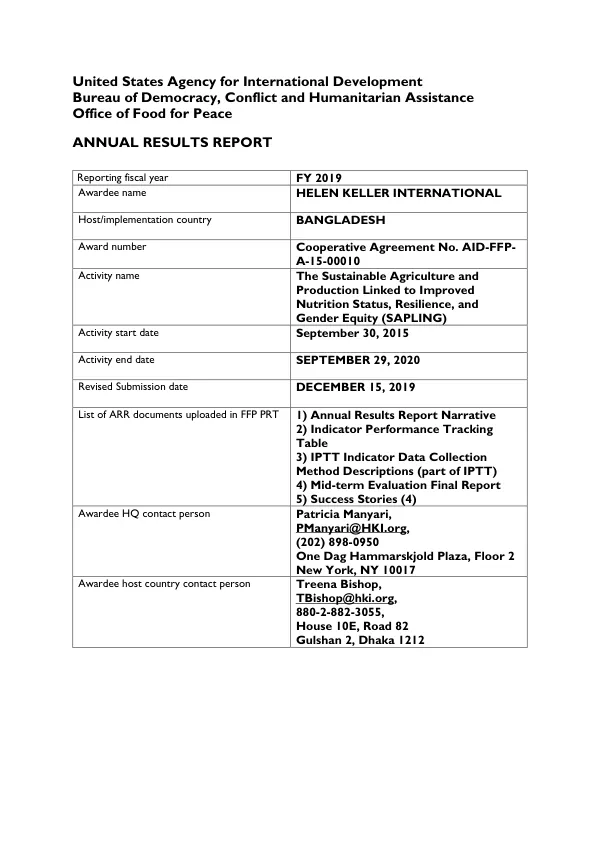
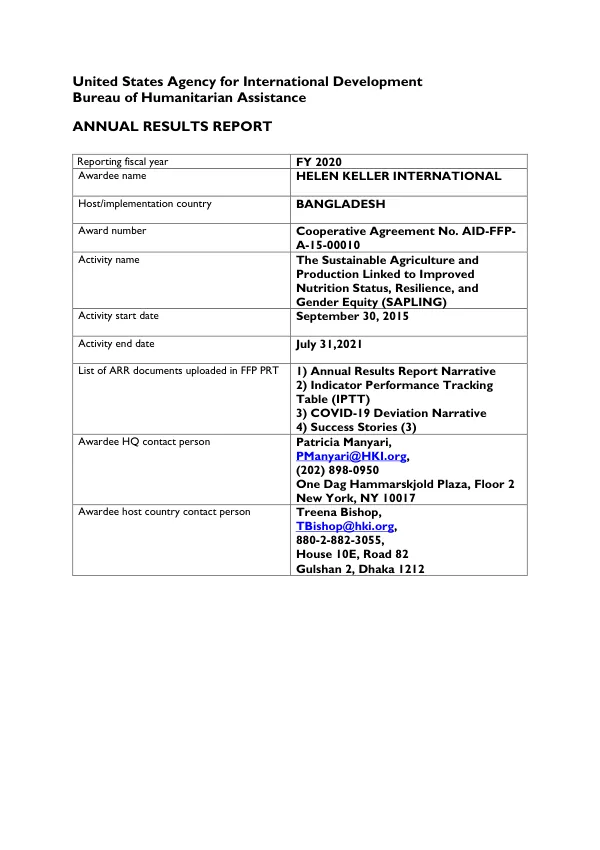
Annual Results Report: Sustainable Agriculture and Production Linked to Improved Nutrition Status, Resilience, and Gender Equity (SAPLING)
Sign inCATHOLIC RELIEF SERVICES ORGANIZATION
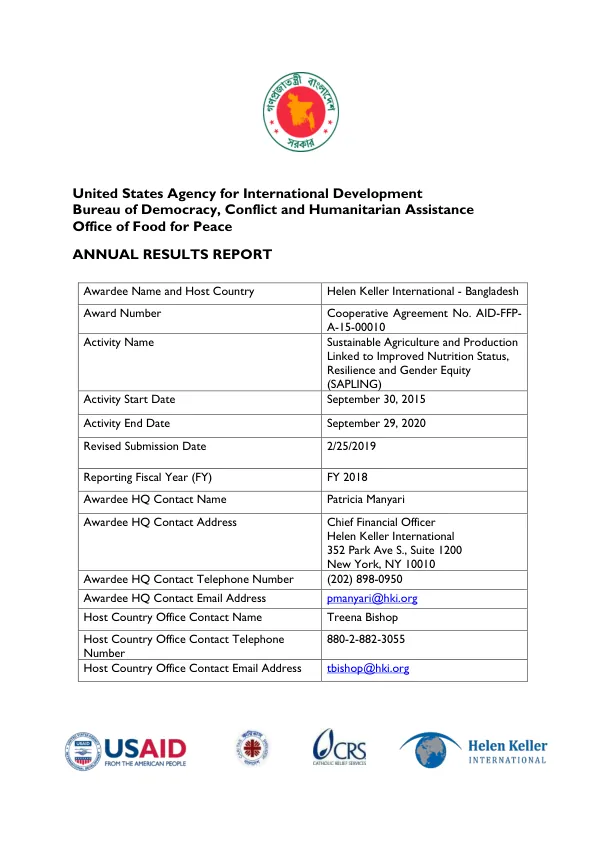
Annual Results Report: Sustainable Agriculture and Production Linked to Improved Nutrition Status, Resilience, and Gender Equity (SAPLING)
The Sustainable Agriculture and Production Linked to Improved Nutrition Status, Resilience, and Gender Equity (SAPLING) project is a USAID-funded initiative implemented in the Chittagong Hill Tracts (CHT) region of Bangladesh.
2019 · 26 pages
Sign in to readA free account is required to download.
Abstract
The project aims to improve gender equitable food security, nutrition, and resilience of people in the region, focusing on five upazilas of Bandar District. SAPLING is implemented through a consortium approach, with Helen Keller International (HKI) responsible for overall vision and management, and Catholic Relief Services (CRS) as the strategic lead on disaster risk management, water, sanitation, and hygiene. The project has three main purposes: to increase income and access to food equitably by women and men, to improve the nutritional status of children under five, pregnant and lactating women, and adolescent girls, and to sustain gender equitable ability of people, households, communities, and systems to mitigate, adapt to, and recover from human-induced and natural shocks and stresses. SAPLING will reach its goal through multiple pathways that build livelihoods assets, improve health and nutrition, and disaster risk management. The project involves integrated enhanced homestead food production, income-generating activities, savings and internal lending communities, maternal and child health and nutrition, and disaster risk management. Local capacity building, water, sanitation, and hygiene, and gender equity and natural resource management are also mainstreamed through integrated implementation. In FY18, SAPLING carried out household-level activities in 1579 villages in 24 unions, reaching 71,396 unique participants, with 48% identified as poor and 47% as extreme poor. The participants were predominantly women, with 21% being pregnant or lactating, 14% under two years old, 21% adolescent girls, 2% youth, and 2% men. The project has made significant progress toward its outcomes, despite the complexity of the post-conflict context. The project's theory of change posits that sustainable improvements in agricultural production for both profit and home consumption, combined with women's increased participation in on- and off-farm income-generating activities, will increase household access to income, availability of nutritious foods, and contribute to women's decision-making within the household, thereby achieving gender equitable food security. The project's interventions aim to improve nutrition knowledge and practices, increase preparedness and protection, and enhance the functionality of government and private sector service providers. SAPLING's interventions improve resilience capacities, leading to reduced vulnerabilities to shocks and stressors and increased utilization of nutritious foods and essential services. The project's activities are designed to build on existing capacities and strengthen linkages to markets, increasing household access to income and availability of nutritious foods. The project's focus on gender equity and women's empowerment is critical to achieving its outcomes, as women's participation in on- and off-farm income-generating activities is essential to increasing household income and improving nutrition. The project's progress toward its outcomes is significant, with significant increases in household income and access to nutritious foods. The project's interventions have also improved nutrition knowledge and practices, increased preparedness and protection, and enhanced the functionality of government and private sector service providers. Despite the complexity of the post-conflict context, SAPLING has made significant progress toward its outcomes, and its interventions are expected to continue to improve the lives of people in the Chittagong Hill Tracts region. SAPLING's approach to building resilience capacities is critical to achieving its outcomes, as it addresses the root causes of vulnerability to shocks and stressors. The project's focus on gender equity and women's empowerment is also essential to achieving its outcomes, as women's participation in on- and off-farm income-generating activities is critical to increasing household income and improving nutrition. The project's interventions are designed to be sustainable, with a focus on building on existing capacities and strengthening linkages to markets. The project's progress toward its outcomes is significant, with significant increases in household income and access to nutritious foods. The project's interventions have also improved nutrition knowledge and practices, increased preparedness and protection, and enhanced the functionality
Related documents
Documents in this collection
 2018
2018USAID DEC
Annual Results Report: Sustainable Agriculture and Production Linked to Improved Nutrition Status, Resilience, and Gender Equity (SAPLING)
Open record 2016
2016USAID DEC