USAID DEC
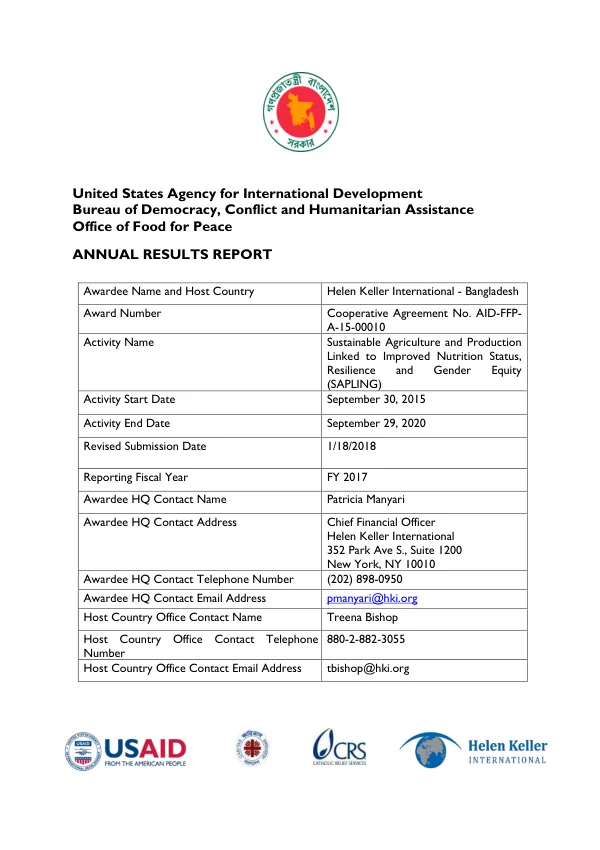
Annual Results Report: Sustainable Agriculture and Production Linked to Improved Nutrition Status, Resilience, and Gender Equity (SAPLING)
Sign inCATHOLIC RELIEF SERVICES ORGANIZATION
Annual Results Report: Sustainable Agriculture and Production Linked to Improved Nutrition Status, Resilience, and Gender Equity (SAPLING)
The Sustainable Agriculture and Production Linked to Improved Nutrition Status, Resilience, and Gender Equity (SAPLING) activity is a five-year Development Food Security Activity (DFSA) pilot project funded by the United States Agency for International Development (USAID).
2018 · 30 pages
Sign in to readA free account is required to download.
Abstract
The project aims to improve gender equitable food security, nutrition, and resilience of vulnerable people in the Chittagong Hill Tracts (CHT) region of Bangladesh. The project is being implemented in the upazilas of Bandarban Sadar, Ruma, Lama, Rowangchari, and Thanchi of the Bandarban District through a consortium approach. The project has three purposes: P1, Increased income and access to nutritious foods attained equitably by both women and men; P2, Improved nutritional status of children under five years of age, pregnant and lactating women, and adolescent girls; and P3, Sustained gender equitable ability of people, households, communities, and systems to mitigate, adapt to and recover from human-induced and natural shocks and stresses. Helen Keller International (HKI) is responsible for program results, budget, representation, strategic vision, management, compliance, and quality control, while Catholic Relief Services (CRS) provides strategic direction and oversight of disaster risk management, water, sanitation, and hygiene, local capacity building, and Savings and Internal Lending Communities. The project's household census and participant identification process has been conducted in 1,609 paras out of 1,645 paras within the five target upazilas, identifying a total of 58,851 households with 274,192 individuals in the target area. Participatory wealth ranking identified 40% of these households as poor and an additional 38% as extreme poor, totaling 78% either poor or extreme poor. The census data also revealed that 6% of the total population were pregnant or lactating, 7% were children under two, and 11% were adolescent girls. The project's theory of change posits that sustainable improvements in agricultural production for both profit and home consumption and women's increased participation in on- and off-farm income-generating activities, combined with stronger linkages to markets, will increase household access to income, the availability of and access to nutritious foods, and contribute to women's increased decision-making within the household. Project activities promote improved nutrition and hygiene knowledge and practices and increase household preparedness and protection of assets, as well as strengthen the functionality of government and private sector service providers. The livelihoods strategy for SAPLING aims to make households more resilient with increased income, increased access to and availability of nutritious foods, increased access to markets, more diversified assets, better disaster preparedness, and improved skills for planning, budgeting, and achieving goals. Within this strategy, gender transformative activities support women's empowerment as part of the overall household empowerment. Helping men to achieve goals, to respect and value the contributions of women in the household and community, and to change attitudes about men's and women's roles in productive and reproductive activities in the household is critical to success. The project's interventions began in Fiscal Year 2017 and will contribute to meeting the overall theory of change goals. The project's results will be presented below, highlighting the progress made towards achieving the project's purposes and overall goals. The project's implementation is being carried out through a consortium approach, with Helen Keller International as the technical lead on maternal and child health and nutrition, livelihoods, gender, and environment, and Catholic Relief Services providing strategic direction and oversight of disaster risk management, water, sanitation, and hygiene, local capacity building, and Savings and Internal Lending Communities. The livelihoods strategy for SAPLING aims to make households more resilient with increased income, increased access to and availability of nutritious foods, increased access to markets, more diversified assets, better disaster preparedness, and improved skills for planning, budgeting, and achieving goals. Within this strategy,
Related documents
Documents in this collection
 2020
2020USAID DEC
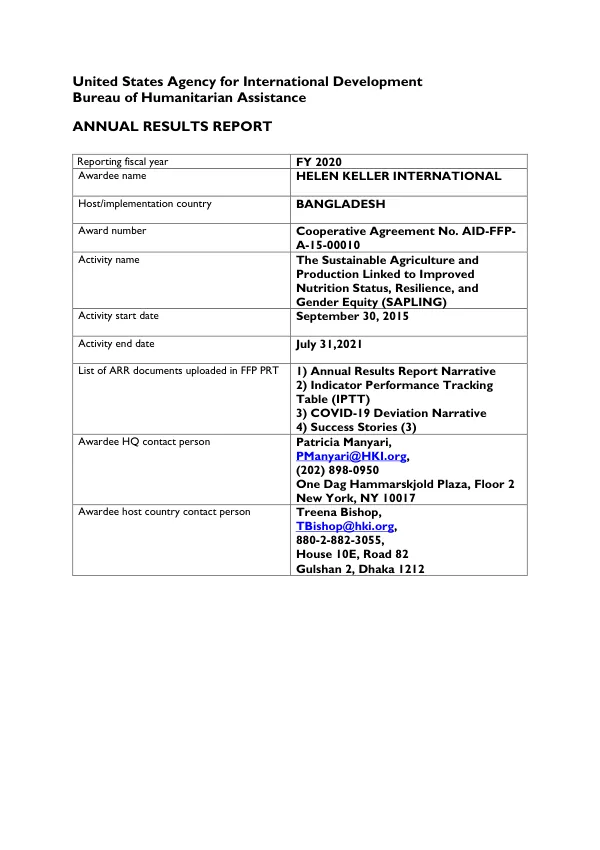
Annual Results Report FY 2020: The Sustainable Agriculture and Production Linked to Improved Nutrition Status, Resilience, and Gender Equity (SAPLING) Development Food Security Activity
Open record 2019
2019USAID DEC