THE NATURE CONSERVANCY
Endangered Ecosystems of Tanzania Final Project Report
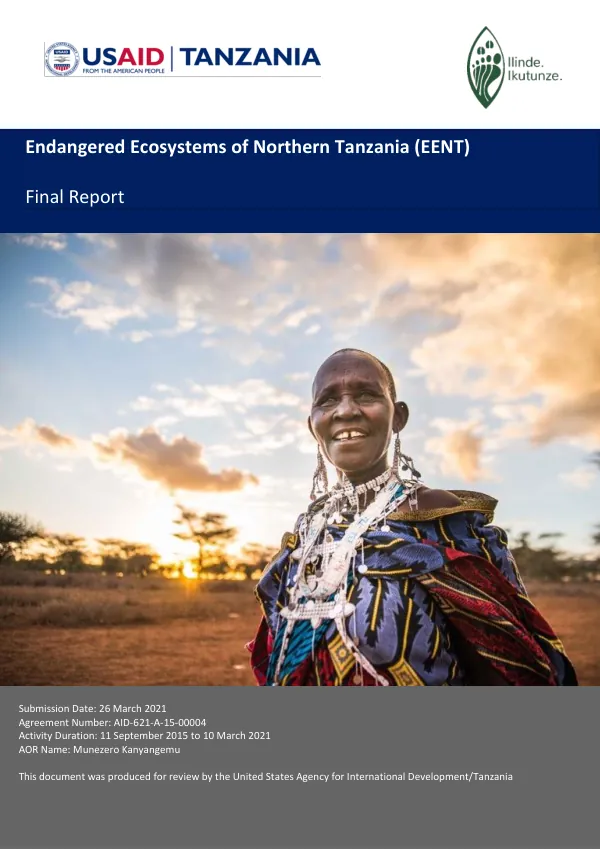
Endangered Ecosystems of Northern Tanzania (EENT) Final Report The EENT project, implemented by The Nature Conservancy, aimed to conserve and protect the rangelands of Northern Tanzania.
2021 · 90 pages
Sign in to readA free account is required to download.
Abstract
The project was funded by the United States Agency for International Development (USAID) and ran from September 2015 to March 2021. The project's primary goal was to address the threats facing the rangelands, including overgrazing, habitat fragmentation, and human-wildlife conflict. The project focused on three key strategies: Strategy I, which aimed to improve rangeland health through sustainable grazing practices and habitat restoration; Strategy II, which focused on enhancing rangeland governance through community-led conservation and land-use planning; and Strategy III, which sought to promote coordination and collaboration among stakeholders to catalyze change. The project achieved significant results, including a 27% increase in rangeland cover and a 25% reduction in bare ground areas. The project also supported the establishment of community conservation banks, which provided financial incentives for landowners to adopt sustainable land-use practices. Additionally, the project facilitated the development of a rangeland management plan, which was endorsed by local authorities and stakeholders. The project also conducted several assessments and studies, including a University of York study on the impacts of climate change on rangeland ecosystems and a Savannas Forever Tanzania study on the effectiveness of holistic grazing management. The project's findings and recommendations were shared on USAID platforms and with local stakeholders. The project's value added was significant, with USAID's five-year support contributing to the development of a robust results framework, the establishment of a rangeland management plan, and the creation of a community conservation bank. The project also demonstrated the importance of integrating cross-cutting topics, such as climate change and human-wildlife conflict, into conservation efforts. The project's success stories include the development of artisanal leather crafts in the Maasai Steppe, which provided a unique and sustainable income-generating activity for local women. The project also supported the implementation of holistic grazing management in Kitwai B, which improved rangeland health and reduced human-wildlife conflict. The project's lessons learned highlight the importance of community engagement, collaboration, and coordination in achieving conservation goals. The project also demonstrated the need for flexible and adaptive project design, as well as the importance of integrating cross-cutting topics into conservation efforts. The project's results framework, which was developed in collaboration with local stakeholders, provided a clear and measurable approach to achieving conservation goals. The framework included indicators for rangeland health, governance, and coordination, as well as targets for reducing human-wildlife conflict and improving livelihoods. The project's geographic focus was on the rangelands of Northern Tanzania, with a particular emphasis on the Maasai Steppe and the Kitwai B area. The project's timeframes were from September 2015 to March 2021, with a focus on achieving short-term and long-term conservation goals. Overall, the EENT project demonstrated the importance of collaborative conservation efforts and the need for flexible and adaptive project design. The project's results and lessons learned provide valuable insights for future conservation efforts in Northern Tanzania and beyond.