COASTAL RESOURCES CENTER
Anti-Child Labor and Trafficking Radio Dialogue Program
The Sustainable Fisheries Management Project (SFMP) in Ghana aims to rebuild targeted marine fisheries stocks through the adoption of sustainable fishing practices and exploitation levels.
2016 · 10 pages
Sign in to readA free account is required to download.
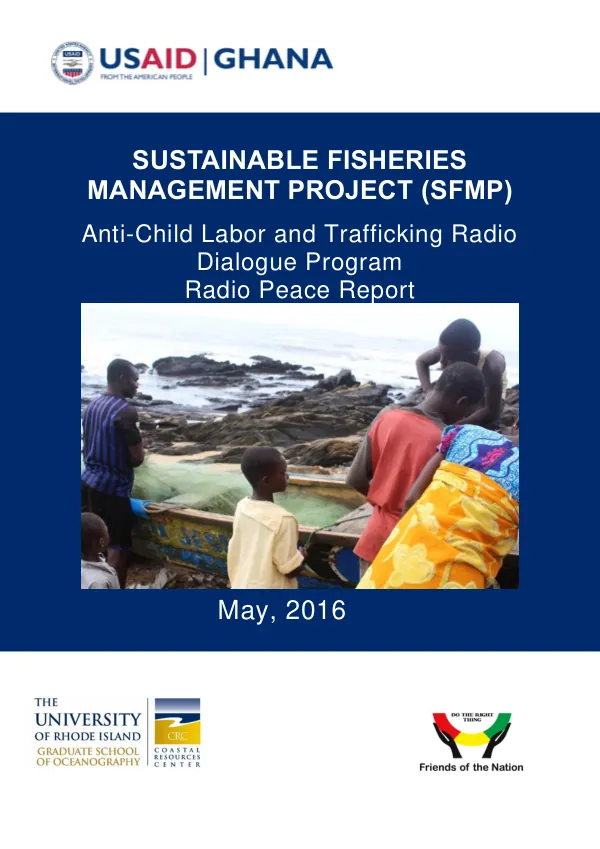
Abstract
The project focuses on small pelagic fisheries management along the entire coastal stretch of Ghana, seeking to rebuild the fishery, which is near collapse. Ghana's fishing industry is crucial to the local economy, directly employing about 135,000 fishers in the marine capture sub-sector, with 92% being artisanal fishers. An estimated 27,000 women are involved in fish processing and marketing. The SFMP seeks to work closely with the Government of Ghana (GOG) through the Ministry of Fisheries and Aquaculture Development (MoFAD) under the World Bank-funded fisheries project, as well as with the Fisheries Commission (FC), to revamp the sector. The project also contributes to the GOG's agriculture and fisheries development goals and the USAID's Feed the Future (FtF) development objectives to reduce poverty and hunger. Furthermore, the SFMP aims to reduce Child Labor and Trafficking (CLaT) and promote Behavioral Change Communications (BCC) to make CLaT practices socially unacceptable. A series of radio programs were organized by Friends of the Nation (FoN) as part of the BCC efforts. One such radio program was held on Wednesday, May 18, 2016, in Winneba on Radio Peace, a local FM station. The radio discussion took the form of a panel interview and discussion, moderated by a presenter at the Radio station. The Fante language was used during the radio discussions to enable local fisher folks to understand the content. The panelists included Madam Leticia Dampson, a community sustainable fisheries advocate affiliated with the Development Action Association (DAA); Ms. Esi Harrison, a teacher and a community anti-CLaT advocate; and Mr. Kwesi Randolph Johnson, a Project Officer with FoN. The discussions started with the background of the fisheries sector and zoomed in on Child Labor and Trafficking (CLaT). Scenarios in relation to fisheries and CLaT were cited to deepen the understanding of listeners to appreciate the issues discussed. The radio program provided an overview of the Sustainable Fisheries Management Project (SFMP), the background of Ghana's fisheries, and discussions on Child Labor and Trafficking (CLaT), including its definition, causes/drivers, types of anti-CLaT interventions, and what the law says about CLaT. The radio program also highlighted the work of Friends of the Nation (FoN) in addressing CLaT. The program aimed to raise awareness about the issue of CLaT in the fisheries sector and promote behavioral change among listeners. The SFMP's efforts to reduce CLaT and promote sustainable fishing practices are crucial to rebuilding the fishery and supporting the livelihoods of fishers in Ghana.