FAMILY HEALTH INTERNATIONAL
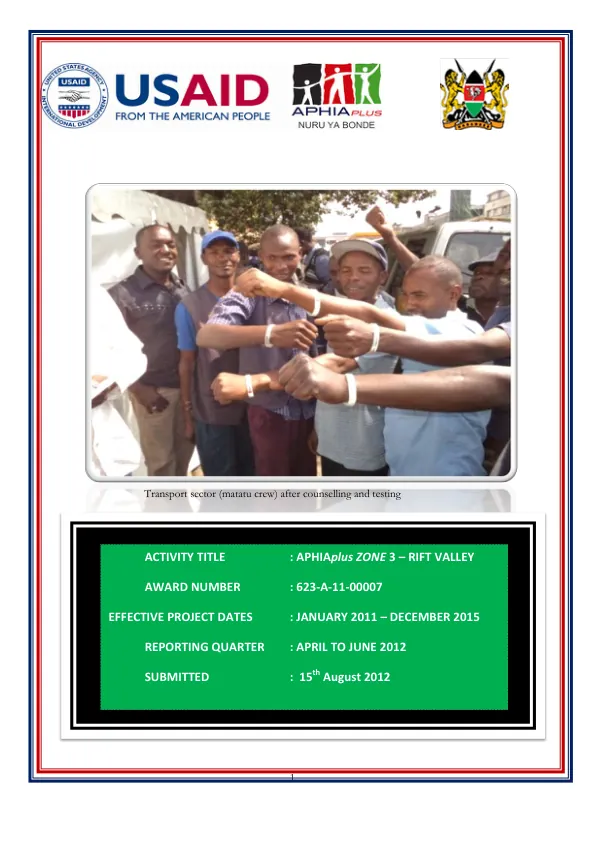
APHIAplus ZONE 3 – RIFT VALLEY Final Report
APHIAplus Zone 3 – Rift Valley is a project funded by the United States Agency for International Development (USAID) under award number 623-A-11-00007.
2012 · 70 pages
Sign in to readA free account is required to download.
Abstract
The project's effective dates are January 2011 to December 2015, with reporting quarter April to June 2012. The project's primary focus is on improving health service delivery in the Rift Valley region of Kenya. The project's contribution to health service delivery is multifaceted, with a focus on increasing the availability and quality of high-impact interventions at community and health facility levels. This includes improving the capacity of public sector facilities to provide reliable and consistent high-quality services, increasing the capacity of district health management teams to plan and manage service delivery, and strengthening the capacity to record, report, and use data for decision-making. One of the key results of the project is the increased availability of HIV/AIDS treatment services at points of contact for people living with HIV/AIDS (PLHIV) with the health system. The project has also increased the availability of screening and treatment for tuberculosis (TB), as well as family planning services in public and private sector facilities and communities. Additionally, the project has increased the availability and capacity of functional skilled birth attendants in public and private sectors in health facilities and communities. The project has also made significant contributions to addressing social determinants of health, including increasing access to economic security initiatives, food security, improved nutrition, and sustainable livelihoods amongst marginalized, poor, and underserved groups. The project has also increased access to education, skills, and literacy initiatives for highly marginalized children, youth, and other life-marginalized populations. In terms of monitoring and evaluation, the project has built the capacity of project M&E officers on key interventions and reporting requirements, as well as the capacity of the Ministry of Health/National AIDS and STI Control Programme (NACC/IP) systems, structures, and personnel on data collection and reporting. The project has also strengthened the demand for data and information use by project staff and healthcare workers. The project has faced several challenges, including environmental compliance and cross-cutting issues such as gender, youth, equity, whole market, and innovations. Despite these challenges, the project has made significant progress in improving health service delivery and addressing social determinants of health in the Rift Valley region of Kenya. The project's success can be seen in the increased availability and quality of high-impact interventions, as well as the increased capacity of district health management teams and the public sector to provide reliable and consistent high-quality services. The project has also increased access to economic security initiatives, food security, improved nutrition, and sustainable livelihoods amongst marginalized, poor, and underserved groups. Overall, the APHIAplus Zone 3 – Rift Valley project has made significant contributions to improving health service delivery and addressing social determinants of health in the Rift Valley region of Kenya. The project's success has been achieved through a combination of improved capacity, increased availability of services, and strengthened demand for data and information use.
Related documents