COASTAL RESOURCES CENTER OF THE UNIVERSITY OF RHODE ISLAND
Applied Political Economy Analysis of Decentralized Fisheries Management in Malawi
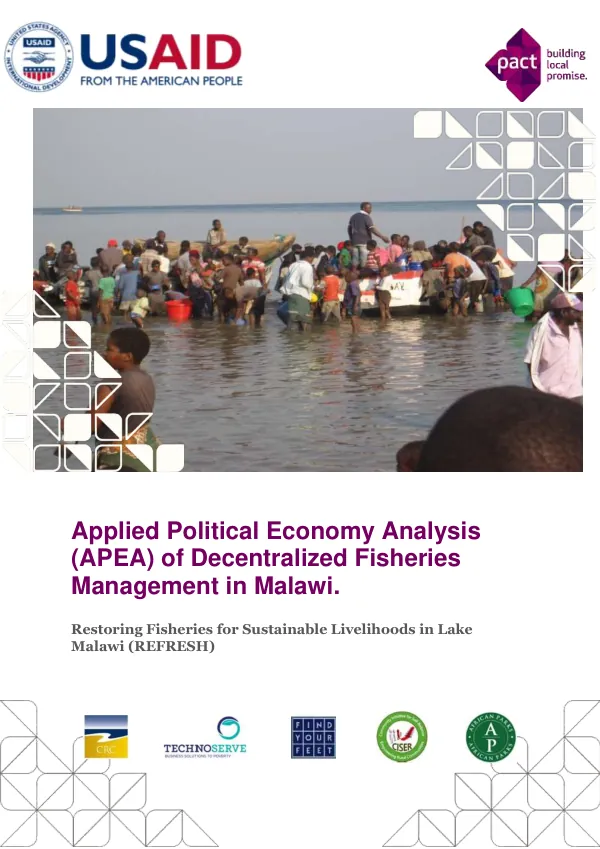
The Applied Political Economy Analysis (APEA) of Decentralized Fisheries Management in Malawi is a comprehensive study conducted by the REFRESH Project, a USAID-funded initiative aimed at restoring fisheries for sustainable livelihoods in Lake Malawi.
2021 · 44 pages
Sign in to readA free account is required to download.
Abstract
The study focuses on the operationalization of the regulatory framework, financial structures, and enforcement mechanisms within the Department of Fisheries (DoF) at the national level. At the national level, the study identifies key challenges in operationalizing the regulatory framework, including the need for a clear and concise policy framework, adequate resources, and effective enforcement mechanisms. The study also highlights the importance of overhauling financial structures within the DoF, including the establishment of a Fisheries Fund to support sustainable fisheries management. Additionally, the study emphasizes the need for effective enforcement of rules and regulations, including the use of revenue generated from fisheries activities to support conservation efforts. The study also examines the sub-national level, focusing on the representation, responsiveness, revenue generation, and Ecosystem-Based Fisheries Management (EBFM) in the context of decentralization in Malawi. The study finds that decentralization has created opportunities for local communities to participate in fisheries management, but also poses challenges, including the multiplicity of actors and coordination failure. The study highlights the need for a more representative Local Fisheries Management Authority (LFMA) to galvanize community-led compliance with fishing regulations. The study identifies key systemic EBFM challenges in Malawi, including the multiplicity of actors and coordination failure, limited visibility of the fisheries sector within district councils, challenging interface and understaffing within the sector in key strategic positions at the council, mental stagnation and/or perceptions by stakeholders at council, and ineffective reporting by the fisheries sector to district councils. The study also highlights the need for a more representative LFMA to galvanize community-led compliance with fishing regulations. The study provides recommendations for addressing these challenges, including the establishment of a more representative LFMA, the development of a clear and concise policy framework, the establishment of a Fisheries Fund, and the effective enforcement of rules and regulations. The study also emphasizes the need for effective coordination and collaboration among stakeholders, including government agencies, local communities, and civil society organizations. The study was conducted through a combination of key informant interviews, focus group discussions, and analysis of secondary data. The study involved a total of 34 key informants, including senior government officers, academics, and civil society representatives. The study also involved the use of a research vessel to collect data on fisheries activities in Lake Malawi. The study has implications for fisheries management in Malawi, highlighting the need for a more decentralized and community-led approach to fisheries management. The study also emphasizes the importance of effective coordination and collaboration among stakeholders to address the challenges facing the fisheries sector in Malawi.