USAID DEC
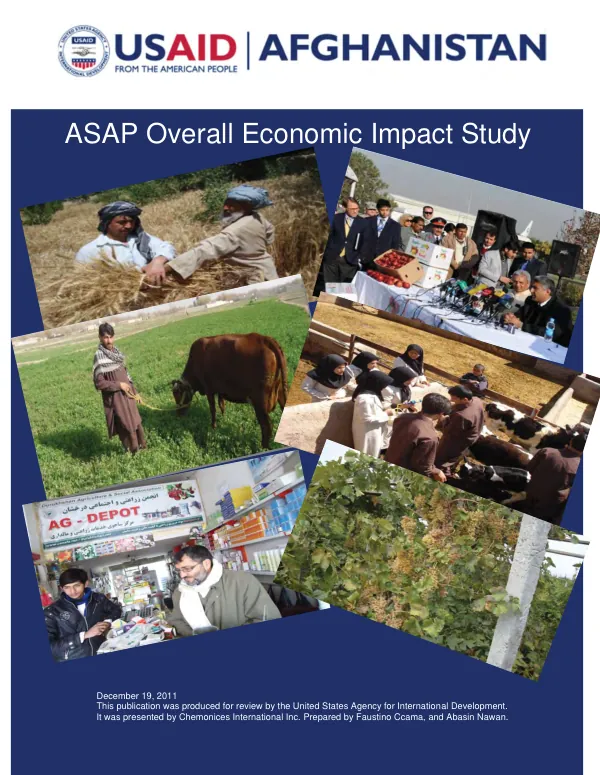
ASAP Economic Impact Study: Agribusiness Trade Facilitation and Investment Program in Afghanistan
Sign inAFGHANISTAN MINISTRY OF AGRICULTURE, IRRIGATION AND LIVESTOCK
ASAP Economic Impact Study: Agribusiness Trade Facilitation and Investment Program in Afghanistan
The Accelerating Sustainable Agriculture Program (ASAP) is a nationwide initiative funded by the United States Agency for International Development (USAID) to revitalize Afghanistan's agricultural sector and improve global competitiveness of the country's agribusiness.
2011 · 44 pages
Sign in to readA free account is required to download.
Abstract
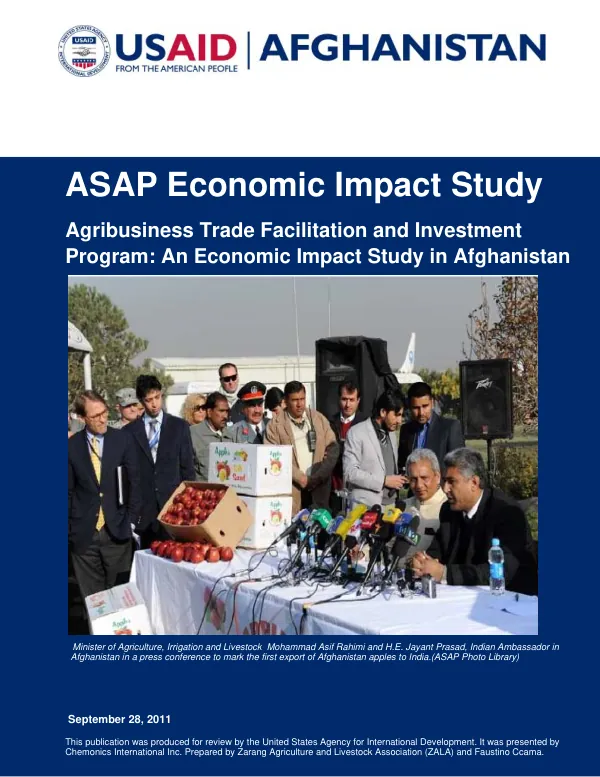
ASAP began in November 2006 and concluded in September 2011. The program's overarching goals include improving agriculture production, increasing sales of agriculture products, creating new jobs, and introducing modern agriculture technologies and practices. ASAP's main objective is to accelerate broad-based, market-led agriculture development capable of responding and adapting to market forces in ways that provide new economic opportunities for rural Afghans. To accomplish this objective, ASAP is focused on accelerating sales of high-value commodities and improving the capacity of the Government of Afghanistan, specifically the Ministry of Agriculture, Irrigation, and Livestock (MAIL), to formulate agriculture sector policies and strategies, and to carry out the administrative and financial functions needed to support more competitive, market-led agricultural production. ASAP's support for agribusiness local traders has improved the quality of Afghan produce by better post-harvest techniques and increased export of Afghan produce to international markets such as India, the United Arab Emirates, Saudi Arabia, Pakistan, the United Kingdom, and Tajikistan. Local traders have been involved in sales within the country and to limited channels outside Afghanistan, but with ASAP technical support and promotion of Afghan produce, they managed to export to international markets. ASAP helped standardize sorting and packaging of Afghan produce to compete in the world market. The program's economic impact study found that 70% of the traders confirmed that ASAP helped them find new markets, while others said sorting, packaging, and transportation assistance were provided. In total, sales increased from about $5 million to about $9 million each year since ASAP started supporting the traders. With ASAP support, the local traders reported net income of over $17 million since ASAP has extended its assistance to the local traders in 2006. Additionally, 63% of the traders said their businesses are sustainable and their sales will stay the same after ASAP concludes in September 2011, while 20% seemed excited about their future sales and said their sales will increase in the future – without any external support. The study also found that future sales project is over $12 million for next year, indicating the economic impact and sustainability of ASAP's Agribusiness trade facilitation and investment program. In total, ASAP managed to increase the export of these 34 traders by 11,110 metric tons since ASAP has supported them. ASAP helped create 340 new jobs with a high rate of 43% female participation. In total, ASAP provided technical training on improved post-harvest and pre-export techniques to 1,364 individuals. On average, each trader received a contract worth of $153,714, and all the 34 traders surveyed in total received contracts worth of over $5.2 million due to participation in the AgFairs, organized by ASAP. Afghanistan produces about 80,000 metric tons of apples each year, with each metric ton sold at an average price of US$300. In total, Afghan apples contribute US$24 million to the national economy of Afghanistan. Due to ASAP's support and promotion of Afghan apples, the price of one metric ton raised from $300 to $500. Additionally, Afghanistan exported 300 metric tons of Dried Fruit annually, but with ASAP's contributions, the export jumped to 500 metric tons per year. ASAP's Agribusiness trade facilitation and investment program has had a significant impact on the Afghan economy, increasing sales, creating new jobs, and introducing modern agriculture technologies and practices. The program's success has been attributed to its focus on accelerating sales of high-value commodities and improving the capacity of the Government of Afghanistan to formulate agriculture sector policies and strategies.
Related documents