USAID DEC
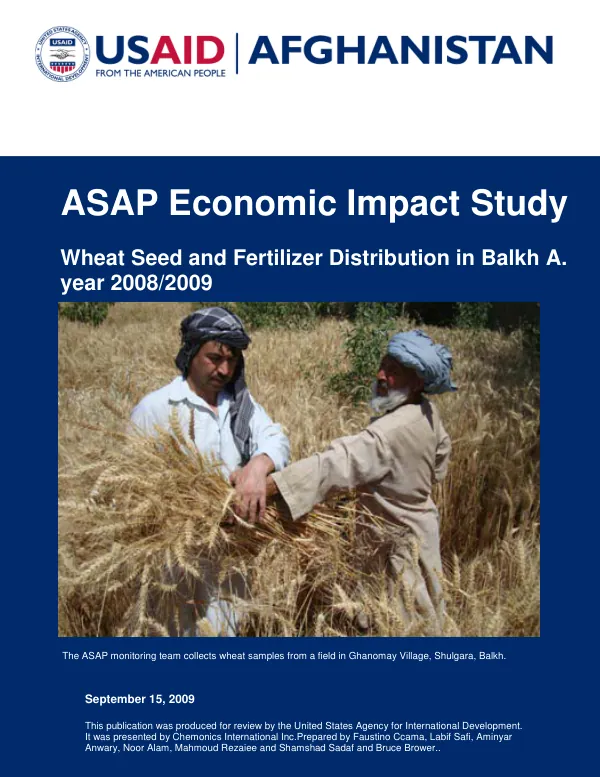
ASAP Economic Impact Study: Wheat Seed and Fertilizer Distribution in Balkh Province
Sign inCARE
ASAP Economic Impact Study: Wheat Seed and Fertilizer Distribution in Balkh Province
The Accelerating Sustainable Agriculture Program (ASAP) in Afghanistan implemented a wheat seed and fertilizer distribution program in 2008 to address the severe drought affecting the country.
2009 · 15 pages
Sign in to readA free account is required to download.
Abstract
The program aimed to provide 20,000 farmers in six districts of Balkh province with certified wheat seeds and fertilizers at a discounted price. USAID shouldered 85% of the cost, while beneficiaries paid the remaining 15%. The distribution program involved the distribution of 1,000 MT of irrigated and rain-fed certified wheat seeds and 1,600 MT of fertilizer. The total subsidy package included 300 MT of certified irrigated wheat seed, 700 MT of certified rain-fed wheat seed, 1,000 MT of DAP 18-46-0, and 600 MT of Urea 46-0-0. Farmers with irrigated lands received a package of inputs sufficient to cultivate 0.4 ha of land, while farmers tilling rain-fed land received a package of inputs designed to cultivate 0.4 ha of land. The study aimed to measure the production, incremental yield, gross income, and number of families benefited from the seeds and fertilizer distribution in Balkh province. The methodology involved actual measurement of yield of 494 samples, each sample measuring 1 m2, and extrapolated to one hectare of a farmer's wheat field. Farmer-beneficiaries were also interviewed about the benefits and challenges of the program. The results of the study showed that the wheat seed and fertilizer program achieved 100% of its objective, with the intended 20,000 family beneficiaries receiving their pre-determined share of wheat seed and fertilizer. A total land area of 5,200 hectares was planted, resulting in the production of 11,753 MT of wheat, generating a total value of US$ 4 million. The average gross income per family due to wheat distribution was around US $ 200, derived by multiplying the total average yield by area cultivated per family, and finally multiplied by the market price of US $ 340 MT. The study also found that the average yield per ha was 2.26 MT/ha, compared to 0.84 MT/ha in 2008. The average incremental yield per ha was 1.42 MT/ha, indicating a significant increase in wheat production. The total area benefited was 5,200 ha, resulting in a total production of 11,752 MT. The average market price was US$ 340/MT, resulting in a gross value of wheat production of US$ 3,995,680. At the family level, the average farm size was 0.26 ha/family, and the average farm production was 2.26 MT/ha. The average gross income per family due to wheat distribution was US$ 200, indicating a significant increase in income for the beneficiary families. The study concluded that the wheat seed and fertilizer distribution program was successful in achieving its objective of increasing wheat production and improving the income of beneficiary families.