IOM
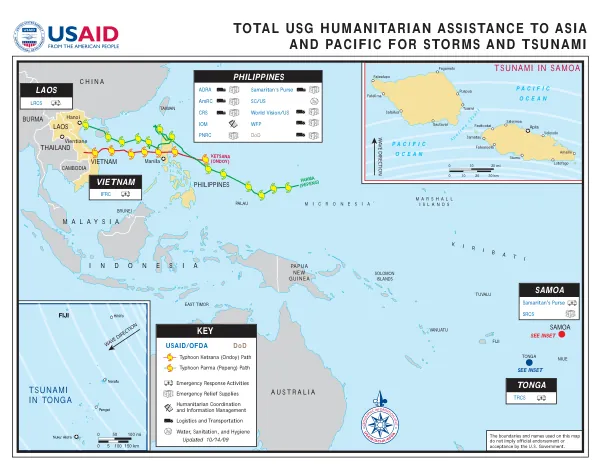
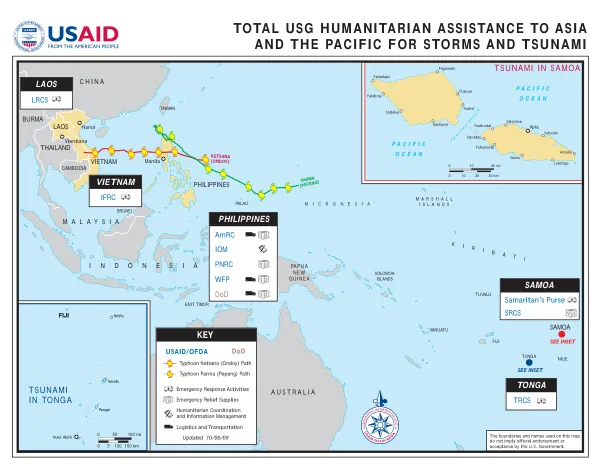
Asia and The Pacific Storms and Tsunami Program Maps 10/08/2009
Typhoon Ketsana, also known as Ondoy, made landfall in the Philippines on September 26, 2009, bringing heavy rainfall and widespread flooding.
2009 · 2 pages
Sign in to readA free account is required to download.
Abstract
The storm's path traversed the country, affecting multiple regions, including Metro Manila and surrounding provinces. The typhoon's impact was exacerbated by the country's geography, with many areas prone to flooding due to the presence of rivers and low-lying terrain. The storm's effects were particularly severe in the provinces of Rizal, Laguna, and Quezon, where heavy rainfall caused rivers to overflow, resulting in widespread flooding. The city of Manila was also severely affected, with the Pasig River overflowing its banks and inundating nearby communities. The storm's impact was further compounded by the fact that many areas were already experiencing heavy rainfall due to the approach of Typhoon Parma, which made landfall in the Philippines on October 1, 2009. Typhoon Parma, also known as Pepeng, brought additional heavy rainfall to the Philippines, exacerbating the flooding caused by Typhoon Ketsana. The storm's path was similar to that of Typhoon Ketsana, with the storm affecting multiple regions, including Metro Manila and surrounding provinces. The storm's impact was particularly severe in the provinces of Benguet, Ifugao, and Nueva Vizcaya, where heavy rainfall caused landslides and further exacerbated the flooding caused by Typhoon Ketsana. The combined impact of Typhoons Ketsana and Parma resulted in significant damage and loss of life in the Philippines. The storms caused widespread flooding, landslides, and damage to infrastructure, including roads, bridges, and buildings. The storms also affected the country's agricultural sector, with many crops destroyed or damaged due to the heavy rainfall and flooding. The international community responded to the disaster with significant humanitarian assistance. The United States Agency for International Development (USAID) provided emergency relief supplies, including food, shelter, and medical aid, to affected communities. The US Department of Defense also provided logistical support, including transportation and communication equipment, to aid in the relief efforts. Other international organizations, including the American Red Cross, the International Organization for Migration, and the World Food Programme, also provided assistance to affected communities. The storms also affected other countries in the Asia-Pacific region, including Samoa, Tonga, and Fiji. In Samoa, the storms caused widespread flooding and damage to infrastructure, while in Tonga, the storms caused significant damage to crops and infrastructure. In Fiji, the storms caused flooding and damage to infrastructure, particularly in the western division of the country. The storms also had a significant impact on the Pacific Ocean, with the storms causing significant changes in sea levels and ocean currents. The storms also affected the region's climate, with the storms causing significant changes in temperature and precipitation patterns. The storms were monitored by various international organizations, including the Joint Typhoon Warning Center (JTWC) and the National Aeronautics and Space Administration (NASA). The storms were tracked using satellite imagery and radar data, with the storms' paths and intensities monitored closely by meteorologists and disaster response officials.