UNIVERSITY OF MARYLAND
Aspirations Formation and Failure in Rural Nepal
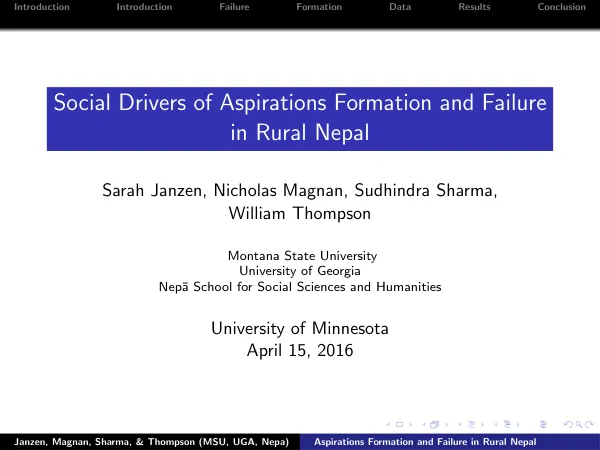
Aspirations Formation and Failure in Rural Nepal is a study that examines the role of aspirations in influencing investment decisions among poor households.
2016 · 45 pages
Sign in to readA free account is required to download.
Abstract
The research focuses on rural Nepal, where poverty is prevalent, and households often struggle to invest in their future. The study aims to understand how aspirations are formed and how they affect future-oriented behavior. The study suggests that internal constraints, such as high discount rates and inconsistent time preferences, are often overlooked as factors contributing to underinvestment in the future. However, empirical evidence from various studies indicates that internal constraints matter. For instance, a study in Mozambique found that an agricultural input subsidy and training program lengthened poor farmers' planning horizons and increased investment. Similarly, a study in Nicaragua showed that cash transfers improved recipients' outlook on the future and their investment in human capital. Aspirations are defined as hopes or ambitions of achieving something, and expectations are defined as beliefs about what will happen in the future. The study highlights that the poor have little reason to think things can get better, and thus do not aspire for a better situation. They themselves have known only poverty, and most of the people they know or interact with are also poor. This lack of aspirations can lead to frustration rather than action. The study uses data from rural Nepal to empirically test theoretical models of how aspirations are formed and how they affect future-oriented behavior. The research questions focus on how aspirations influence investment and what are the social drivers of aspirations formation. The study finds that aspirations do affect investment, and in the way theory predicts: if one's aspirations are too small or too large relative to their current status, they are less likely to invest in the future. The status of one's peers is also important in forming aspirations. The study suggests that development programs that raise people's aspirations may incite them to invest in the future, facilitating their exit from poverty. However, if people's aspirations are raised too much, it could actually discourage investment. Programs that help some people could have spillover effects by changing the aspirations of others. The study also introduces the concept of aspirations gaps and failures. An aspirations gap is the difference between one's current status along some dimension and what they aspire to achieve. Ray (2006) hypothesizes that aspirations gaps lead to an aspirations failure in one of two ways: a small gap is too easily bridged or so small as to not warrant any effort, while a large gap is viewed as unbridgeable and results in frustration rather than persistent action. To motivate the empirical analysis of aspirations failures, the study employs a model presented in Genicot and Ray (2015). The model describes an agent who has a wealth endowment and can either consume or invest in the future. The agent receives a return on her investment, and her income in the subsequent period is determined by her investment. The study aims to apply this model to the data from rural Nepal to understand how aspirations failures occur and how they can be addressed.