UNIVERSITY OF MARYLAND
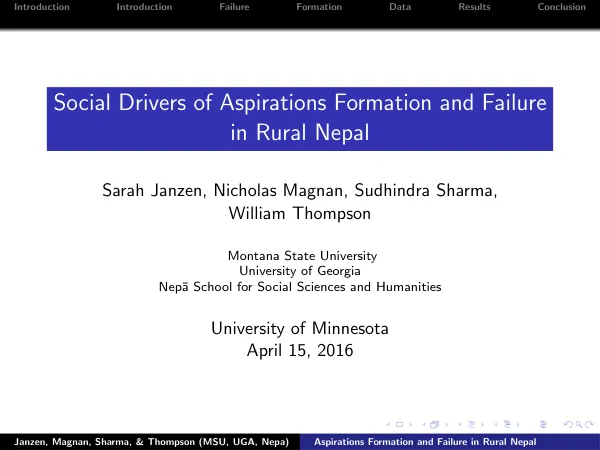
Social Drivers of Aspirations Formation and Failure in Rural Nepal
The agricultural development initiative in rural Nepal began with a focus on understanding the social drivers of aspirations formation and failure.
2016 · 41 pages
Sign in to readA free account is required to download.
Abstract
Researchers from Montana State University and the University of Georgia, in collaboration with the Nepal School of Social Sciences and Humanities, conducted a study to empirically test the theories of aspirations windows, gaps, and failures articulated in Appadurai (2004), Ray (2006), and Genicot and Ray (2015). The study used a unique dataset from rural Nepal to analyze the determinants of aspirations and their role in determining future-oriented behavior. The researchers found that social drivers are important for forming aspirations, with individual aspirations influenced by the outcomes of those around them. The study also presented evidence supporting the inverse-U relationship between aspirations and future-oriented financial behavior, including saving and borrowing for investment. The probability of engaging in these behaviors increased with aspirations up to a point, but then fell as predicted by the model. The study's findings suggest that aspirations are socially determined and affect behavior, providing tremendous scope for development interventions to have secondary effects by altering aspirations within a community. The researchers used rich social networks data combined with a unique measure of aspirations across three dimensions (income, assets, and education) to estimate social influences of aspirations formation among rural Nepali women and evaluate the importance of aspirations in determining future-oriented economic behavior. The study's results have implications for policies and programs aimed at increasing investment among the poor. By understanding the social drivers of aspirations formation and failure, policymakers can design interventions that target internal constraints, such as aspirations, in addition to external constraints. The study's findings suggest that aspirations can be externally influenced to encourage higher levels of investment, and that development interventions can have secondary effects by altering aspirations within a community. The researchers' analysis suggests that the amount an individual invests in the future depends on an individual's aspirations relative to their current status. If aspirations barely exceed current status, the investment required to meet them is relatively low. As aspirations increase, optimal investment increases, but if aspirations grow too large (relative to current status), the theory suggests that "failure" will occur, and investment is suspended. The researchers' analysis also highlights the importance of considering the complex relationship between aspirations, investment, and poverty. Recent theoretical work has analyzed the relationship between aspirations, investment, and poverty, and has suggested that aspirations can be an important determinant of investment behavior. The study's findings suggest that aspirations are socially determined and affect behavior, providing tremendous scope for development interventions to have secondary effects by altering aspirations within a community. The researchers' analysis suggests that the probability of engaging in future-oriented financial behavior, such as saving and borrowing for investment, increases with aspirations up to a point, but then falls as predicted by the model. The study's findings have important implications for poverty dynamics and investment behavior, and suggest that aspirations can be an important determinant of investment behavior.