USAID DEC
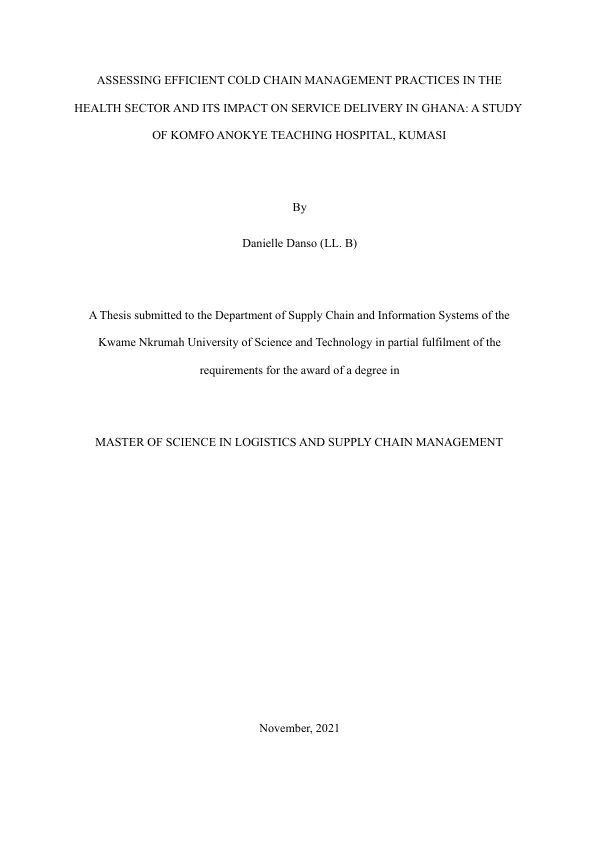
Assessing Efficient Cold Chain Management Practices in the Health Sector and Its Impact on Service Delivery in Ghana: A Study of Komfo Anokye Teaching Hospital, Kumasi
Sign inKWAME NKRUMAH UNIVERSITY OF SCIENCE AND TECHNOLOGY
Assessing Efficient Cold Chain Management Practices in the Health Sector and Its Impact on Service Delivery in Ghana: A Study of Komfo Anokye Teaching Hospital, Kumasi
The assessment of efficient cold chain management practices in the health sector and its impact on service delivery in Ghana is a critical area of study.
2021 · 108 pages
Sign in to readA free account is required to download.
Abstract
The study aimed to identify the existing cold chain practice in the Ghanaian healthcare sector, evaluate the challenges associated with the cold chain delivery system, and determine the impact of an efficient cold chain delivery system on healthcare service delivery. The study adopted a quantitative research approach, involving a comprehensive review of literature and a survey of healthcare professionals at the Komfo Anokye Teaching Hospital in the Ashanti region of Ghana. The survey revealed a moderate level of practice of cold chain management in Ghana, with the use of fridge tags or functional thermometers, presence of emergency power supply, use of appropriate refrigeration equipment, and storage of products at required temperatures being practiced. However, the study also identified significant challenges to efficient cold chain practice in the Ghanaian healthcare sector, including lack of modern technology or optimal equipment, inadequate financing, lack of reliable transportation, erratic electric power supply, and transportation delays. The study found that trained personnel, reliable transportation, reliable storage equipment, and efficient management are essential for efficient cold chain management. The study's findings suggest that efficient cold chain management has a significant impact on healthcare service delivery, with improved waiting times, quality of care, and responsiveness. The study provides empirical evidence regarding the efficient cold chain management practice and its impact on service delivery in a developing country such as Ghana, and recommends strategies necessary to improve cold chain practice in the Ghanaian healthcare sector. The study's methodology involved a comprehensive review of literature, a survey of healthcare professionals, and data analysis using mean scores and the one-sample t-test. The study's population consisted of 62 healthcare professionals at the Komfo Anokye Teaching Hospital, and the sample size was determined using a random sampling technique. The study's results indicate that the existing cold chain practice in the Ghanaian healthcare sector is moderate, with significant challenges associated with the cold chain delivery system. The study's findings also suggest that an efficient cold chain delivery system has a significant impact on healthcare service delivery, with improved waiting times, quality of care, and responsiveness. The study's conclusions highlight the importance of efficient cold chain management in the healthcare sector, and recommend strategies necessary to improve cold chain practice in the Ghanaian healthcare sector. The study's contribution to the field of logistics and supply chain management is significant, and provides empirical evidence regarding the efficient cold chain management practice and its impact on service delivery in a developing country such as Ghana. The study's limitations include the small sample size and the limited scope of the study, which focused on the Komfo Anokye Teaching Hospital in the Ashanti region of Ghana. Future research should aim to replicate the study in other healthcare settings and regions, and explore the impact of efficient cold chain management on healthcare service delivery in other developing countries. The study's recommendations include the implementation of strategies necessary to improve cold chain practice in the Ghanaian healthcare sector, such as the provision of modern technology or optimal equipment, adequate financing, reliable transportation, and efficient management. The study also recommends the training of healthcare professionals in cold chain management, and the establishment of a cold chain management system that is responsive to the needs of healthcare providers and patients.
Related documents