USAID DEC
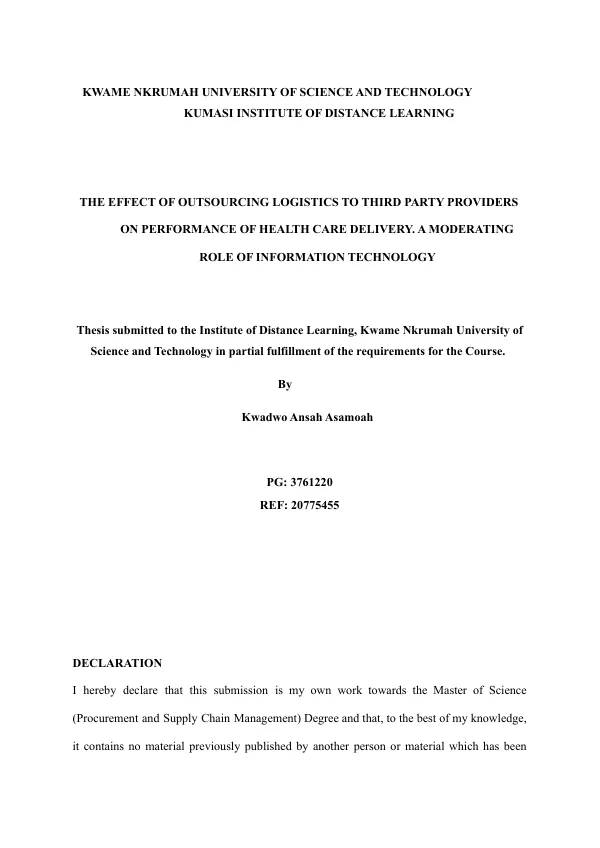
The Effect of Outsourcing Logistics to Third Party Providers on Performance of Health Care Delivery. A Moderating Role of Information Technology
Sign inKWAME NKRUMAH UNIVERSITY OF SCIENCE AND TECHNOLOGY
The Effect of Outsourcing Logistics to Third Party Providers on Performance of Health Care Delivery. A Moderating Role of Information Technology
Logistics outsourcing refers to the process in which a third-party logistics (3PL) provider or a logistics service provider is contracted for all or part of a firm's logistics operations.
93 pages
Sign in to readA free account is required to download.
Abstract
This practice has gained increasing scholarly attention due to its positive contribution to operational efficiency. Logistics outsourcing coincides with mounting pressure in firms to increase their profitability and improve business competitiveness. Ensuring efficiency and effectiveness when executing logistics activities requires firms to focus on the core logistics operations. The outsourcing of logistics operations has become a strategic decision for many firms, allowing them to focus on core activities that are a source of competitive advantage. While literature suggests that logistics outsourcing is more evident in highly developed economies, such as the United States of America, where 3PL providers are better established, in developing countries the practice has taken a faster pace due to heightened competition and increasing complexity in aspects of business logistics operations. Logistics creates place, time, and quality, which are essential for the delivery of goods and services. Effective logistics management is critical for the success of businesses, particularly in the healthcare sector, where timely delivery of medical supplies and equipment is crucial. The outsourcing of logistics operations can help healthcare organizations to improve their operational efficiency, reduce costs, and enhance their ability to respond to changing market conditions. The study aimed to investigate the effect of outsourcing logistics to third-party providers on the performance of healthcare delivery. The research design used a survey methodology to collect data from staff and management of hospitals in Ghana. The sample population consisted of approximately 200 staff and management of hospitals, with an overall sample size of 160 staff and managers of the hospital. The data was analyzed using regression, percentages, mean, and standard deviation, and hierarchical regression model analysis. The findings of the study revealed that outsourcing warehousing, outsourcing transportation, and outsourcing inventory had a significant and positive effect on the performance of healthcare delivery. However, the study found a positive but insignificant relationship between integrating operations and performance of healthcare delivery. The study further found full moderation of Information technology capability (ITC) between third-party logistics service providers and performance of the healthcare delivery. The study concluded that third-party logistics outsourcing adopted are very significant and making a unique contribution to the performance of the healthcare delivery in the hospital. It is therefore recommended that there should be an improved system of communication and feedback measures to ensure effective flow of information between the hospital and its third-party logistics service providers in order to ensure effective performance among the supply chain partners. The study's findings have implications for healthcare organizations in Ghana, highlighting the importance of outsourcing logistics operations to third-party providers to improve their operational efficiency and enhance their ability to respond to changing market conditions. The study also emphasizes the need for effective communication and feedback measures between healthcare organizations and their third-party logistics service providers to ensure effective performance among the supply chain partners. The study's methodology and findings provide a framework for future research on the impact of logistics outsourcing on the performance of healthcare delivery in developing countries. The study's results can also inform policy decisions and strategic planning in the healthcare sector, highlighting the potential benefits of logistics outsourcing for improving operational efficiency and enhancing competitiveness. The study's findings on the moderating role of Information technology capability (ITC) between third-party logistics service providers and performance of the healthcare delivery have significant implications for healthcare organizations in Ghana. The study's results suggest that the adoption of ITC can enhance the effectiveness of third-party logistics outsourcing, leading to improved performance of healthcare delivery. The study's recommendations for improved communication and feedback measures between healthcare organizations and their third-party logistics service providers are critical for ensuring effective performance among the supply chain partners. The study's findings highlight the need for healthcare organizations to invest in IT infrastructure and develop effective communication systems to support their logistics operations. The study's results have implications for the development of logistics outsourcing strategies in the healthcare sector, highlighting the importance of considering the moderating role of IT capability in the adoption of third-party logistics outsourcing. The study's findings suggest that healthcare organizations should prioritize the development of IT infrastructure and effective communication systems to support their logistics operations.
Related documents
Documents in this collection
 2021
2021USAID DEC
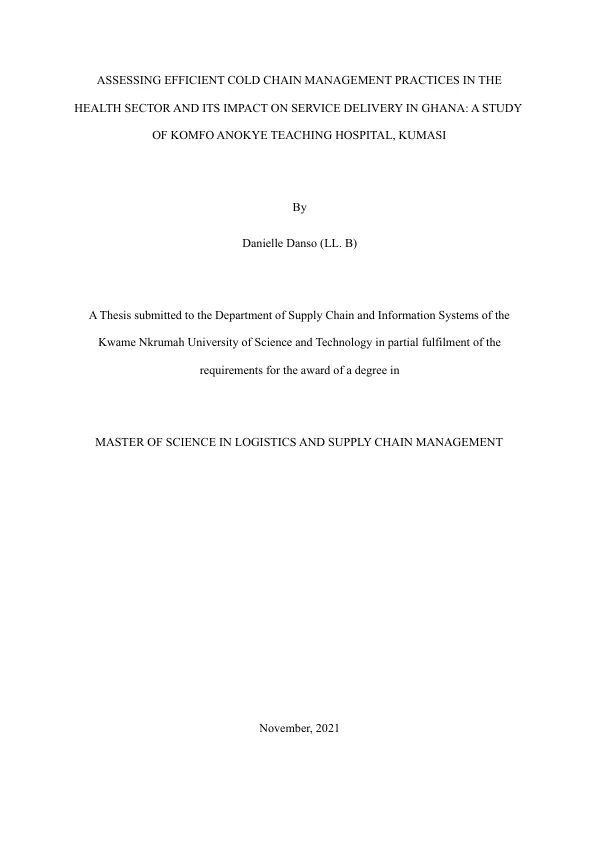
Assessing Efficient Cold Chain Management Practices in the Health Sector and Its Impact on Service Delivery in Ghana: A Study of Komfo Anokye Teaching Hospital, Kumasi
Open record 2021
2021USAID DEC
The Usage Of E-Procurement Systems And Its Impact On The Performance Of Smes In Ghana
Open record