ARIZONA STATE UNIVERSITY
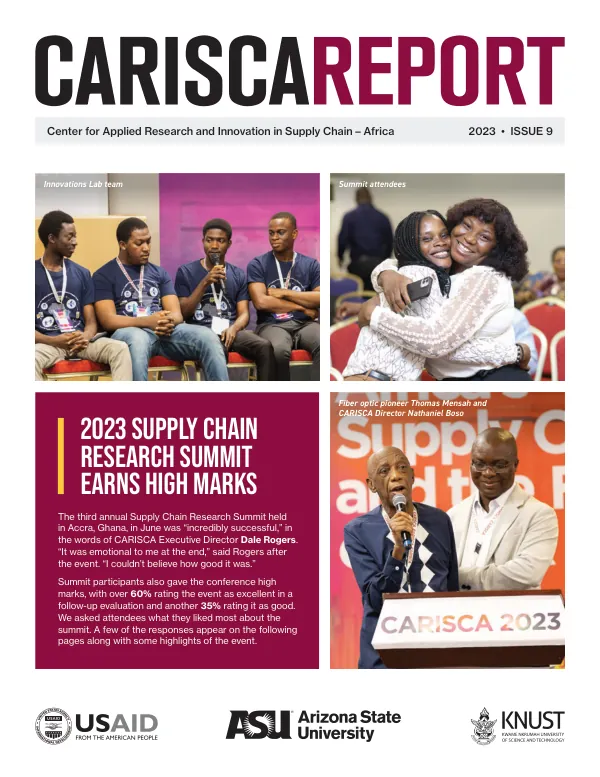
CARISCA Report Newsletter, 2021, Issue 1
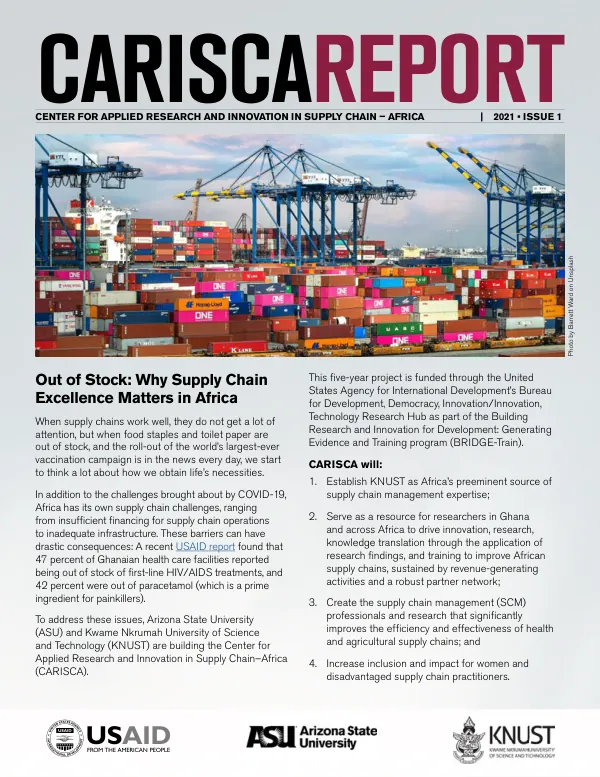
The Center for Applied Research and Innovation in Supply Chain–Africa (CARISCA) is a five-year project aimed at improving supply chain management in Africa.
2021 · 8 pages
Sign in to readA free account is required to download.
Abstract
Funded by the United States Agency for International Development's Bureau for Development, Democracy, Innovation/Innovation, Technology Research Hub, CARISCA is a collaborative effort between Arizona State University and Kwame Nkrumah University of Science and Technology (KNUST). The project's primary objective is to establish KNUST as Africa's preeminent source of supply chain management expertise. CARISCA's scope encompasses four key components: advancing supply chain research, engaging stakeholders, curriculum and training, and building a center to drive supply chain excellence in Africa. The project focuses on significantly improving the efficiency and effectiveness of health care and agricultural value chains, with a strong commitment to increasing inclusion and impact for women and disadvantaged supply chain stakeholders across sub-Saharan Africa. In its first six months, CARISCA laid the operational groundwork for future success. Meetings were conducted with international and Ghanaian stakeholders, and supply chain research capacity was evaluated at KNUST. A process was created to award scholarships to supply chain management students at KNUST, and course buyouts were explored for faculty to enable more time for research. The project also hosted its first webinar focused on women in leadership and entrepreneurship in African supply chains. CARISCA's annual supply chain summit for academics across Africa is planned for 2021, along with the development of a consulting framework for working with partners and development actors. The project aims to advance the education of KNUST's SCM students through new business analytics and simulation courses, as well as build supply chain apps and continuing education and certification courses for new non-traditional audiences. The center is positioned to be Africa's preeminent source of supply chain management expertise, serving as a resource for researchers across Africa to drive innovative research, research translation, and training to improve African supply chains. CARISCA's focus on supply chain management and innovation reflects a large body of research showing that efficient local supply chains are crucial to local, regional, and national economic development. CARISCA's goal is to lead cutting-edge research in supply chain, engage vital stakeholders, and publish policy briefs, journal articles, and case studies that advance supply chain best practices in Ghana. The project has partnered with local and international networks of industry and academic partners to connect African researchers, practitioners, and businesses to global supply chain assets. The center offers diverse and internationally recognized academic programs in supply chain, procurement, logistics, and transportation management in the West African sub-region. CARISCA is the only center of excellence in West Africa to hold the twin global professional accreditation for the Chartered Institution of Procurement and Supply (CIPS) and Chartered Institute of Logistics and Transport (CILT), making it one of the very few accredited study centers to train supply chain professionals in the sub-region. CARISCA aims to be a globally connected partner for supply chain research, training, and policy, providing a one-stop-shop for research capacity development, internationally accredited academic programs, and C-suite executive and professional training programs in supply chain management. The project is committed to collaborating with stakeholders to advance supply chain research, executive training, and policy development needs. The project's success is exemplified by the story of KNUST Professor Abdul Samed Muntaka, who defied the odds to become a leading figure in supply chain management. Muntaka's journey from being too small for school to becoming a department chair serves as a testament to the potential of education and the importance of supply chain management in driving economic development in Africa.
Related documents