MICHIGAN STATE UNIVERSITY FOUNDATION
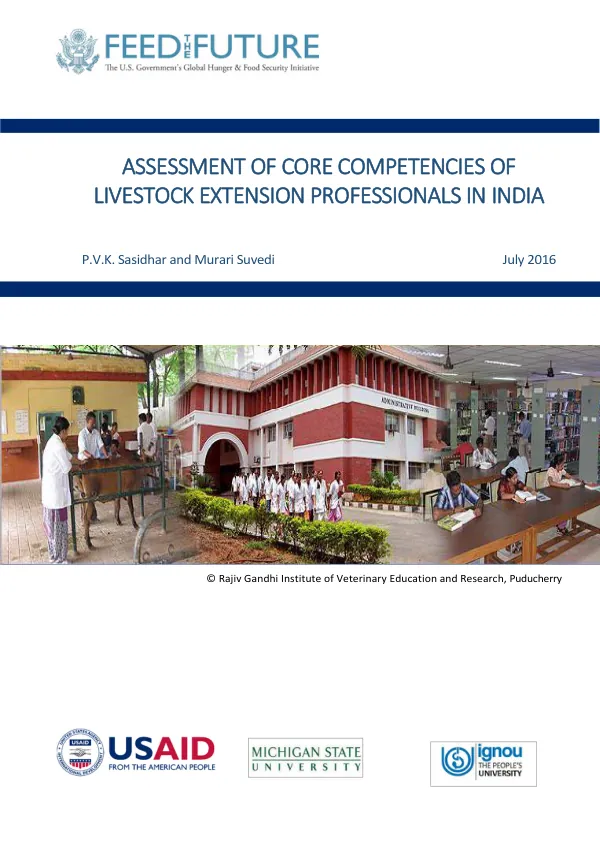
Assessment of Core Competencies of Livestock Extension Professionals in India
Livestock extension professionals play a crucial role in promoting agricultural development and improving the livelihoods of rural communities in India.
2016 · 55 pages
Sign in to readA free account is required to download.
Abstract
The livestock sector contributes significantly to the country's agricultural gross domestic product (Ag. GDP), with the Animal Husbandry Department (AHD) and other organizations working to enhance the sector's productivity and efficiency. The study on assessment of core competencies of livestock extension professionals in India was conducted by P.V.K. Sasidhar and Murari Suvedi in 2016. The researchers aimed to identify the key competencies required by livestock extension professionals to effectively deliver their services. The study was conducted in Andhra Pradesh, Karnataka, and Telangana states, with a sample size of 300 livestock extension professionals. The researchers operationalized and measured various variables related to livestock extension competencies, including specific livestock extension competencies, specific subject matter competencies, technical subject matter application competencies, and communication competencies. The data was collected through focus group discussions, front-line demonstrations, and on-farm trials. The study revealed that livestock extension professionals in India require a range of competencies to effectively deliver their services. The specific livestock extension competencies identified in the study include knowledge of animal husbandry practices, disease diagnosis and control, and extension methods. The specific subject matter competencies include knowledge of livestock production and management, livestock products technology, and agricultural extension services. The technical subject matter application competencies include the ability to apply knowledge of animal husbandry practices, disease diagnosis and control, and extension methods to real-world situations. The communication competencies include the ability to communicate effectively with farmers, extension agents, and other stakeholders. The study also identified the need for livestock extension professionals to acquire additional competencies, including education and informational technology competencies, personal and professional development competencies, and diversity competencies. The researchers recommended activities and programs to enhance the core competencies of livestock extension professionals, including training programs, workshops, and on-the-job training. The study has implications for policy and practice in the livestock extension sector in India. The findings highlight the need for livestock extension professionals to acquire a range of competencies to effectively deliver their services. The study also emphasizes the importance of education and informational technology competencies, personal and professional development competencies, and diversity competencies in enhancing the core competencies of livestock extension professionals. The study was made possible by the generous support of the American people through the USAID-MEAS project. The researchers acknowledge the support received from the officials of the Modernizing Extension and Advisory Services project, especially Andrea Bohn, Indira Gandhi National Open University and Michigan State University. The authors also thank all the respondents of the study who graciously gave their time and inputs. The study's findings have implications for the development of effective livestock extension services in India. The researchers recommend that livestock extension professionals acquire a range of competencies, including specific livestock extension competencies, specific subject matter competencies, technical subject matter application competencies, and communication competencies. The study also emphasizes the importance of education and informational technology competencies, personal and professional development competencies, and diversity competencies in enhancing the core competencies of livestock extension professionals.