USAID DEC
Assessment of Effectiveness of Guiding Fences along Sikta Irrigation Canal
The agricultural sector is a significant contributor to Nepal's economy, accounting for one-third of the nation's GDP and providing employment for two-thirds of the population.
2018 · 15 pages
Sign in to readA free account is required to download.
Abstract
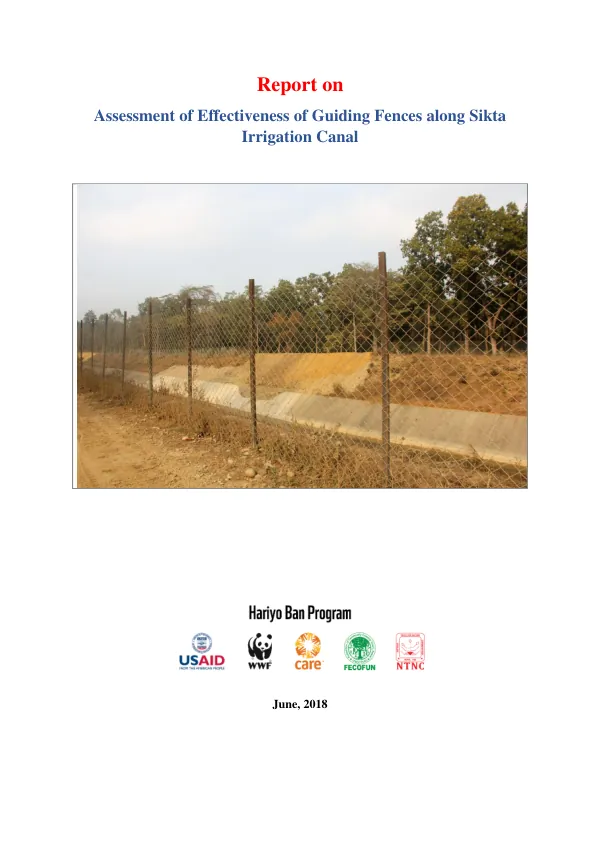
The country's diverse and varied agricultural land uses are attributed to its distinct geological, climatic, and hydrological characteristics. The Terai region, often referred to as the "granary," comprises 23% of the nation's land area and has a great potential for increased productivity and access to irrigation. The development of large irrigation canals in Nepal is crucial for meeting the country's food requirements and reducing poverty. Despite having an abundant water resource, less than 10% of available water has been utilized for irrigation purposes. Large irrigation projects, such as the Sikta Irrigation Project, play a vital role in increasing productivity and GDP. The Sikta Irrigation Project, a nation pride project, is under construction and will traverse through the forest of Banke National Park, Buffer zone, and corridor area. The project's main canal has recorded an increasing number of wildlife drowning incidents in the past few years. During the dry season, animals migrate towards the Rapti river, which is south of the National Park area, and attempt to cross the wide irrigation canal, resulting in casualties. To minimize wildlife casualties, the World Wildlife Fund (WWF) Nepal/Hariyo Ban Program worked with the Department of Irrigation and Banke National Park to pilot guiding fences along a stretch of the main canal in Mahadevpuri. The park constructed a 2-meter-high mesh wire fence along the 1 km stretch of the Sikta irrigation canal at both sides where wildlife death incidents are frequently noticed. The major objective of this assessment was to explore the effectiveness of guiding fences installed to minimize wildlife casualties from drowning in the irrigation canal. The study area is located at Ovari, Banke, where the guiding fence has been constructed and the Sikta Main Canal passes through the forest area. A week-long field visit was conducted along the Sikta irrigation canal with a joint team of Banke National Park officials, Nepal Army team, and Sikta project team. Joint consultation meetings were also held with related stakeholders, including National Park officials, Nepal Army officials, and Sikta project officials. During the field visit and stakeholder consultation, relevant data and information were noted, and secondary data on wild animal casualties and other relevant information were obtained from different websites, literatures, and park published documents. Every data obtained was critically analyzed, and a report was prepared. The infrastructure development and wildlife casualties scenario is a critical issue in Nepal. The construction of large linear infrastructure, such as roads and irrigation canals, poses threats to species by fragmenting their habitat and causing wildlife casualties. The Sikta Irrigation Project is a prime example of this issue, with an increasing number of wildlife drowning incidents recorded in the past few years. The guiding fences installed along the Sikta irrigation canal have shown promising results in minimizing wildlife casualties. The fences have helped wildlife find safe crossings and water access points, reducing the number of incidents. However, further analysis and evaluation are necessary to determine the effectiveness of the guiding fences and identify areas for improvement. The assessment highlights the importance of considering the environmental impact of large infrastructure projects, such as the Sikta Irrigation Project. The project's developers and stakeholders must work together to implement effective measures to reduce the adverse impact on the natural environment and minimize wildlife casualties.