MANAGEMENT SYSTEMS INTERNATIONAL
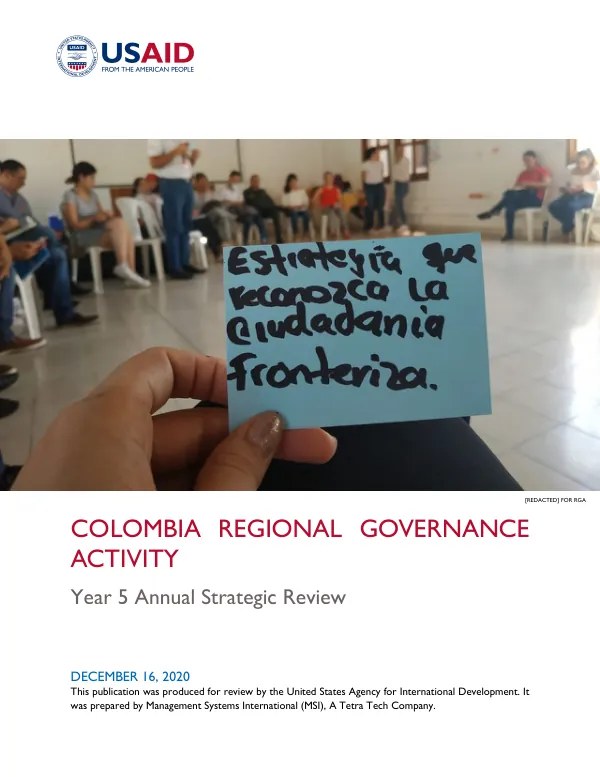
Year 5 Annual Strategic Review
The Regional Governance Activity (RGA) in Colombia began on June 22, 2015, with an initial period of performance of four and a half years.
2020 · 70 pages
Sign in to readA free account is required to download.
Abstract
The program's original objective was to improve governance in 40 Colombian municipalities affected by the nation's armed conflict through five program components: decentralization, public financial management, tertiary roads, citizen participation, and electoral reform. On April 23, 2019, RGA was awarded a six-month cost extension to June 21, 2020, which added a sixth component and adjusted RGA's territorial focus to concentrate on 10 subnational governments in three border departments—Arauca, La Guajira, and Norte de Santander—to help them cope with the challenges created by the influx of Venezuelan migrants and Colombian returnees in host communities. The program's focus shifted further with a second cost extension awarded on June 17, 2020, which added a seventh program component, shifting RGA's focus to COVID-19 prevention, containment, and recovery, and to service provision improvements for the migrant population. The amendment also broadened the project's geographic focus to implement activities in 14 target municipalities in six departments affected by the Venezuelan migrant crisis. This report presents the results of RGA's Year 5 Annual Strategic Review (ASR), which was organized based on four regional meetings with program counterparts and beneficiaries in its 14 target municipalities, and a plenary session with RGA experts, USAID, and external consultants. Regional ASR sessions helped RGA gather information on the evolving issues connected with the Venezuelan migration into Colombia, the effects of the COVID-19 pandemic, and security concerns. ASR discussions highlighted multiple challenges that local governments and stakeholders are currently facing, including limited resources, lack of coordination between and among the three levels of government, lack of coordination with the private sector, barriers in advocating for government transparency, and increased xenophobia, gender-based violence (GBV), and human trafficking. The report details ASR participant insights into these challenges and the impact that COVID-19 and the Venezuelan migrant crisis have had on them. The plenary session of the ASR brought together key challenges identified throughout regional roundtables to further discuss their implications and the actions the program can take in response. The program identified challenges and responses under the following lines of work: education service provision, health service provision, economic reactivation, public administration and resource mobilization, gender issues, and citizen participation. For example, in economic reactivation, the program identified a profound lack of coordination between municipal administrations and the private sector that partly stems from lack of municipal leadership. To address this challenge, the program will adapt its field strategy to increase municipal leadership and develop roadmaps that establish work methodologies between the public and private sector to implement a unified economic reactivation strategy. Considering RGA's upcoming program closure in June 2021, this ASR report concludes with a discussion on challenges identified that fall outside of the program's scope of work and recommendations to address these, especially regarding the migrant crisis. A key issue discussed in this closing section is migrant lack of documentation, which is a main barrier to accessing services for this population. The report highlights the need for continued support to address the challenges faced by local governments and stakeholders in the 14 target municipalities, particularly in the areas of education service provision, health service provision, economic reactivation, public administration and resource mobilization, gender issues, and citizen participation.