USAID DEC
Autonomisation et Innovation en matière de Genre pour le Leadership des filles à travers l’Education
Sign inINTERNATIONAL RESCUE COMMITTEE
Autonomisation et Innovation en matière de Genre pour le Leadership des filles à travers l’Education
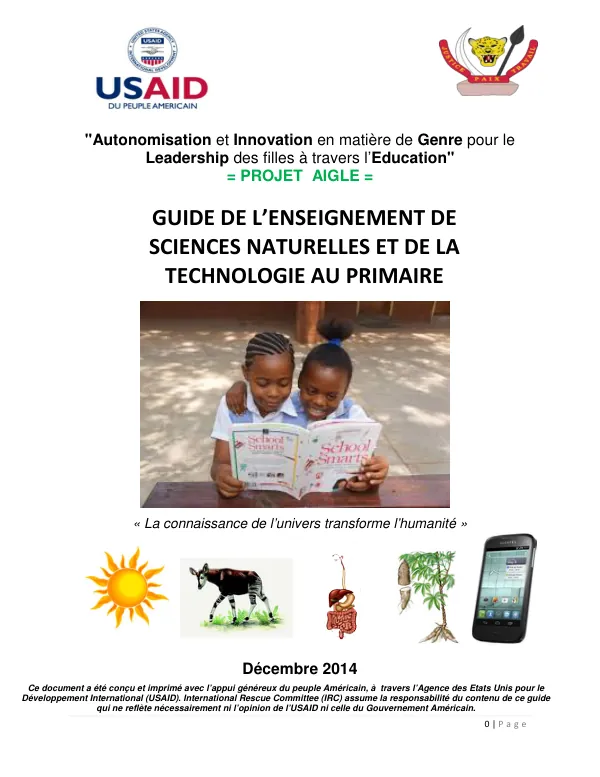
The Autonomisation et Innovation en matière de Genre pour le Leadership des filles à travers l’Education project, also known as PROJET AIGLE, aims to promote girls' leadership through education.
2014 · 80 pages
Sign in to readA free account is required to download.
Abstract
The project focuses on improving girls' access to education, particularly in science, technology, engineering, and mathematics (STEM) fields. The project is implemented in the Democratic Republic of Congo and is supported by the International Rescue Committee (IRC) and the USAID. The project's guide for teaching science and technology at the primary level emphasizes the importance of creating a supportive learning environment, known as a "classe curative." This approach prioritizes students' emotional and social well-being, encouraging them to feel safe, in control, and connected to their peers and teachers. The guide outlines various strategies for creating a classe curative, including promoting a sense of security, control, and belonging among students. It also emphasizes the importance of relationships between students and teachers, as well as among students themselves. The guide provides examples of activities and exercises that can be used to promote these strategies, such as role-playing, group work, and peer-to-peer learning. The project also focuses on improving the quality of education in the Democratic Republic of Congo. It aims to enhance the skills and knowledge of teachers, particularly in STEM fields, and to improve the availability and accessibility of educational resources. The project's evaluation framework includes formative, diagnostic, and summative assessments to monitor progress and identify areas for improvement. The project's long-term goal is to improve girls' access to education and promote their leadership and empowerment in the Democratic Republic of Congo. By creating a supportive learning environment and improving the quality of education, the project aims to break down barriers to girls' education and promote their full potential. The project's implementation is guided by a range of international and national partners, including the USAID, the IRC, and the Ministry of Primary, Secondary, and Professional Education. The project's success will depend on the effective collaboration and coordination of these partners, as well as the commitment and engagement of teachers, students, and communities. The project's evaluation framework includes a range of indicators and metrics to monitor progress and identify areas for improvement. These indicators include measures of girls' access to education, their academic achievement, and their leadership and empowerment. The project's evaluation will also assess the effectiveness of its strategies and interventions, including the creation of a classe curative and the improvement of teacher skills and knowledge. Overall, the Autonomisation et Innovation en matière de Genre pour le Leadership des filles à travers l’Education project represents a significant effort to promote girls' access to education and leadership in the Democratic Republic of Congo. By creating a supportive learning environment and improving the quality of education, the project aims to break down barriers to girls' education and promote their full potential.