USAID DEC
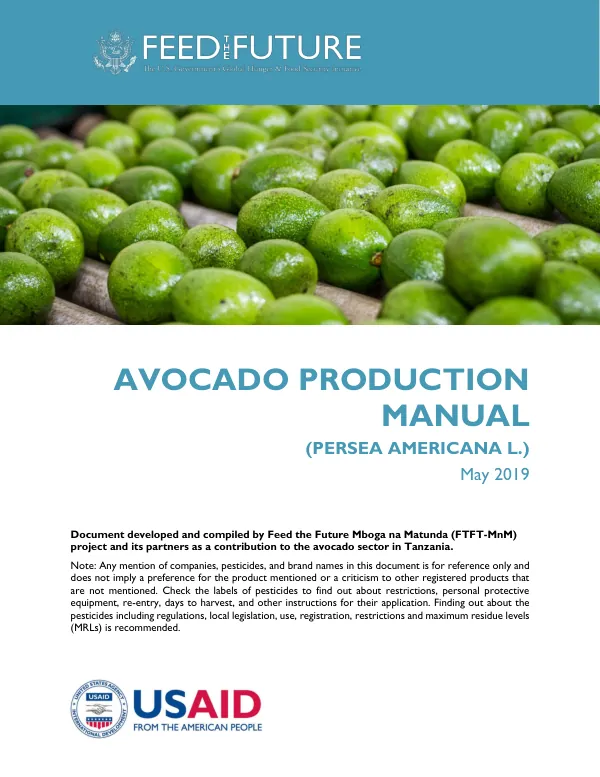
Avocado Production Manual (Persea Americana L.)
The Feed the Future Tanzania Mboga na Matunda Activity (FTFT-MnM) is a four-year initiative that aims to increase the productivity and profitability of horticulture value chains in Tanzania.
2019 · 48 pages
Sign in to readA free account is required to download.
Abstract
The activity focuses on scaling improved technologies and practices that lead to increased productivity of women, men, and youth, leveraging horticulture to improve family nutrition, scaling market system models to empower value chain stakeholders, and strengthening the overall capacity of the horticulture subsector. The geographic scope of FTFT-MnM encompasses 16 districts in the mainland and 10 districts in the Zanzibar Islands. Avocado production in Tanzania is mainly found in the southern highland regions of Iringa, Mbeya, and Songwe, as well as the northern regions of Kilimanjaro and Arusha. Smaller scale production is found in other regions like Kigoma, Rukwa, and Ruvuma, which target local regional markets. The purpose of the Avocado Production manual is to help all avocado farmers, input providers, and exporters of avocado throughout Tanzania. Avocados require a high initial investment, technical assistance, and the adoption of new technologies for planting, fertilization, phytosanitary control, pruning, harvest, and postharvest handling. The origin of avocados is in Mexico and Central America, with archaeological research indicating that avocados were found in Mexico in 8000 B.C. and in Peru towards 3000-4000 B.C. The area of origin is not exactly known, given the existence of several wild populations. There are three main races of avocados: Mexican, Guatemalan, and West Indian. The Mexican avocado originates in the valleys and high plateaus of central Mexico, where the climate is subtropical and mild, and the elevation is between 1,500 and 2,000 meters above sea level. The Mexican avocado is resistant to cold weather, generally small, and has a pyriform shape, thin skin, and a smooth exterior. The Guatemalan avocado originates in the western central region of Guatemala, with an elevation of between 1,000 and 2,000 meters above sea level. It has thick skin and is resistant to transport, but less resistant to cold weather than the Mexican avocado. The West Indian avocado comes from the Pacific coast of Mexico, Guatemala, El Salvador, Honduras, Nicaragua, Costa Rica, and Panama, from an elevation below 1,000 meters above sea level. It is susceptible to cold weather, and resistant to salinity and chlorosis. The characteristics that set each race apart are the flowering stage, the harvesting period, the flowering-harvesting period, the weight and type of skin, the flesh's fat content, and resistance to cold weather in both young and adult plants. Avocado morphology includes the root system, which is a critical component of the plant's growth and development. The root system of avocados is characterized by a taproot, which is a single, main root that grows downward into the soil. The taproot is surrounded by a network of smaller roots that branch off from it, providing additional support and anchorage to the plant. The root system of avocados is also characterized by a high degree of branching, with many small roots that grow outward from the taproot. The root system of avocados plays a critical role in the plant's ability to absorb water and nutrients from the soil. The roots are responsible for anchoring the plant in place, providing support and stability, and allowing the plant to grow and develop. The root system of avocados is also sensitive to environmental factors, such as drought, flooding, and soil salinity, which can impact the plant's ability to absorb water and nutrients. In addition to the root system, avocado morphology also includes the stem, leaves, and fruit. The stem of an avocado tree is a woody, branching structure that supports the leaves and fruit. The leaves of an avocado tree are large, elliptical, and have a waxy texture. They are arranged alternately on the stem and are responsible for photosynthesis, the process by which plants convert light energy into chemical energy. The fruit of an avocado tree is a large, green or purple berry that grows from the flower. The fruit is characterized by a single seed, which is surrounded by a fleshy, edible pulp. The fruit of an avocado tree is a critical component of the plant's reproductive cycle, providing a means for the plant to disperse its seeds and propagate new plants. Overall, the morphology of avocados is a complex and highly specialized system that plays a critical role in the plant's growth and development. The root system, stem, leaves, and fruit of an avocado tree are all critical components of the plant's morphology, and are responsible for its ability to absorb water and nutrients, photosynthesize, and reproduce.
Related documents