USAID DEC
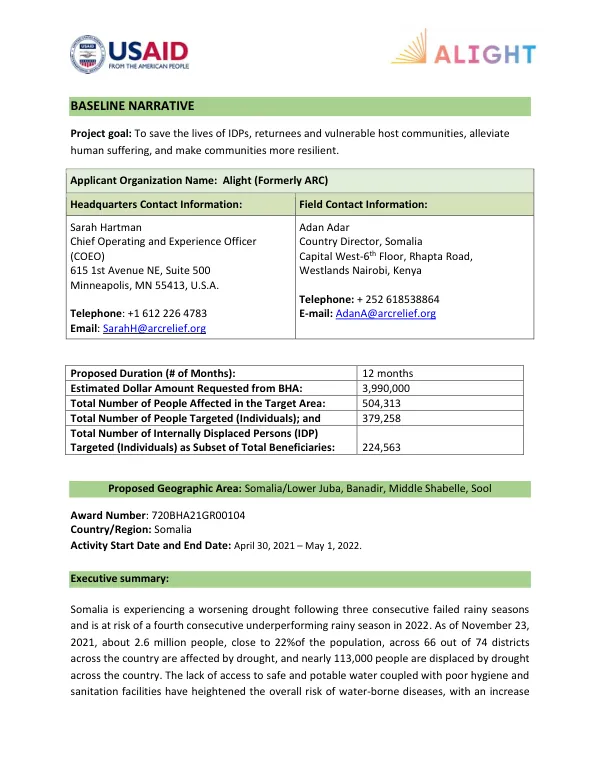
Baseline Narrative: Humanitarian Assistance to IDPs, Returnees, and Vulnerable Host Communities in Somalia
Sign inUSAID BUREAU FOR HUMANITARIAN ASSISTANCE
Baseline Narrative: Humanitarian Assistance to IDPs, Returnees, and Vulnerable Host Communities in Somalia
The humanitarian crisis in Somalia is characterized by a worsening drought, exacerbated by three consecutive failed rainy seasons and a risk of a fourth consecutive underperforming rainy season in 2022.
2021 · 4 pages
Sign in to readA free account is required to download.
Abstract
As of November 23, 2021, approximately 2.6 million people, or nearly 22% of the population, across 66 out of 74 districts in the country are affected by drought, with nearly 113,000 people displaced by drought. The lack of access to safe and potable water, coupled with poor hygiene and sanitation facilities, has heightened the overall risk of water-borne diseases, with an increase in suspected cases of acute watery diarrhea/cholera and measles. The government and humanitarian partners in Somalia are scaling up responses and reprogramming activities to address critical emerging needs, but continue to be constrained by funding and access concerns in some of the affected areas. Natural disasters such as floods and armed conflict persist as key drivers of humanitarian needs. The Somalia 2020 Humanitarian Response Plan targets 3 million people out of a total of 5.2 million people in need. The total number of people in need has increased by 19% (one million people), from 4.2 million in 2019 to 5.2 million in 2020, while people targeted for assistance has decreased by 12% (400,000 people), from 3.4 million people in 2019 to 3 million in 2020. The overall humanitarian situation in Somalia remains unpredictable and volatile due to ongoing conflict, displacement, and extreme weather conditions. New and protracted armed conflicts, insecurity, and erratic weather have continued to push Somali civilians away from their homes and into already-crowded towns and cities. Consequently, the number of internally displaced persons (IDPs) has reached a record 2.6 million, one of the largest IDP populations in the world. With support from the Bureau for Humanitarian Assistance (BHA), Alight (Formerly ARC) will continue to provide multi-sectoral humanitarian assistance to reduce morbidity and mortality and deliver immediate emergency relief to flood-affected communities in the regions of Sool, Middle Shabelle, Lower Juba, and Banadir of Somalia. Alight will link primary health care and management of malnutrition with WASH and protection services to ensure a complete and holistic response to the needs of vulnerable communities. The organization will utilize baseline data from previous projects, including a country-wide evaluation, a KAP survey, and a final M&E report, to inform the current project. For new activities and corresponding indicators, Alight will draw baseline data from existing reports, including an external impact evaluation report, a KAP survey, a regional protection assessment, and the Somalia Humanitarian Response Plan. The project will be implemented in the regions of Sool, Middle Shabelle, Lower Juba, and Banadir of Somalia, with a proposed duration of 12 months and an estimated dollar amount requested from BHA of $3,990,000.